Lily of the Valley in Perfumery: The Silent Flower of Happiness
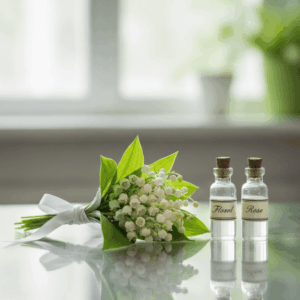
Lily of the valley originates from China and has been known in France since the Middle Ages. For a long time, it was associated with renewal and then became a symbol of happiness. It is also called the lily of the valleys or the grass of Parnassus.
History and Legends
It was created by Apollo, god of Mount Parnassus, according to legend, so that the nine muses who surrounded him could tread upon this pretty green carpet without injuring their delicate feet.
The first sales of lily of the valley began to appear in France in 1936, at the time of the Popular Front and paid holidays. The first of May is still celebrated today in France; it is Labor Day. On that day, many vendors offer their production informally in the streets. It is also found at florists.
The lily of the valley flower has always been very present at Christian Dior, who made it his lucky charm.
Botanical Fact Sheet and Origins
Botanical name of lily of the valley: Convallaria Majalis
Botanical family of lily of the valley: Liliaceae
Lily of the valley comes from countries with a temperate climate. With its bell-shaped flowers and delicate smell, lily of the valley has known and still knows a certain commercial success. It is one of the typical plants of spring, a perennial herb that can also be found in the wild. It is a flower that can prove toxic if ingested.
A “Silent Flower”: Processing and Manufacturing
It is a flower that is called a silent flower (or mute flower), meaning that it does not deliver its perfume, neither as an essence nor as an absolute, like lilac, honeysuckle, violet, mock orange, hyacinth, or sweet pea. All these flowers are considered in perfumery as fresh and spring-like flowers.
It is therefore not possible to extract the fragrance of lily of the valley from the flower. One is thus obliged to recreate its smell through an accord composed of natural and synthetic raw materials. This accord can also be called reproduction or reconstitution.
It is also possible to use headspace, which will be a reproduction of the flower’s smell but more centered on its top notes.
Olfactory Description and Use
Description: Fresh, spring-like, light, watery, slightly jasmine-like, floral, crisp green.
Use: It is associated with fresh floral perfumes. Soliflores are sometimes made from it. Lily of the valley brings freshness, innocence, or naturalness to the perfume. It sometimes happens that it is found in the top notes of an oriental perfume, like Ubar by Amouage notably.
Chemistry: The Components of Lily of the Valley
Main components: Phenylacetaldehyde oxime and dihydrofarnesal.
These molecules help to build the scent of lily of the valley:
- Linalool
- Hydroxycitronellal (limited)
- Lilial and Lyral (now banned)
- Cyclamen aldehyde, mayol, florol, nympheal, and so many other molecules have over time helped in the reconstitution of lily of the valley.
Fantasy Lily of the Valley Formula
Here is, in broad strokes, the formula of a lily of the valley composition, each perfumer having their own way of transcribing and interpreting it. In descending order, the list of components most present to those that will be found in traces in the composition:
- Florol (transparent floral note)
- Jasmonal (transparent floral note)
- Phenyl ethyl alcohol (molecule contained in rose)
- Citronellol (molecule contained in rose)
- Bulgarian rose essence
- Jasmine absolute
- Indole (animal component contained in jasmine)
Floral Perfumes with Lily of the Valley
The first perfumes with lily of the valley were:
- Muguet des Bois by Coty
- Muguet by Caron
- Muguet by Guerlain
Nowadays we can cite these perfumes:
- Muguet by Guerlain which every year curls up in a new bottle
- Diorissimo by Dior
- Pleasures by Estée Lauder
- Anaïs Anaïs by Cacharel
- Beige by Chanel
- Lily of the Valley and Bluebell by Penhaligon’s
- Muguet Porcelaine by Hermès
- Miu Miu by Miu Miu
- Le Muguet by Goutal
- Muguet Blanc by Van Cleef & Arpels
- Velvet Mughetto by Dolce & Gabbana
- The perfume of Nivea cream