Nerolia Bianca by Guerlain: The Total Homage to the Bitter Orange Tree
Behind every creation, there is the quest for the “strong idea,” the “clear message” that will structure the fragrance.
Here the idea of this new Aqua Allegoria was to gather all the treasures of the bitter orange tree (the tree that yields bitter oranges): the fruit with bitter orange essence, the flower thanks to orange blossom absolute and neroli essence, and finally, the twigs with which petitgrain essence is obtained. From the roots to the top, the entire tree is put in a bottle!
The unthronable fragrances of this range are: Mandarine Basilic, Pamplelune, and Herba Fresca. In this new fragrance as in all others, there are dominant citrus notes: Nerolia Bianca highlights bitter orange.
Bitter Orange (Bigarade Essence)
Bitter oranges are produced by the bitter orange tree. It is the fourth most cultivated citrus fruit in the world. The orange is said to be the golden apple of the Garden of the Hesperides.
Properties: Bitter orange essential oil possesses anti-depressant, sedative, and bactericidal properties.
History and origins: The orange originates from South Asia, more particularly from China, India, and Indochina. Current orange cultivation takes place mainly in Brazil and Florida. It is also cultivated in Tunisia and Morocco, but production remains less important because it is that of orange blossom and neroli that prevails.
The orange comes from a small flowering tree, which can grow from 2 to 5 meters in height. This tree was introduced to Europe around the 15th century. Nearly a century later, women of the high aristocracy consumed oranges daily to preserve their beauty and youth.
Extraction and Olfaction
Orange essence is obtained from the zest by cold expression; the orange peel is scraped thanks to “la machina” which allows recovering: bitter orange essential oil or essence.
Olfactory description: Olfactory family: citrus. Sparkling, somewhat close to the smell of a clementine, tangy, green accents, also naturally slightly aldehydic.
Main constituents: Linalool, citral, aldehyde C10, d-limonene, aldehyde C8, pinenes, methyl anthranilate, terpineol.
From the opening of Nerolia Bianca, the bitter orange tree and its olfactory marvels leave their signature through the sparkling bitter orange essence with its tonic and fusing inflections; it offers aromatic freshness full of character by blending with peppermint.
The Heart: Neroli Essence and Orange Blossom Absolute
Then, gently, the flight of top notes gives way to the delicate neroli essence in the top/heart accord. But for it to intensify, to reveal a caressing sensuality, it was chosen to associate it with orange blossom absolute.
- Botanical name: Citrus Aurantium
- Botanical family: Rutaceae
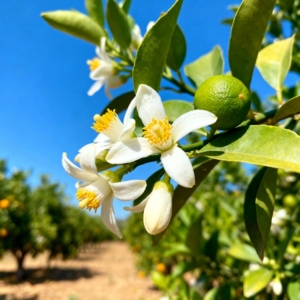
The bitter orange tree is a tree of 5 to 10 m. Its leaves are oval, shiny, and persistent. Its flowers are white or pink, larger than those of the sweet orange tree.
The 4 Treasures of the Bitter Orange Tree
Orange blossom is a flower of the bitter orange tree. From this tree, 4 different raw materials are derived (apart from bitter orange):
- Petitgrain essence
- Neroli essence
- Orange blossom absolute
Petitgrain essence, neroli, and orange blossom absolute have very different, yet complementary characteristics.
Extraction Techniques and Differences
- Leaves and twigs are treated by distillation; the product that is distilled is called petitgrain essence, a fresh, lively, fusing green note, usually very used in eaux de Cologne.
- Usually white flowers are too fragile to withstand steam distillation. Orange blossom is the only one that lends itself to both modes: distillation and volatile solvent extraction.
- Steam distillation of flowers produces neroli essence. Neroli essence: fresh is airy, very fusing, it acts mainly in the top notes, it has very slightly lavender-like, sweet accents (a bit marshmallow).
- Volatile solvent extraction allows obtaining orange blossom absolute. Orange blossom absolute: more “indolic” (natural animal note contained in white flowers), it is darker, intense, it acts as a heart note. It has a narcotic, animal, sensual side. A more honeyed one (due to phenylacetic alcohol).
Main Constituents
- Neroli essence: linalyl acetate, linalool, alpha pinene, d-limonene, methyl anthranilate, indole, geraniol, nerol, phenylethyl alcohol.
- Orange blossom absolute: indole, linalool, methyl anthranilate, linalyl acetate, nerol, geraniol, pinenes, phenylethyl alcohol.
The Final Accord
This bouquet of neroli and orange blossom is associated with ylang-ylang essence. Two very slightly fruity-honeyed floral notes which reveal a femininity (or masculinity) full of voluptuousness.
This heart trio can now be prolonged in the comfortable and enveloping base accord. There, they mingle with white musk notes nuanced with a white amber and cedar wood accord.
Thus, Nerolia Bianca reveals over time the timeless and refined freshness of an eau de Cologne, the intensity of an eau de parfum, and the depth of a skin perfume.
Since 1999, the Aqua Allegoria spirit has never ceased to reinvent itself like a garden that season after season unveils original perfumes and new colors.