The Perfumer’s Herbarium: Guide to Rare Plant Materials (Oud, Ambrette, Tobacco…)
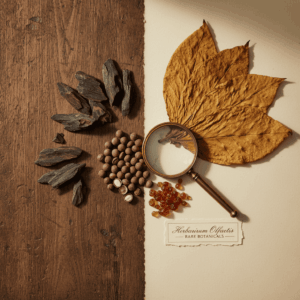
In perfumery, among the raw materials used to compose a perfume, there are animal, synthetic, or plant-based raw materials.
The latter consist of flowers, fruits, spices, woods, balms, and resins. There are also numerous other plant materials that can be used in a fragrance. We propose a list below, in alphabetical order.
Natural Almond
There is a synthetic note called Benzoic aldehyde which has recently become obtainable in a natural way. It is manufactured from the inside of apricot kernels by a hydrodistillation process, which allows extracting benzaldehyde (the product obtained is called natural benzaldehyde).
Obtention and Characteristics
The raw material used is the fruit, which is crushed and then macerated in warm water for 12 to 24 hours, allowing the formation of the essential oil. A specific distillation allows obtaining a purified product. It is a colorless, or even very pale yellow liquid, whose pleasant and penetrating smell recalls that of crushed fresh almonds.
Other almond notes in perfumery:
- The tonka bean and its constituent, coumarin.
- Heliotrope or heliotropin.
- Anisic aldehyde.
The Health Benefits of Almond
Almond is very rich in vitamin E, minerals, and trace elements. It is an alkalizing, highly nutritious, energetic, and remineralizing fruit. Devoid of cholesterol, rich in phytosterols and plant proteins, it is salutary for the chest, lungs, stomach, and intestines.
Indeed, almond possesses antiseptic properties, thus preserving the good balance of the intestinal flora. Its richness in magnesium and phosphorus assimilable by the body makes it an excellent tonic for our nervous system, and its high calcium content is excellent for bone health.
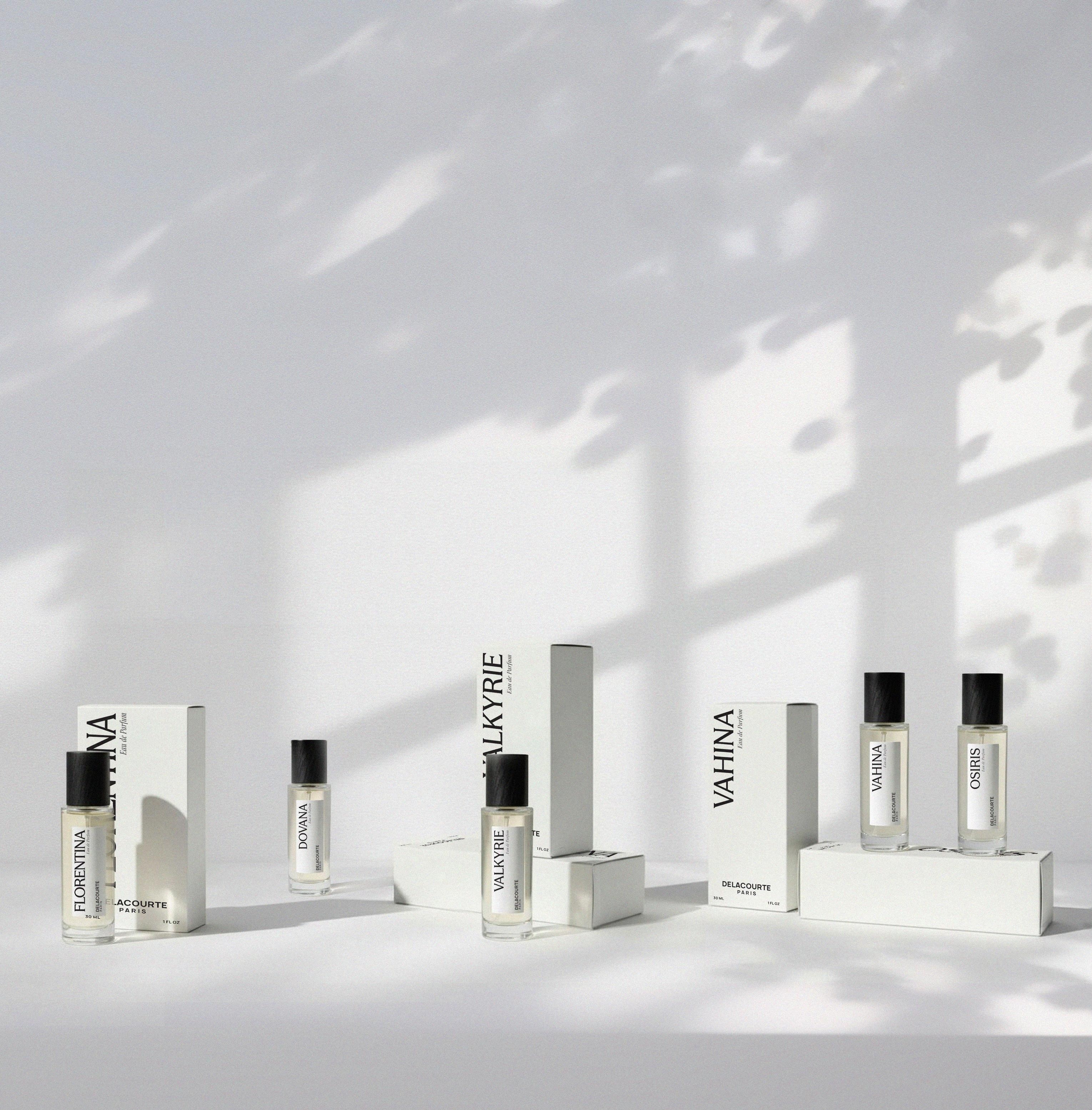
Perfumes: Natural almond is present as a top note in Florentina by Delacourte Paris. This scent is also found in L’Instant Magic, developed by Randa Hammami and Sylvaine Delacourte.
Ambrette (Vegetable Musk)
Botanical name: Abelmoschus moschatus
With a size that can reach 3.50 m, ambrette is the cousin of the hibiscus. It possesses a large sulfur-yellow flower with a brown throat and is used for its seeds found inside fruits with large brown capsules.
Ambrette is so called because its seeds exhale a very pleasant smell, between amber and musk. The latter are bean-shaped and are surrounded by a seed coat (living tissue) containing an oil. A yellow resinous substance gives the seed its very particular smell, which is even more sensitive when crushed.
The True Vegetable Musk
It is in fact a vegetable musk with a natural presence of ambrettolide, not to be confused with Musk Ambrette (a toxic nitrated musk with musky notes), which is now banned in perfumery.
Each year, about sixty tons of seeds are produced. The harvest period takes place from June to July and everything is picked by hand. This product is excessively expensive and luxurious, and few perfumers use it.
Processing and Scent
The processing of ambrette is done by distillation and results in an essential oil wrongly called “ambrette butter”, due to its pasty consistency. This oil is then fractionated to eliminate the remaining solid organic acids, yielding a final product called “absolute”.
Supercritical CO2 extraction is an interesting method because it is more adapted to carrying heavy molecules, with a much better yield as a key result.
Scent: The smell of ambrette is soft, musky, amber, and slightly animalic. It is also fruity, with a note situated between pear and plum brandy, and slightly floral. Its high concentration of farnesol gives a note that approaches lily of the valley. It is a product of exceptional power and tenacity.
History and Perfumes
Ambrette seeds were used for their relaxing and stimulating virtues, but also for their antiseptic and aphrodisiac power. Formerly, they allowed offering good oral hygiene and relieved itching in the form of an emulsion.
Today, ambrette seeds are sometimes added to coffee, but also to certain traditional herbal liqueurs, such as Bénédictine.
Perfumes with Ambrette:
- Champs Elysées Guerlain
- Muscs Koublaï Khän Serge Lutens
- Clair de Musc Serge Lutens
- Bois Farine L’Artisan Parfumeur
- N°19 Chanel
- Dovana Delacourte Paris
Birch Wood
Birch tar essence is obtained by slow distillation of the wood. The birch is a tree native to Russia and Northern Europe. Also called “white birch,” it grows in the wild. The oil obtained after distillation is dephenolized and washed in an alkaline medium to be used in perfumery.
Nowadays, a reproduction made with five to ten raw materials is used to replace birch wood, which, now deemed toxic, is therefore banned.
Use and Leathery Notes
Birch tar is used in Russia to tan skins and is integrated into certain pharmaceutical preparations (chewing gums, toothpastes). In perfumery, the scent of birch wood provided a leathery note to these emblematic perfumes: Cuir de Russie by Chanel or Cuir de Russie by Guerlain.
It is also present in Shalimar and Habit Rouge. These fragrances had to be reformulated, and birch wood was substituted by reproductions based on natural products like Cade oil and Cistus Labdanum, often mixed with synthetic notes like IBQ (green and leathery note close to rubber) or Sederal (cf. Leather facet).
Cade Essence: This is another leathery raw material (anti-dandruff properties) obtained by distillation of juniper (oxycedrus). It participates in the “birch wood” accord.
Chamomile
A sacred flower in ancient Egypt, dedicated to the god Ra (the Sun god), Roman chamomile possesses a very aromatic scent, slightly bitter, with fruity apple facets. This flower cultivated in Europe looks like a daisy and possesses medicinal virtues. In perfumery, it acts rather as top notes and blends very well with light floral notes.
Chamomile is present in Jubilee Bouquet by Penhaligon’s, and has recently been highlighted in Mémoire d’une Odeur by Gucci. However, this flower remains very little used in perfumes.
Lemongrass
Contrary to popular belief, lemongrass has nothing to do with lemon. It is a grass (plant with tiny flowers grouped in spikes), which is widely used in cooking and renowned for its numerous medicinal virtues.
The Different Varieties
- Cymbopogon nardus Quality (Sri Lanka, Malaysia): The leaves are dried in the sun then distilled. The essence contains geraniol and citronellal. Its English name is ginger grass.
- Cymbopogon winterianus Quality (Java): Much fresher and prized. Often integrated into masculine perfumes, its scent is very lively and fresh, which sublimates citrus notes (cf. Hesperidic facet). It has been widely used as a mosquito repellent, which perhaps explains its limited use in perfumery.
Cistus Labdanum and Its Derivatives
Cistus labdanum is a resin, renowned since Antiquity for its scent but also for its medicinal properties (healing). This bush is found in countries bordering the Mediterranean (Spain, Morocco). The young shoots secrete a fragrant and viscous resin, labdanum, a gum also called “tears of Christ”.
Its scent possesses some notes in common with ambergris: it has leathery, animalic, and herbaceous accents. Traditionally, labdanum was collected by shepherds using leather straps, by scraping the branches of the cistus, or by combing the beards of goats that rubbed against the plant.
Difference Between Cistus and Labdanum
There is a Cistus Labdanum absolute and a Cistus essence. Today, the gum is obtained by boiling the branches in hot water and soda.
- Products from the Gum (“Labdanum”): The labdanum resinoid has a notable olfactory thickness, dark, deep, and warm. It is a powerful note close to incense (burnt), with leathery, amber, vanilla, and salty facets.
- Products from Leaves/Branches (“Cistus”): Cistus essence possesses a very aromatic, camphorated facet, nervous in the top notes. Its evolution then becomes resinous, woody, almost caramelized.
This note is widely used in oriental, amber, and chypre perfumes.
Nigella
Botanical name: Nigella Damascena
Botanical neighbor of aconites and delphiniums, nigellas are elegant Ranunculaceae with pale blue star-shaped flowers. Nigella is an astonishing plant, and its seeds have a honeyed fruity scent, which strangely recalls wild strawberry.
It is highly appreciated by perfumers having few natural fruity notes at their disposal (cf. Fruity facet).
Its name comes from the Latin niger which means “black”. Furthermore, this plant is very present in the rocky terrains of the south, west, and south-west of France.
Opopanax
From the Greek opos meaning “sap”, and panax meaning “medicinal plant”, it is a perennial plant of the Umbelliferae family (variety Commiphora erythraea). Opopanax is mainly found in Africa (Ethiopia, Eritrea, Somalia).
Like myrrh, its essence is obtained by exudation of the bark, then treated by distillation. It is used in the base notes of oriental perfumes. Its scent is soft, warm, fruity, earthy, and balsamic, but also leathery in base notes. Opopanax is present in Shalimar by Guerlain, and Coco by Chanel.
Oud
Oud has been used for centuries for medicinal and spiritual purposes. In Muslim culture, it is considered one of the fundamental ingredients. It is a new woody note in the perfumer’s organ, very different from the others.
Oud Wood (Agarwood)
Oud is produced by a tropical tree of the Aquilaria genus when it is infected by a fungus named Phialophora parasitica. The infected tree reacts by producing a rare and precious resin: oud wood (or agarwood, aloeswood). It comes from Southeast Asia and gives a woody, dark, and intense note.
Only one specimen out of a hundred contains the precious resin. Today, these trees are protected. In most niche perfumes, there is not a drop of real oud, because of its price which exceeds that of gold.
It is most often reconstitutions composed with other woody notes (cedar, sandalwood, vetiver, patchouli, incense), often associated with Cypriol, and added with leathery and animal notes. These “fake ouds” possess incredible power.
Sesame
Botanical name: Sesamum indicum
Immortalized by the tales of One Thousand and One Nights, sesame seeds (native to Central Africa) have played a role in daily life since ancient times. The scent of sesame is very well known and blends perfectly well with woods or oriental notes. It possesses effects of hot bread, maple syrup, coffee, peanut, and hazelnut.
To be used in perfumery, sesame is most often treated by CO2 extraction, a process that allows it to preserve its original scent. In Osiris by Delacourte Paris, sesame is married to honey, cedar, and orange blossom.
Blond Tobacco
It is an annual plant native to tropical America. After being harvested and dried, the leaves are subjected to non-alcoholic fermentation. The absolute is obtained by volatile solvents (often decolorized afterward). 200 kg of dried leaves yield 850 g of essence.
The smell of tobacco is earthy, animalic, with notes of tonka bean and dried hay. Its scent is also warm, honeyed, and soft; it blends particularly well with leathery, woody, and chypre notes.
Linden (Lime Blossom)
This tree, which can reach up to 30 meters in height and live up to a thousand years, is found mainly in Europe. Its flowers possess five petals of yellowish-white color and are very fragrant. In perfumery, the hydrosol by distillation is used to extract the essence of the flowers.
However, linden is most often reproduced in the form of “reconstitution” in perfumes. Indeed, it is not easy to use because the scent has connotations of “herbal tea”. Its soft and delicate scent is widely used in Eaux de Cologne, and possesses a slightly honeyed note.
Perfumes containing Linden:
- Eau du Ciel Annick Goutal
- Extrait de Songe L’Artisan Parfumeur