Patchouli: History, Earthy Scent, and the Iconic Ingredient of Cult Perfumes
The patchouli leaf is a mythical ingredient in perfumery, used for centuries for medicinal, spiritual, and olfactory purposes. It is at the heart of oriental and chypre fragrances.
Woody, deep, and enchanting, patchouli is now an essential note on the perfumer’s organ. Long associated with hippies, today it symbolizes luxury, elegance, and distinct character.
Origin and the Scent’s Secret: The Drying Process
The patchouli leaf comes from the Pogostemon genus in the Lamiaceae family. The word “patchouli” appeared in the early 19th century, derived from the Tamil words patch (green) and ilai (leaf).
Originally from Southeast Asia, patchouli is primarily cultivated in Indonesia (90% of global production). Patchouli is one of the most widely used raw materials in perfumery, second only to citrus.
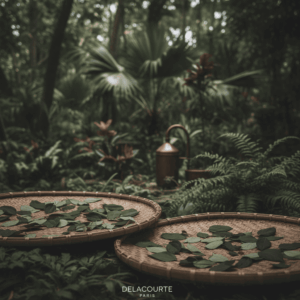
The Secret: Fresh patchouli leaves have little to no smell. Their characteristic woody, earthy aroma appears only after 5 to 6 days of shaded drying, avoiding fermentation. This process concentrates the main active molecule, patchoulol.
History and Dual Identity: From Luxury Shawls to Hippie Icon
Patchouli has always had a polarizing history, fluctuating between exclusivity and rebellion.
- 19th Century (Luxury): Patchouli reached Europe scenting cashmere shawls imported from India, symbolizing exotic refinement.
- 1970s (Rebellion): Hippies popularized pure patchouli oil as a fragrance of freedom. This overuse led to its reputation as a dusty, overpowering scent.
Olfactory Description and Technical Role in Formulas
Patchouli possesses a woody, earthy, dark aroma. Depending on the terroir, it may reveal notes of camphor, damp cellar, cork, or cocoa.
Patchouli leaves are steam distilled for about 8 hours (learn about steam distillation). The essential oil is rich in patchoulol (around 40%).
Technical Role: Fixative and Oakmoss Replacement
Patchouli is an indispensable woody note because it acts as an excellent fixative and booster:
- It reinforces woody notes and ambery notes.
- It is crucial for chypre accords, where it largely replaces oakmoss (restricted by IFRA).
The modern patchouli heart, derived via fractional distillation, eliminates the dusty notes, providing a cleaner, more luminous trail. This cleaner quality was sought by Sylvaine Delacourte for L’Instant pour Homme (Guerlain).
Iconic Fragrances Featuring Patchouli
Patchouli appears in many legendary perfumes, crossing all fragrance boundaries, including gourmand accords.
- Gourmands / Orientals: Angel, A*Men (Mugler), Opium (YSL), Patchouli (Reminiscence).
- Chypre / Niche: Mitsouko, La Petite Robe Noire (Guerlain), Coco Mademoiselle (Chanel), Portrait of a Lady (Frédéric Malle), Tempo (Diptyque), Coromandel (Chanel).
- Woody/Thematic: Patchouli Absolu (Tom Ford), Bornéo 1834 (Serge Lutens), Eau du Soir (Sisley).
Medicinal Uses of Patchouli
In aromatherapy, patchouli is valued for its therapeutic benefits:
- Anti-inflammatory and digestive.
- Vein tonic (relieves heavy legs).
- Antifungal and antiseptic (treats skin issues).
- Natural sedative (soothes stress, insomnia).
Thanks to its complex, sensual, and charismatic character, patchouli continues to play a key role in both perfumery and herbal medicine.