Perfume Against the Plague: History, Aromatherapy and Hygiene
The Plague and Bad Smells
The plague has appeared as an archetype of the great evils that have struck humanity. The plague has left the word “empester” (to stink/to plague) in our language. Moreover, in the 16th century, this term appeared and referred to death whereas nowadays, it simply refers to bad smells.
Plague victims obviously smelled bad. Bad smells were accused of causing numerous deadly diseases such as the plague. A remedy had to be found for this evil; it was at this moment that aromatherapy developed.
Hippocrates (Greek physician), considered the “father of medicine”, notably recommended burning perfumes on pyres to sanitize the air.
The Plague in France: The End of Baths
The great Black Death started from the Caspian Sea in 1346 and reached France in 1348. It is estimated that the Black Death killed between 30 and 50% of the European population in five years, claiming about twenty-five million victims. This epidemic had disastrous consequences on European civilization.
Especially since after this first wave, the disease then regularly reappeared in the various affected countries, notably between 1353 and 1355 in France, and between 1360 and 1369 in England.
It was said that the Black Death came from nauseating vapors rising from the ground. The infected air penetrated the body and corrupted the organs.
French doctors designated baths as factors of contamination and in particular hot baths which open the pores of the skin where bad smells can enter. They then decreed that it was better to stop bathing. But the doctors’ warnings were not heeded immediately and the 27 public baths that existed in Paris only closed in the 16th century.
The Power of Aromatherapy
People then began to fight the plague with aromatherapy. Knowledge was held by monks because they possessed gardens with aromatic plants in their monasteries. Monks also wrote works on aromatherapy.
Certain essences were known for their benefits, such as lily which cures colds or tiger nut (a kind of papyrus), hazelnut, ginger, iris, etc.
Famous Remedies
Two products met with immense success at that time:
- Hungary Water (1370): It marks an important step in perfumery because it is made with distillation products; the base of this perfume is alcohol. One rubbed the whole body with this water but also drank it to ward off the plague. This water was said to restore health, beauty, and youth.
- Eau des Carmes (1379): Lemon balm, anise, marjoram, thyme, sage, juniper berries, cardamom, cinnamon. This water had been reconstituted in the 17th century and still exists in pharmacies. It was used by Charles V who was sick and suffering from pulmonary tuberculosis.
The Dominicans of Florence (1221)
In 1221, the first Dominicans settled in Florence. On the ruins of a small church, Santa Maria alle Vigne, they built a convent complex and a basilica which took the name of Santa Maria Novella. Quickly this community grew and as the rule requires, an apothecary was created for the monks of the convent.
It was directed by an apothecary brother also called Speziale.
Very quickly at Santa Maria Novella, the pharmacy did not limit itself to its internal activity. It was in 1348 when the plague devastated Europe, that the apothecary brothers put their knowledge at the service of the population of Florence. The development of rose water and potpourri dates from this period.
Theriac and Four Thieves Vinegar
Theriac was a formula that fought against the bad smells of the plague. It contained 120 aromatic ingredients and also viper flesh.
Another product that had its moment of glory in the 18th century is the Aromatic Vinegar of the 4 Thieves containing rosemary, wormwood, mint, and camphor. Common rue (Ruta graveolens) is a shrub of the Rutaceae family, cultivated for its leaves used for their aromatic and medicinal qualities.
It was said that this vinegar would have allowed 4 thieves, after drinking it and sprinkling themselves with it, to enter the homes of plague victims in order to rob them. There is still a moral to the story: they were arrested anyway.
In the 14th Century: Gardens and Pomanders
From the second half of the 14th century, princes would also have their own medicinal gardens because they also wanted to protect themselves against the plague. In 1348, the therapeutic aspect of perfume was privileged. People wanted to escape death through perfume and perfume was one of the rare means of fighting against the plague.
In 1365, Charles V had medicinal plants planted. In his garden, he had many plants but especially sage (comes from the Latin salvare “to save”), lavender, hyssop, rose, iris, violet.
Scent apples (Pommes de senteurs) appeared in the Middle Ages to fight against the plague; one just had to hold it to the nose to breathe it. Some of these objects were made of gold encrusted with precious stones and thus marked the social status of the person who possessed it.
Inside this object, there was a mixture of aromatic plants and animal notes. Musk, amber, castoreum, and civet appeared in the Middle Ages.
There were also rings that could contain aromatic preparations. Pomanders were made up of several separate compartments which contained different products such as civet, amber, castoreum.
In the 16th Century: Closure of Bathhouses and Cyprus Birds
In 1520, at the time of the Renaissance, the plague continued to appear but less significantly than during the Middle Ages. In the 16th century, authorities sought to limit the spread of the plague and asked working trades to work outside the cities; indeed the fact that they sweated and therefore did not smell very good, could bother others!
It was the same for prostitutes; the French word “pute” comes from putare which means to stink and which can therefore cause the plague.
It was at this time that bathhouses were finally closed, because of the plague of course but also because these bathhouses had become places of orgies. The last bathhouse was destroyed in Dijon in 1566. Water disappeared from toiletries, especially in France. Louis XIV did not wash with water because it had the reputation of being dangerous.
He used toilet vinegars. Germans and Austrians were less affected by the closure of bathhouses. It would be with Marie Antoinette (Austrian) that water would reappear.
Protective Preparations
Benzoin from Siam and Sumatra entered into the composition of certain scents. These products added to different preparations made it possible to fight against the plague.
In 1521, Cyprus birds (Oiselets de Chypre) appeared, scented birds put in cages that were burned to fight the plague. Preparation to scent these Cyprus birds: Oakmoss, cypress, iris, storax, almond.
It was said that François Coty was the inventor of the chypre structure, whereas Guerlain created many chypres long before Coty. Moreover, oakmoss was already used long before to scent these birds.
A preparation very fashionable during the Renaissance was Angel Water (Eau d’ange) which consisted of benzoin, storax, clove, cinnamon, calamus, lemon. Cordoba Water (Eau de Cordoue) was a preparation recommended to fight against epidemics. It was a mixture of angel water and rose water.
The distillation process progressed during the Renaissance; Copper Stills were replaced by Glass Stills. André de Fournier’s famous recipe consists of benzoin, rose, storax, clove, aloe, musk, and camphor.
In the 18th Century and the Arrival of Modern Medicine
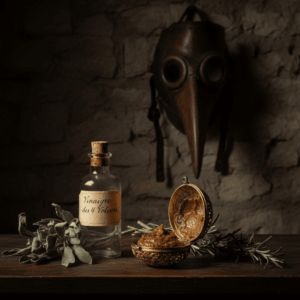
In 1720, the Plague of Marseille (arrived by ship because the Grand Saint Antoine had not forbidden the unloading of goods) caused a lot of damage. A preparation called Imperial Water was used to protect against the plague. Costumes were also made to protect against the plague with masks containing aromatic substances to filter the air.
Plague Doctor and Fumigations
Fumigating powders were developed to protect against the plague. Several types of powders existed:
- A violent and strong powder with caustic products like sulfur which kills miasmas.
- A mediocre or common powder allowing adults to be disinfected.
- A gentle powder to protect children.
In 1720 with the Plague of Marseille and in 1771 with the Plague of Moscow, the use of perfumes to fight against this epidemic was questioned. Moreover, it is at this period that chemistry began to appear.
The Discovery of the Bacillus
In 1894, Doctor Alexandre Yersin isolated the plague bacillus.
Between 1897-1898, Doctor Paul-Louis Simond was sent to British India by the Pasteur Institute; he continued the anti-plague vaccination campaign. At the end of 1897, overworked, exhausted, he fell victim to malaria and had to rest in Agra. He was recalled urgently to Karachi, in February, where a resurgence of the plague was raging.
Alongside the application of anti-plague serum therapy to the victims of the epidemic, he had the intuition that the plague could be transmitted by an insect, and pursued research in this direction. They led, on June 2, 1898, to an experiment where he demonstrated the transmission of the plague by the rat flea to the rat and by deduction from the rat to humans.
Thanks to Annick Le Guérer, historian of perfumes.