Perfumery Lexicon: The Glossary of Technical Terms
From A to Z, discover the definitions of technical words used by perfumers and enthusiasts. Absolute, Baudruchage, Communelle… the language of perfume will no longer hold any secrets for you.
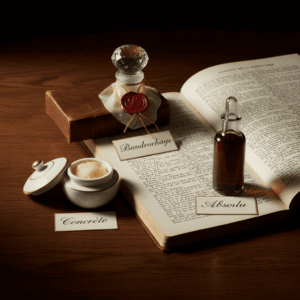
Absolute (Absolu): This is the result obtained after treating the concrete to remove the waxes. It comes in the form of essential oils. The technique is called extraction.
Accord: Effect obtained by mixing two or more raw materials. Its harmony depends on the balance of proportions and the olfactory intensity of each of them. The very soul of the perfume, the magic that takes place, comes from the accord.
Chypre Accord: Association of bergamot, rose, jasmine, moss (now replaced by patchouli), wood, vetiver, labdanum.
Fougère Accord: Association of different natural raw materials such as bergamot, lavender, geranium, oakmoss, tonka bean, and coumarin.
Oriental Accord: Association of balsamic, resinous notes such as: incense, opoponax, styrax, myrrh, benzoin, with vanilla, tonka bean, and sometimes patchouli.
Barbichage: Separation of silk threads using a fine metal blade (a finishing step for extract bottles).
Baudruchage: Manipulation entirely done by hand. The “dames de table” (craftswomen) will cover the stopper of the extracts with a translucent membrane and then surround them with a silk thread to hold them. It is the guarantee of airtightness and a perfect seal.
Brushing (Brossage): Once knotted, the silk threads are brushed to give them volume.
Communelle: Blend of several batches of the same natural essence. It is generally used to ensure homogeneous quality every year. For example, a bergamot communelle from several producers in Calabria. It can also be used to create a unique blend of the same essence chosen for its particular characteristics, which guarantees a specificity of the olfactory seal.
Concentrate (Concentré): It designates the composition obtained at the end of the preparation work (weighing of the different products defined in the formula established by the Perfumer-Creator). Concentrates, depending on their destination, are then incorporated into alcohol: manufacture of extracts, eau de toilette, etc.
Concrete (Concrète): Waxy, solid, or semi-solid matter, obtained after solvent extraction of the odorous principles of certain plant raw materials such as jasmine, rose, etc.
Diffusion: Magnitude of the olfactory message left behind.
Distillation: It is an extraction process based on a mixture of water and plants. Once the mixture is heated, essential oils will be obtained by condensation of vapors.
Enfleurage: Ancient method of cold extraction of floral products, developed in Grasse, using the property that certain fats have of absorbing and retaining odorous principles. These scented fats (pomades) are then washed with alcohol to give pomade absolutes.
Extraction: Technique which consists of placing a plant in the presence of a volatile solvent which, once heated, will be gorged with odorous materials then eliminated by evaporation. The concrete thus obtained will be purified with alcohol to obtain the precious absolute.
Expression: Extraction technique for certain essential oils, mainly citrus zests, using mechanical means such as cold pressing.
Facet (Facette): Designates the alliance of several similar notes. Ex: citrus facet.
Fragrance: In contrast to odor which can be unpleasant, this French word of Latin origin translates the pleasant smell of a scented product.
Essential Oil (or Essence): Designates aromatic and volatile products extracted from plants, either by distillation or by cold expression: essential oil or essence of bergamot, rose, sandalwood, etc.
Natural Raw Material: Product existing in nature, product of plant origin. There are 1000 available to the perfumer.
Synthetic Raw Material: They are indispensable for a perfumer because they bring diffusion, tenacity, and replace nature when certain odors cannot be extracted (example: lilac, plum, lily of the valley). They are obtained either by chemical reaction or isolated from a natural product to be then reproduced. There are about 3000 available to the perfumer.
Note: Term to express a simple facet (ex: lilac note, rose note) or the volatility and structure: top note, heart note, base note.
Top Note (Flight or Smile): Very volatile, it is the first olfactory impression felt. It can last a few minutes. It is generally composed of citrus materials such as lemon, bergamot, petitgrain, but also aromatics and green notes.
Heart Note (Sillage/Trail): It links the top notes and the base notes. Felt after about fifteen minutes and for a few hours, it constitutes the identity of a perfume. Often composed of flowers, one can find jasmine, violet, rose, magnolia, but also aromatic plants, fruits, spices, etc.
Base Note (Print/Signature): It will diffuse from one hour onwards and can last up to twenty-four hours. This note constitutes the soul of your perfume. It is what makes the perfume last over time and can be considered the foundation of the top and heart notes. The raw materials used can be opopanax, tonka bean, vanilla, iris, woods.
Palette: Set of raw materials favored by a perfumer-creator.
Wax Seal Application (Pose du cachet de cire): Allows sealing the cord on the bottle.
Reproduction: Composition recreating the smell of a raw material, generally because it does not exist in the natural state (example: lilac, lily of the valley, gardenia, lily, violet, honeysuckle) etc.
Sillage: Olfactory footprint perceived upon the passing of a person who has used a perfuming product.
Tincture (Teinture): It is the result of the maceration of a raw material in alcohol. A minimum of 30 days is necessary to obtain a tincture. For example, vanilla tincture is obtained by macerating vanilla pods in alcohol for 30 days.
Tenacity: Characteristic of a high-quality perfume, its capacity to last over time.