The Aromatic Facet: Guide to Lavender, Anise, and Mint Notes
In music, it is said of an accord “that one retains certain melodies, while others not.” As with a musical chord, the accord in perfumery defines the main theme of the fragrance by assembling different components (between 5 and 10), selected by the perfumer-creator.
The latter creates the architecture of their perfume, which will represent the very soul of the fragrance and will elicit an emotion in the person who smells it.
The French Perfume Committee (CFP) proposes classifying scent palettes, or notes, into 6 perfume families, or main accords.
The 6 Olfactory Families
- The Hesperidic family (cf. Hesperidic family)
- The Floral family (cf. Floral family)
- The Amber or Oriental family (cf. The Amber or Oriental family)
- The Chypre family (cf. The Chypre family)
- The Woody family (cf. Woody family)
- The Fougère family (cf. Fougère family)
The perfumer-creator can then dress each main accord of the perfume with one or more facets, to make it more complex. Thus, the aromatic facet links to all olfactory families but particularly well with perfumes of the fougère family, the woody family, the oriental family, and the hesperidic family.
What Does the Term “Aromatic” Mean?
The term “aromatic” designates all fresh herbs. As soon as the notes are dried, we then speak of “spices.”
Notes of the aromatic facet are subdivided into 3 distinct categories:
- Lavender notes
- Minty notes
- Anise notes
1. Lavender Notes in the Aromatic Facet
In perfumery, certain aromatic raw materials possess lavender notes. This is notably the case for the following aromatics: lavender, lavandin, rosemary, thyme, sage, mugwort.
Lavender: The Reference of the Aromatic Facet
Native to the Mediterranean basin, lavender is today cultivated in Yugoslavia, Bulgaria, Russia, or in Southern European countries such as Spain and Italy. But the south of France remains the main producer. Lavender is always cultivated above 1000m altitude. French production really took on another dimension with the cultivation of lavender in the South of France in Grasse, due to the beginnings of perfumery.
Since the second half of the 20th century, lavender production has become less prolific. To replace it in industrial perfumery, lavandin (a hybrid lavender variety, but of lower quality) was increasingly used.
There are many different varieties of lavender (Lavandula stoechas, Lavandula officinalis, Lavandula spica…), and this plant has always been used, both by the Romans to perfume their baths, and in the Middle Ages for medicinal purposes. It symbolizes purity and tranquility.
There is even an organic lavender: Carla lavender.
A French and organic lavender: cultivated in Drôme Provençale, this lavender is close at hand, much closer to us than most lavenders grown in Eastern Europe. It comes from organic farming. It is this quality that is used by great chefs in cooking; it is very airy and floral.
Generally associated with the fougère family, lavender is also characteristic of Eaux de Cologne and masculine perfumes. However, it is also present in the composition of chypre or oriental perfumes and today in certain feminine fragrances.
Lavender in the Aromatic Facet in Perfumery
In perfumery, lavender can be used in the form of lavender essence by steam distillation, or lavender absolute by volatile solvent extraction, with a scent very different from that of the essence.
This very aromatic and powerful note evokes southern gardens, summer, and even, sometimes, a slightly vintage side (recalling classic Eaux de Cologne). It is also herbaceous, camphorated, and medicinal. Its fresh scent includes a note of bergamot, a little floral, with woody tones. The percentage of linalyl gives lavender all its olfactory quality.
Lavandin: Cousin of Lavender
Cousin of lavender, lavandin is a hybrid lavender variety obtained by crossing Lavandula Vera and Lavandula spica. Mainly harvested in the south of France and cultivated since the 1930s, lavandin is widely used today and often serves to replace lavender.
Indeed, lavender cultivation encountered some difficulties. However, lavandin is more productive in quantity of essential oil, even if it yields an essential oil of lower olfactory quality than lavender. There are 3 varieties of lavandin: Lavandin Grosso, Lavandin Abrial, and Lavandin Super. Lavandin Grosso is the most cultivated one.
Lavandin in the Aromatic Facet in Perfumery
Just like lavender, lavandin essence is obtained through steam distillation. This aromatic is more camphorated than lavender, fresh, a little woody, spicy offers a less “chic” and less refined side than true lavender. This slightly soapy note is mainly used in detergents and soaps and generally in functional perfumery.
Rosemary: An Aromatic Note of Character
This aromatic is today cultivated in Spain, Morocco, and Italy (it needs arid and rocky soils to develop). Numerous phytotherapeutic virtues are attributed to it, and it is also widely used in cooking.
In the Middle Ages, rosemary was said to ward off evil spirits. It was also the wedding flower in the time of Charlemagne.
Rosemary in the Aromatic Facet in Perfumery
The use of rosemary in perfumery is very ancient (proof is with L’Eau de la Reine de Hongrie, in the 17th century, which contained a lot of it). Rosemary essence is obtained by distilling its leaves and flowers with steam.
An aromatic note, rosemary is fresh, herbaceous, camphorated. It is also woody in its evolution, powerful, lavender-like, and bitter and possesses accents of incense and animal notes. Eaux de Cologne, men’s perfumes, perfumes of the hesperidic family, as well as fragrances with fresh notes, tend to contain rosemary (this can also be the case for oriental perfumes in top notes).
Thyme: A Singular Aromatic Note
Used by Egyptians and Greeks in the form of incense, thyme comes from Europe and today originates from France, Spain, Algeria. Lemon thyme, wild thyme, and German thyme are among the multiple varieties of this aromatic.
Thyme in the Aromatic Facet in Perfumery
In spring and summer, thyme branches are dried, then distilled with steam. This process allows obtaining thyme essence. This aromatic offers a very intense camphorated, herbaceous, spicy, medicinal note. It is very present in Eaux de Cologne, aromatic perfumes, and certain spicy oriental perfumes.
Sage in History
It was said that sage owed its unique perfume to Aphrodite, goddess of beauty, who had hidden behind a sage bush to escape Zeus. But Zeus discovered her and in his anger, directed the sun’s rays to burn the plant. Then Aphrodite allegedly offered the sage leaves a sort of velvet film which made them thicker.
The name comes from the Latin Salvia, salvare which means “to save.”
It was said that one absolutely had to have sage in one’s garden, which helped calm “feminine” pains. In the Middle Ages, sage was a plant that was somewhat the panacea of remedies of the time.
Sage: A Curative Aromatic Note
There are about 900 species of sage in the world. Clary sage belongs to the same family as common sage. It contains about 40 molecules. It is a herbaceous plant of the Lamiaceae family, sage is very fragrant and bushy. Native to southern Europe, it is today cultivated in many countries: in France (on the Albion plateau), Central Europe, Russia, the United States, or China.
There are two main varieties: clary sage (the most used in perfumery; its scent is animalic, woody, earthy, floral, lavender-like, minty, and camphorated) and sage used for infusions, also called “salvia officinalis” (its scent is herbaceous, aromatic, camphorated, terpenic, and close to bergamot).
Sage in the Aromatic Facet in Perfumery
The most common extraction technique to obtain sage is steam distillation. This process yields sage essence. Sage absolute can be obtained by volatile solvent extraction. In perfumery, sage offers a lot of tonicity to perfumes (it is often used in men’s perfumes).
Long associated with fougère families, sage can also be found in absolute form in chypre and oriental perfumes. Being part of the base notes, it brings a lot of tenacity to perfumes. Sage notably allows obtaining ambrox, a material used instead of ambergris in fragrances.
Ambrox or Ambroxan is produced from the oxidation/reduction process of sclareol, obtained from sage.
Mugwort: A Poisonous Aromatic Note
A rare and “atypical” plant, mugwort, from the Latin artemisia, is a perennial herbaceous plant originating from North Africa and the Mediterranean basin. There are nearly 300 different varieties of mugwort. The scent of this aromatic is herbaceous, fresh, camphorated, bitter, with a slightly poisonous note. Mugwort is mainly present in men’s perfumes.
Other notes: myrtle, cedar leaf.
2. Anise Notes in the Aromatic Facet
Anise notes are also part of the aromatics used in the aromatic facet in perfumery. We find: basil, tarragon, and star anise.
Basil: An Anise Note Different from Fresh Basil
The name “basil” comes from the Latin basilicum which means “royal.” It is formed on the ancient Greek basilikon, which means “little king.” In Greco-Roman times, basil was consumed neither as an aromatic nor as a medicinal plant. It was reserved for ritual practices, and only kings could cut their stems.
Imported to Europe in the 16th century, from India and Lebanon, basil is also cultivated in certain Maghreb countries. There are 6 varieties, each with a very different smell (large-leaf basil offers a smell of jasmine, licorice, and lemon while purple basil has peppery accents).
Basil in the Aromatic Facet in Perfumery
In perfumery, basil essential oil is used (from fresh leaves dried then distilled with steam), notably in fresh or fougère fragrances, and in some chypre compositions, it is often combined with lemony or spicy notes.
The herbaceous, fresh, green, and slightly minty scent of basil makes it a very lively and dynamic note, which brings an anise effect to perfumes.
Tarragon: A Very Tonic Note
Its name comes from the Latin dracunculus which means “little dragon.” Tarragon was used to treat snake bites. This herb was appreciated by Maharajas who drank it as herbal tea (it is reputed to whet the appetite).
This aromatic originating from Russia and the Orient was imported to Spain by the Moors. The majority of tarragon production is today concentrated in France.
Tarragon in the Aromatic Facet in Perfumery
In perfumery, tarragon essential oil is used, thanks to the distillation of leaves with steam. Its green, herbaceous, spicy, and anise scent is often appreciated in fresh perfumes in top notes and associated with citrus, rose, or cinnamon and allows bringing an anise facet to fragrances.
Star Anise: A Sunny Anise Note
Star anise is currently mainly cultivated in Spain, Russia, and Poland. The essential oil is obtained by distilling its seeds with steam, and is used notably in top notes in perfumery: it is highly appreciated for the freshness and modernity it brings to fragrances.
This aromatic exhales green accents and a spicy, powerful, and liquorous smell. It is notably integrated into aromatic and chypre perfumes, and into men’s perfumes, as well as into some woody perfumes.
3. Minty Notes in the Aromatic Facet
In the aromatic facet, we also encounter aromatics with minty notes: peppermint and spearmint.
Peppermint: A Refreshing Note
Born from the cross between Mentha aquatica and Mentha spicata, this variety of mint is essentially produced in Europe, Russia, Bulgaria, and China. Its cold, aromatic, minty, fresh, slightly camphorated scent is also very powerful and possesses some balsamic notes.
Often used in men’s perfumes and fresh waters, peppermint is also used to accompany peppery notes in spicy fragrances. It notably allows reproducing green and lavender notes in top notes in perfumes.
Spearmint: A Chlorophyll Note
Spearmint (Mentha spicata) is used in perfumery thanks to the distillation of its leaves with steam, a process that yields spearmint essence.
Its herbaceous, slightly spicy, fresh, and green perfume, as well as its tangy chlorophyll smell, are highly appreciated in aromatic perfumes, or fougères in top notes. This aromatic also allows bringing great freshness to fruity notes and accords with citrus in fragrances.
Absinthe: A Legendary Aromatic Note
Originating from Europe and Russia, absinthe was discovered by the Egyptians in 1600 BC; absinthe is mostly associated with the famous drink. Used in perfumery in the aromatic facet, absinthe essence is obtained by steam distillation.
Its fresh, minty, bitter, aniseed, and slightly woody scent brings a lot of power and tonicity to perfumes; it is mostly used in fougère or aromatic compositions and in fragrances with green notes.
Perfumes with an Aromatic Facet
There are many perfumes with an aromatic facet. Here are a few, classified by aromatic:
Perfumes Containing Lavender
- Jicky Guerlain
- Shalimar Guerlain
- Habit Rouge Guerlain
- Mon Guerlain Guerlain
- Mouchoir de Monsieur Guerlain
- Pour Un Homme Caron
- Kouros Yves Saint Laurent
- Eternity for Men Calvin Klein
- Brin de Réglisse Hermès
- Bleu Chanel
- Boy Chanel
- Libre Yves Saint Laurent
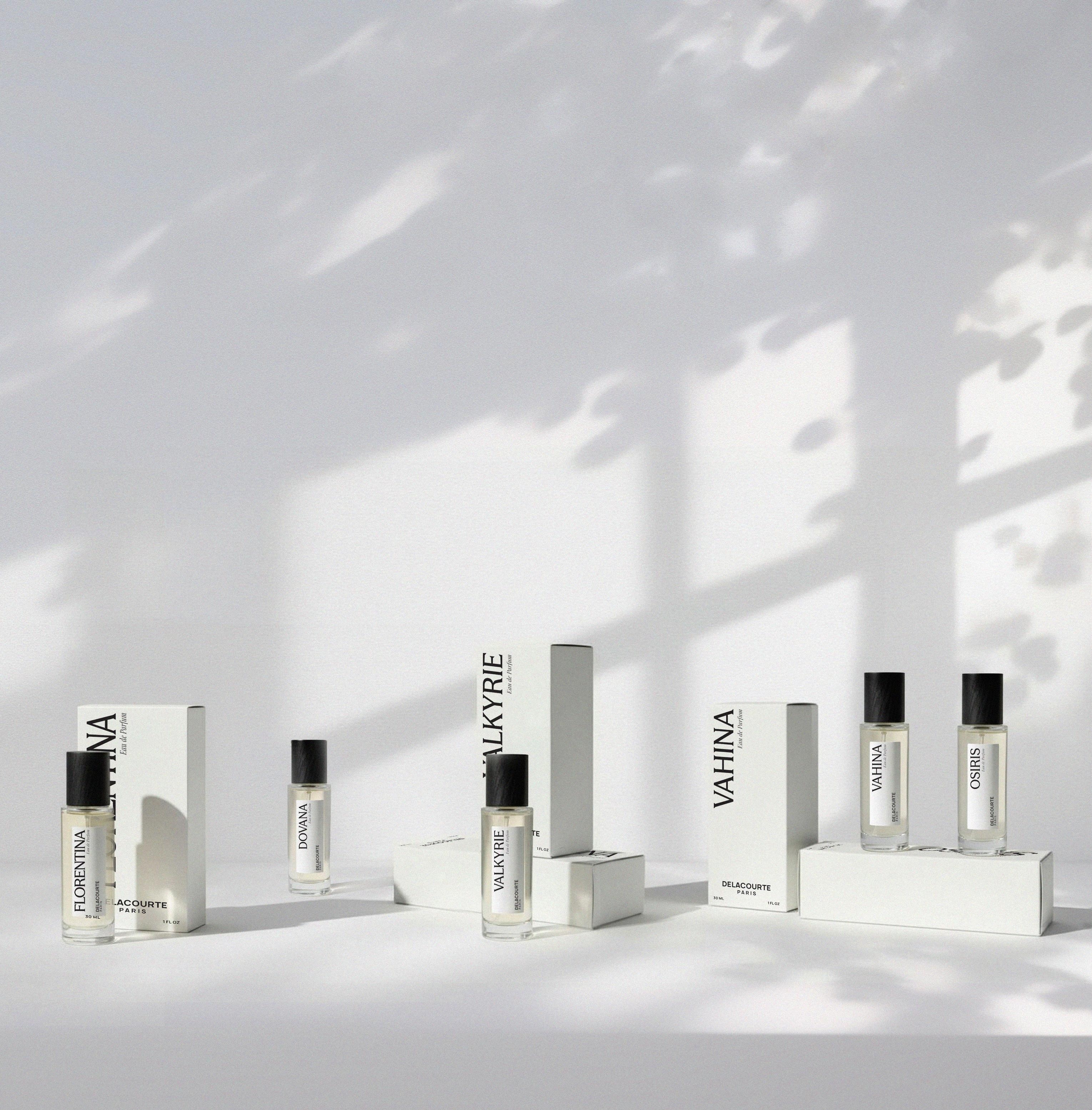
- Dovana Delacourte Paris
Perfumes Containing Rosemary
- Jicky Guerlain
- Eau de Guerlain Guerlain
- Eau du coq Guerlain
- Tonka Impériale Guerlain
Perfumes Containing Thyme
- L’Eau Noire Dior
- Eau de parfum Gucci
- For Him Narcisso Rodriguez
- Pour Homme Van Cleef & Arpels
- L’Heure Bleue Guerlain
- Eau de Guerlain Guerlain
- Après L’Ondée Guerlain
- Infusion de Vétiver Prada
- 1881 Cerruti
Perfumes Containing Sage
- L’Heure Bleue Guerlain
- Polo Ralph Lauren
- Pour Homme Van Cleef & Arpels
- Homme Dior
- H24 Hermès
Perfumes Containing Mugwort
- Déclaration Cartier
- L’Eau d’Armoise Serge Lutens
Perfumes Containing Basil
- Aqua Allegoria Guerlain
- L’Eau d’Hadrien Annick Goutal
- L’Eau Sauvage Dior
- Pour Homme Azzaro
- Euphoria Men Calvin Klein
- L’Eau L’Artisan Parfumeur
- At the Barber’s Margiela
- Tacit Aesop
Perfumes Containing Tarragon
- Eau Sauvage Dior
Perfumes Containing Anise
- L’Instant Pour Homme Guerlain
- Lolita Lempicka
- Hypnôse pour Homme Lancôme
- Mandragore Annick Goutal
- Méchant Loup L’Artisan Parfumeur
- Le Mâle J.-P. Gaultier
Perfumes Containing Mint
- Homme Guerlain
- Géranium pour Monsieur Frédéric Malle
- Green Tea Elizabeth Arden
- Green Water Jacques Fath
- Booster Lacoste
- Roadster Cartier
- Lempicka green lover Lempicka
- Eau de Cologne Orange Verte Hermès
- Eau Minthé Diptyque
- Eau Froide Serge Lutens
- Aqua Celestia Forte MFK
- Virgin Mint Carolina Herrera
- Aqua Allegoria : Herba Fresca Guerlain
- Valkyrie Delacourte Paris
Other Perfumes with Aromatic Facet
- A Taste of Heaven By Kilian
- Fou d’Absinthe L’Artisan Parfumeur
- Douce-Amère Serge Lutens