The Composition of Perfume: Guide to Raw Materials and Olfactory Architecture
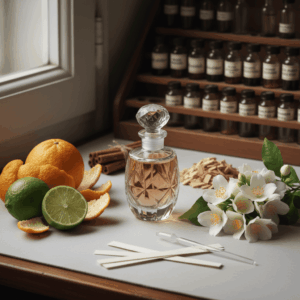
You wonder how a perfume is composed, what is its architecture, its olfactory pyramid, or the raw materials that constitute it. Sylvaine Delacourte reveals all the secrets of perfume composition.
Raw Materials: Natural vs Synthetic
Perfume consists of natural and synthetic raw materials.
- Natural raw materials: There are about 1000, but every year new ones are discovered. They come from flowers, leaves, roots, seeds, fruits, trees, or barks. More and more, natural raw materials are regulated and sometimes suppressed (recently the oak moss note or birch wood have been suppressed).
- Synthetic raw materials: There are between 3000 and 4000; every year, some disappear and others appear (cf. Synthetic products).
The perfumer, according to their tastes or possibilities, will make a choice among these 5000 raw materials, to create their perfume organ. In general, the perfumer will choose 1000 raw materials in total, between natural and synthetic to compose their perfumes.
Aromatics
These are fresh plants, some of which are used a lot in cooking; they contribute to giving a lot of freshness to a fragrance.
There are 3 subdivisions:
- Lavandaceous aromatic notes: Lavender, Lavandin, Hyssop, Laurel, Thyme, Rosemary.
- Anise notes: Anise, Tarragon, Basil.
- Minty notes: Pennyroyal, Peppermint, Spearmint.
Flowers
Flowers are a very rich register, subdivided into categories of flowers:
- Spring flowers such as lily of the valley, lilac, honeysuckle, mock orange.
- Powdery flowers: mimosa, violet, iris root, heliotrope.
- White flowers: jasmine, magnolia, gardenia, lily, tuberose.
- Solar flowers: ylang ylang, frangipani, tiare.
- Spicy flowers: carnation, immortelle.
Some of these flowers reveal their secrets and their perfumes, others do not, like violet for example; in these cases, the perfumer will make a reproduction or reconstitution using natural and synthetic products, to reproduce as closely as possible or not the perfume of this flower.
Fruits
Some are natural, others are not and exist in reproduction or synthesis.
Different categories of fruits are available:
- Citrus: hesperidic facet (cf. Hesperidic facet).
- Red fruits: raspberry, strawberry, blackcurrant, blackberry, blueberry.
- Yellow fruits: peach, apricot, plum.
- Exotic fruits: pineapple, mango, passion fruit.
- Juicy fruits: pear, apple.
Note that some flowers like osmanthus for example can bring a fruity note.
Woods
There are natural woody notes, such as:
There are also many synthetic woody molecules.
Spices
There are many natural spicy notes, which can be classified into two categories:
- Fresh spices: Cardamom, Pepper, Ginger.
- Warm spices: Cinnamon, Saffron, Nutmeg, Clove.
Note some flowers like immortelle can bring a spicy effect.
Balms and Resins
They are also called balsamic notes; they contribute to the amber or oriental accord (cf. Oriental accord). They bring a lot of roundness, mystery, and mystical notes to a composition: Incense, Myrrh, Opoponax, Styrax, Benzoin.
Animal Notes
Natural animal notes are: Musk, Castoreum, Civet, Beeswax, Hyraceum, Ambergris.
Only Ambergris, hyraceum, beeswax are still authorized. Note that certain natural raw materials like: labdanum, costus, osmanthus, jasmine can bring animal notes to a composition. Certain synthetic musks also have an animal tonality.
Architecture: Notes, Facets, and Accords
Olfactory Notes
The language of perfumery borrows a lot of vocabulary from that of music. These raw materials can be called olfactory notes. Example: lavender note, incense note, vanilla note, vetiver note, etc. The term note is also used in the case of the olfactory pyramid, from the most volatile to the most tenacious:
Olfactory Facets
The language of perfume also borrows vocabulary from gemology. Facet in perfumery means: assembly of notes that have a kinship. Example: hesperidic facet assembly of bergamot, orange, mandarin, lime, etc.
From the top note to the base note here are the different facets: hesperidic, marine, aldehyde, new freshness, aromatic, green, floral, solar, fruity, spicy, woody, chypre, oriental, gourmand, musky, powdery, animal.
The Accord
The accord: is an assembly of notes that have no kinship between them. Example: violet note + bergamot note + jasmine note = tea note.
The great accords of perfumery: oriental, chypre, fougère accord, etc. These accords gave birth to the great families of perfume.
Olfactory Families
Feminine or masculine, here are the different olfactory families one can be confronted with: Chypres, Hesperidics, Florals, Orientals, Woods, Fougères.