The Green Facet: Guide to Vegetal Notes, Galbanum, and Cut Grass
We often speak of the soul of a perfume when evoking its “main accord.” Many components, from 5 to 10, constitute the architecture of a perfume. The assembly of these different elements thus defines the main theme of a perfume. This accord is fleshed out by other notes, these are the facets of the perfume. Thanks to them, the perfume, more complex, also arouses a wider range of emotions.
6 olfactory families defined by the French Perfume Committee (CFP) allow perfumes to be classified into categories. We then speak of:
- The Hesperidic family (cf. The Hesperidic family)
- The Floral family (cf. The Floral family)
- The Amber or Oriental family (cf. The Amber or Oriental family)
- The Chypre family (cf. The Chypre family)
- The Woody family (cf. The Woody family)
- The Fougère family (cf. The Fougère family)
Each main theme or accord can be dressed with one or more facets. The green facet can be used to dress each of these 6 families.
Definition of Green Notes
Green Notes: A Breath of Dynamism and Nature
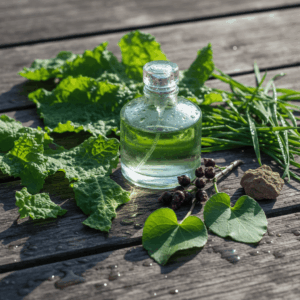
The “green” note is defined by the recognizable smell of crumpled leaves, cut stems, fresh grass wet with dew. As a result, it is a facet that gives a lot of dynamism, cheerfulness, and naturalness to the perfume. Moreover, these facets are also called “vegetal notes” or “detox notes.” They are of course the symbol of renewal and spring.
Currently, green notes are increasingly present in new products offered on the market. It was in 1947 in Vent Vert by Balmain that this green facet was used for the first time in a very intense form and in overdose. The formula of Vent Vert was revised in 1991 and then in 1999, and this green note is associated with another bold and characterful note: the galbanum note.
Galbanum
It is a plant of the umbellifera family that grows in Iran or Afghanistan, from which the gum is harvested by incision of the plant’s roots. It is then distilled to obtain an essence or is treated by solvent to then obtain the resinoid.
Olfactorily, galbanum is a very dark and screechy green note, like an intense undergrowth scent. This note also evokes the smell of peas, recalls potato and nasturtium flower by its humid and peppery note.
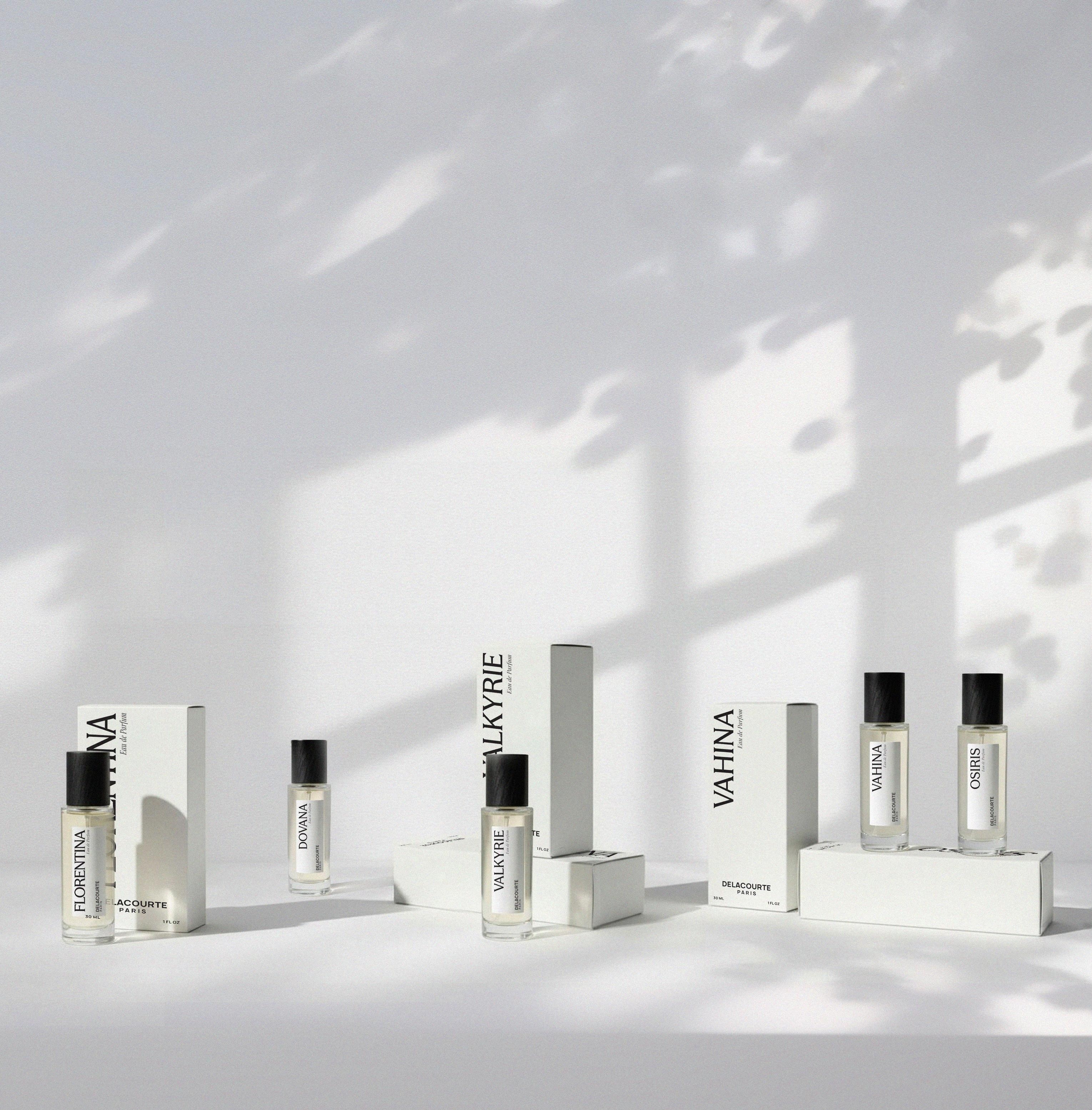
The galbanum note is difficult to work with because it marks the top note very quickly (cf. Testing a perfume) and can be harsh. It perfectly accompanies citrus, mint, and basil notes in Valkyrie.
Natural Green Notes
Pronounced Green Notes: Narcissus, Daffodil, Mimosa
Narcissus, daffodil, and mimosa naturally have quite pronounced green notes.
A Fruity and Green Note: Blackcurrant Bud
Blackcurrant production takes place mainly in France, in the Burgundy region. Young buds are harvested at the beginning of the year. The absolute, whose price is quite high, is obtained by volatile solvent extraction. It enters into the composition of Pampelune, in the Aqua Allegoria range, Chamade by Guerlain, or First by Van Cleef.
The smell of blackcurrant bud is both green and fruity blackcurrant. It can sometimes smell like boxwood. And when the alchemy with the skin does not happen (cf. Testing a perfume, Choosing a perfume), the blackcurrant bud can then give a sometimes unpleasant note. Now, there are qualities of blackcurrant bud stripped of this annoying smell.
A Surprising Green Note: Violet Leaf
The violet, which blooms from April to October, is native to Europe, Asia, and North Africa; it is now found in temperate regions. Many species are odorless; it is the Viola odorata whose color varies from flesh-colored to mauve or magenta to pink, which is the most fragrant.
But in perfumery, nothing can be obtained from the flower! It is only the violet leaf that delivers a natural note. Also, its smell is quite peculiar. Indeed, one finds a green note of cucumber, green bean, or a slightly sulfurous, earthy smell, or even a harsh and rasping leather note.
A Mediterranean Green Note: Lentisk
Lentisk, this shrub growing in the Mediterranean scrublands, in Corsica and Morocco, has a raw, deep, and slightly spicy green note. The latter is increasingly used in recently launched fragrances.
A Green Note “of Angels”: Angelica, Seeds and Stems
Angelica or “angel’s herb” is an umbellifera, with a fluted stem, native to Europe and North Asia. The scents of angelica are quite different, sometimes aromatic, sometimes herbaceous or woody depending on whether one considers the seed or the stem. But these notes respond wonderfully to each other.
Natural green notes are thus few in number; there are less than ten. This is why the perfumer-creator must call upon synthesis.
Synthetic Green Notes
Synthesis allows bringing many notes to this green facet, such as for example:
- Cis-3-hexenol, Cis-3-hexenyl acetate, triplal.
- Vivaldie, cortex, and gabascone, which are IFF specialties.
- Liffarome, stemone, necessary to create a fig note.
- Cassis base.
- Styrallyl acetate which has an asparagus and gardenia effect.
- Nonadienal which has a cucumber effect.
- Veticol acetate which has a rhubarb effect.
Cinquième Sens in Paris offers day training sessions, inexpensive, in their co-working space to smell raw materials or discover classic perfumes or new fragrances.
Some Green Perfumes
Some Perfumes with a “Galbanum” Green Tonality
- Vol de Nuit Guerlain (1933)
- Chamade Guerlain (1969)
- No. 19 Chanel (1971)
- No. 19 Poudré Chanel (2011)
- Alliage Estée Lauder (1972)
- Private Collection Estée Lauder (1973)
- Eau de Campagne Sisley (1974)
- Silence Jacomo (1978)
- Miss Dior Dior (1947 and 1996)
- Premier Figuier L’Artisan Parfumeur (1994)
- Virgilio Diptyque (1990)
- French Lover Frédéric Malle (2007)
- En Passant Frédéric Malle (2007)
- Bel Respiro Les Exclusifs collection by Chanel (2007)
- A Scent Issey Miyake (2009) (very close to the universe of Chanel No. 19)
- Bas de Soie Serge Lutens (2010)
- Untitled Maison Margiela (2010)
- Corsica Furiosa Parfum d’Empire (2014)
- Eau de Rhubarbe Écarlate Hermès (2016)
- Imagine Les Parisiennes collection by Guerlain, formerly London in the “A City, A Perfume” Collection (2019)
Some Green Perfumes Associated with an Oriental Note
- Must Cartier (1981)
- Obsession Calvin Klein (1985)
- Dune Dior (1991)
- Dior Addict Dior (2002)
- Joy Dior (2018)
- Allure Chanel (1996)
- Angélique Noire Guerlain (2005)
Some Perfumes with More Floral Notes
- Anaïs Anaïs Cacharel (1979)
- Pleasures Estée Lauder (1996)
- Les Belles de Ricci Nina Ricci (1996)
- Champs Elysées Guerlain (1996)
- DKNY Donna Karan (1999)
- Envy Gucci (2004)
- Daisy by Marc Jacobs (2007)
Some More “Fresh Water” Perfumes
- Herba Fresca in the Aqua Allegoria range by Guerlain (1999) (with pronounced mint notes)
- L’Ombre dans l’Eau Diptyque (1983)
- Un Jardin en Méditerranée Hermès (2003)
- Eau de Narcisse Bleue Hermès (2014)
- Splash Grass Marc Jacobs (2006)
- Eau de Lierre Diptyque (2006)
- Infusion d’Iris Prada (2007)
- Un Jardin Après la Mousson Hermès (2008)
- La Cologne du Parfumeur Guerlain (2010)
- Un Dimanche à la Campagne Guerlain (2016)
Some More Masculine Green Perfumes
- Polo Ralph Lauren (1978)
- Grey Flannel by Geoffrey Beene (1975)
- Fahrenheit Christian Dior (1988)
- Chrome Legend Azzaro (2007)
- Guerlain Homme Guerlain (2008)