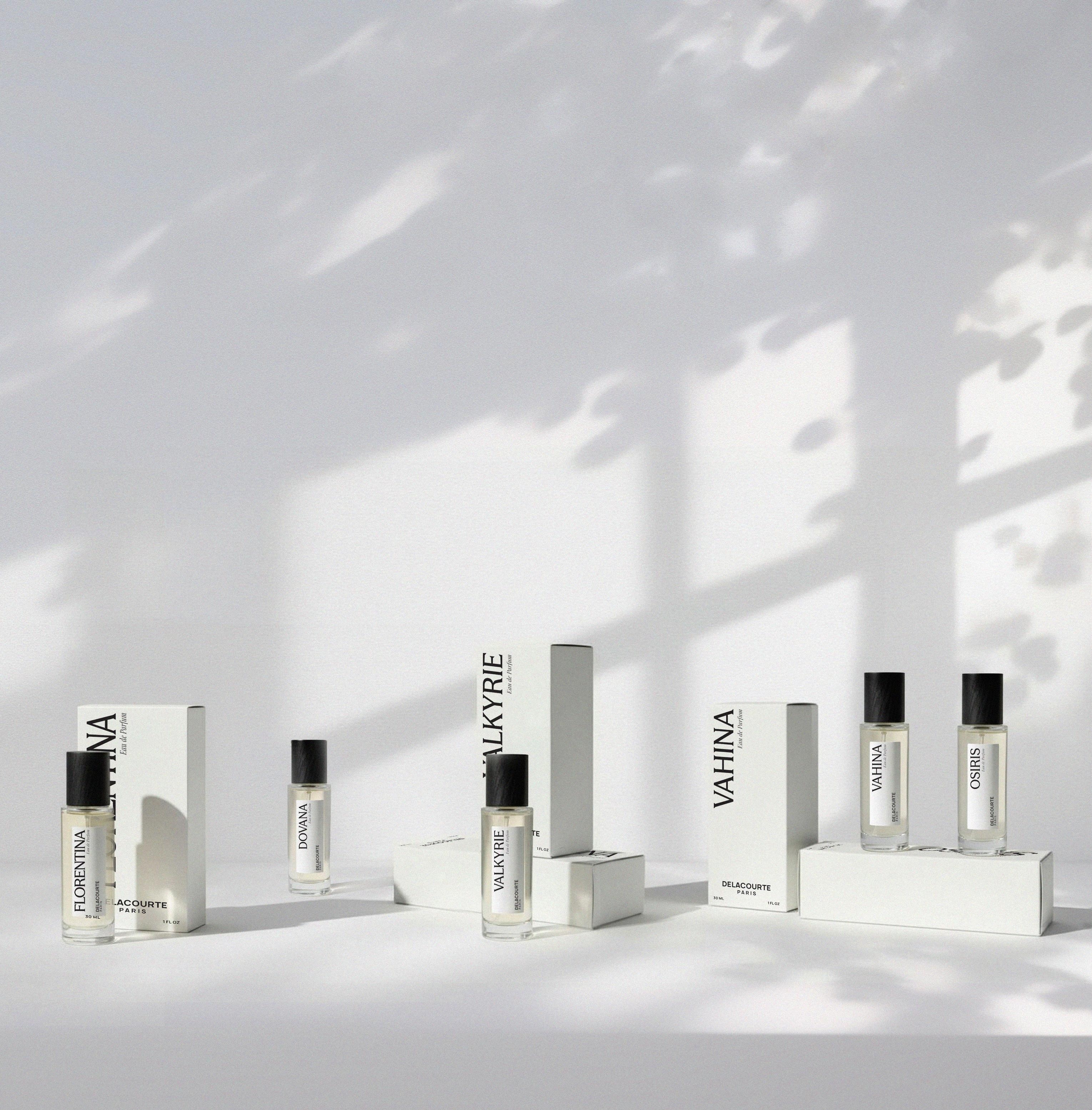
The 6 Olfactory Families: Perfume Classification Guide for Men and Women

Whether feminine or masculine, olfactory families contribute to the main theme of a perfume, to the construction of its soul. It is notably thanks to these families that a perfume can be classified, and we present here the main olfactory families to know:
1. THE CHYPRE FAMILY
The Characteristic of Perfumes in the Chypre Family
First, you should know that the classic chypre accord consists of bergamot, jasmine, rose, patchouli, tree mosses, labdanum, and possibly animal notes. Then, this accord can be associated with different facets, but a chypre perfume is by definition always woody.
The leader of chypres was certainly created by a perfumer: either Guerlain or François Coty. As for the name chypre, its origin is not certain, either the name came from the island of Cyprus, or from the names of ambient perfumes from an ancient era: the “oiselets de Chypre” (Cyprus birds).
The Facets of a Chypre Perfume
A chypre perfume can be dressed at will:
- with a green facet
- with a fruity facet
- with a musky facet
- with a leather facet
- with a floral facet
In contemporary chypres, oakmoss and cistus labdanum have been replaced by patchouli following the IFRA ban on using these materials. However, oakmoss can now be replaced by tree moss.
The Particularity of Chypre Perfumes
Chypre perfumes are perfumes of character, rather discreet in top and heart notes (see Testing a perfume), but whose base notes are intense. These fragrances are ideal for charismatic and original personalities who wish to wear extraordinary perfumes.
2. THE HESPERIDIC FAMILY
The hesperidic facet is present in almost all perfumes; it dresses the perfume in top notes, it is volatile, therefore not very tenacious, it gives a smile to the perfume. It dresses all perfumes, both feminine and masculine.
Obviously, it is found in greater quantities in Eaux de Cologne or fresh waters (see Eau de Cologne, Eau Fraîche), it then becomes the main theme and therefore determines the family: Hesperidic.
Lemon, bergamot, orange, or grapefruit, hesperidics give the first impression to the perfume – called “the smile” “the flight” providing fresh and tonic scents.
These are notes composed of citrus fruits, not to be confused with fruity notes: peach, apple, pear, pineapple, red fruits, etc. which can now be found in masculine perfumes.
Note: The aromatic facet, the new freshness facet, the marine facet very often dress all families of masculine perfumes, but more particularly the hesperidic family.
3. THE FLORAL FAMILY
It is certainly the richest and widest family. It is also a very popular family all over the world. Floral notes are diverse and very different from one another. One cannot say “I like all flowers,” as their scents are so varied; one can realize, however, that one particularly appreciates this or that category of flowers. These floral notes can be treated as figurative or abstract notes.
One can find “soliflores” or “floral bouquets.” These floral notes blend with all olfactory families and are found rather in the heart notes of a perfume (see Heart notes).
The Different Categories of Flowers:
- Green/spring or vegetal flowers
- White or sensual flowers / solar flowers
- Powdery flowers
- Spicy flowers
- Roses
- Atypical flowers
4. THE ORIENTAL (AMBER) FAMILY
The Origin of the Word “Amber” or Also Called Oriental
The word “amber” in perfumery does not come, as one might spontaneously think, from amber stone, which is a fossilized resin and has absolutely no smell! The term “amber” probably comes from the use perfumers made of ambergris in their composition. But this accord word comes from an association of raw materials that were assembled by a perfumer, the oriental accord was created either by Coty or by Guerlain.
Ambergris: natural animal note, pathological concretion of the sperm whale (see Ambergris).
The oriental family is the family that was appreciated quite late by men.
A precursor: Jicky, as well as the first pure masculine oriental: Habit Rouge by Guerlain.
The Classic Amber or Oriental Accord
The classic oriental accord is generally composed of tonka bean, vanilla, vanillin, coumarin, labdanum, patchouli. One also finds resins or balms like benzoin or incense, opopanax, myrrh. The iris note dresses it wonderfully well.
This accord can be accessorized with other facets: hesperidic or green, floral, spicy, aromatic, fruity, gourmand. It will then be called floral oriental, or hesperidic, or spicy etc…
These are generally very enveloping and warm perfumes, with significant sillage and generally excellent longevity.
5. THE WOODY FAMILY
Each main theme or accord is often dressed by one or more facets. Thus, the more faceted the perfume, the more complex it is.
We notice that the woody facet can also be the main theme of a perfume. This means that one clearly smells the woody message, from the flight of this perfume to its conclusion. In the woody family, a wood can be predominant, but it is very often an assembly of several woody notes.
The message is clearly woody. It can be sublimated by subtle facets: hesperidic, floral, fruity, spicy, or vanilla, without these said facets ever taking precedence over the woody notes. Woody notes are reassuring, structured, nervous notes. For the most part, acting as “stakes in the composition,” they give the perfume a backbone.
The woody family is the most popular family in masculine fragrances.
6. THE FOUGÈRE FAMILY
The Fougère family is rather a masculine family, which is always aromatic (lavender, mint, rosemary, sage, etc.).
The leader of this family was the fragrance Fougère by Perfumer Houbigant. The style has been renewed and modernized over time.
Composition of the Fougère Accord
The accord is composed primarily of: bergamot, lavender, rosy notes: geranium, vetiver, moss, tonka bean and/or coumarin. Around this fougère accord, different notes can intervene in the orchestration:
- Top note: you will find aromatic notes: lavender, lavandin, rosemary, thyme, clary sage, mugwort, anise notes, chamomile, bay laurel, mint notes, etc.
- Heart note: geranium Pelargonium rosat with a rose scent also called rose geranium, the carnation accord or rose, the orange note.
- Base note: tonka bean or its main molecule coumarin, vetiver, tree moss, sometimes vanilla, amber notes or leather (see Leather facet) (see Amber or Oriental family) musky notes (see Musky facet).