The Muses of Guerlain: From Empresses to Novel Heroines
Behind many Guerlain perfumes lies a female figure. Homage in the form of an olfactory reverence made to an imperial or royal figure, perfume very quickly becomes a refined and intimate expression of romantic feeling. This token of love first reveals itself with Aimé Guerlain: Voilà pourquoi j’aimais Rosine (That is why I loved Rosine), which he created in 1900, is the most eloquent testimony.
Real women or dreamed women, crowned heads or figures haloed with glory from the art world, heroines of their times or of novels, they all embodied the image of femininity, figureheads of an era whose aura Guerlain knew how to perpetuate in flagship perfumes.
Crowned Heads: Eugénie, Victoria and Sissi
Starting with Eau de Cologne Impériale, created in 1830, which would seduce Empress Eugénie in 1853, which she wanted exclusively at first and later this would earn Guerlain the title of patented perfumer to Her Majesty.
Legend has it that the violent migraines from which the Empress suffered found unhoped-for relief in this fresh and citrusy Eau de Cologne (indeed there was an overdose of orange blossom) for which Pochet et Du Courval would create the iconic bee bottle.
But Queen Victoria, Isabella of Spain, Sissi, and following them, all the courts of Europe, had not waited for this imperial sesame to swear only by Guerlain.
The Bouquets of Nobility
From 1840, innumerable bouquets flourished in the Rue de la Paix boutique:
- Bouquet de la Comtesse de Jersey (Bouquet of the Countess of Jersey)
- Bouquet de la Duchesse de Bedford (Bouquet of the Duchess of Bedford)
- Bouquet de la Marquise de Londonderry (Bouquet of the Marchioness of Londonderry)
- Bouquet Princesse Amélie de Furstemberg (later named Bouquet de Furstemberg) for the courts of Central Europe
As for the Queen of Romania, she would be part of the happy few for whom Guerlain would create a unique perfume. Very quickly, the homage due to rank would give way to that inspired by feelings, as evidenced by perfumes like Marie-Christine or Nice Dear.
Jicky (1889): Secret Love
But it is Jicky, in 1889, that truly opens this page of modernity, both by its mixed composition, blending for the first time (a few synthetic products: coumarin, linalool, and vanillin, worked into many natural products), and the double evocation of its name.
The latter was said to be inspired both by the affectionate nickname given by Aimé Guerlain to his nephew Jacques and by that of a young English girl with whom he had fallen in love while studying in Great Britain. Is it because of this ambiguity that Jicky would confuse women at first and be adopted first by men?
I also think that its bold composition was surprising; after the omnipresence of soliflores, here is a multi-faceted perfume, with a very aromatic opening, laid on a fougère accord with a rather masculine connotation, but surprise!
Behind this top note hides: the hyper-feminine and torrid oriental accord that would become for Jacques the source of inspiration for Shalimar. Jicky, revolutionary therefore, in more ways than one, was the first product to bear the name of “perfume”; incredibly, it still makes men and women swoon today.
Jacques Guerlain: The Perfumer in Love
At the turn of the century, Jacques Guerlain would definitively impose the figure of the perfumer in love, composing new odes to his muses, with the very explicit Voilà pourquoi j’aimais Rosine and the more fickle Vague Souvenir.
In 1904, Jacques Guerlain would compose for a couple of friends the most beautiful wedding gift one could dream of: A duo Voilette de Madame and Mouchoir de Monsieur, both presented in the “snail bottle”, gold for Madame and white for Monsieur, both nestled in the superb red box.
Kadine (1911): The Princess of the Bosphorus
In 1911, Jacques Guerlain is inspired by yet another muse: a great lady, La Kadine, princess of the palace and wife of the sultan, in her kingdom of the Bosphorus, was a woman of great beauty who possessed an incomparable nose and palate; she could guess, for a spice, whether the region it came from had experienced a great drought or unusual humidity.
Floral and powdery, mixing vanilla notes, iris, jasmine, and bergamot, Kadine is in the image of this muse, tender and delicate, like a veil of caress.
Heroines of Novel and Opera
At the beginning of the Roaring Twenties, it was legendary or romantic heroines who would inspire Guerlain with some of his greatest perfumes of love and elsewhere…
Mitsouko (1919): The Japanese Mystery
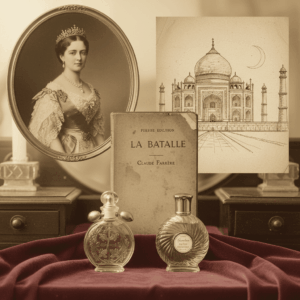
Created as early as 1905 but launched in 1919, Mitsouko is the central figure of “La Bataille” (The Battle), a novel written by Claude Farrère, a friend of Jacques Guerlain. This first name, which means “mystery” in Japanese, reveals implicitly a young woman all the more magnificent as she remains noble and dignified despite the emotions and forbidden passion that overwhelm her.
This enigmatic perfume is a new generation chypre, marrying fruity notes (first use of aldehyde C14) with a woody and chypre base that has kept the secret of its seduction intact.
Shalimar (1925): Eternal Love
Charm is still the topic in 1925, but this time it is to the oriental beauty of Mumtaz Mahal that Shalimar will succumb. A true “temple of love” (this is the translation of its name in Sanskrit), this first great oriental perfume is a marvelous evocation of a fabulous garden.
It housed the loves of the Mughal Emperor Shah Jahan and his favorite wife Mumtaz Mahal, whose disappearance would leave him inconsolable and in whose memory he would have the Taj Mahal built.
Shalimar, now embodied by the sublime Natalia Vodianova who also becomes our muse for makeup and skincare products. In the United States, another French muse: Gabrielle Lazure, embodied Shalimar, but a long time ago.
Liu (1929): Puccini’s Heroine
The exoticism that inspired Shalimar was a strong trend of the first quarter of the century. The “Art Deco” style established a taste for elsewhere, research; Asia fascinated all the more as Japan was gradually being discovered. The opera Turandot would confirm this fascination for Asian heroines, their sense of the sublime and sacrifice, with the character of Liu.
This young servant, in love with Prince Calaf, would prefer to perish rather than reveal his nickname: “Love”. It is in homage to this figure who embodies all feminine virtues that Jacques Guerlain created, in 1929, the perfume Liu.
Its Baccarat bottle, of black glass, inspired by a Chinese tea caddy that belonged to the Guerlain family, contains a delicately floral and powdery perfume.