The Oriental and Ambery Perfumes: Expert Guide to Vanilla, Tonka, and Resins
The oriental facet is undoubtedly a major element of perfumery accords. It can be dressed with several other facets, and its complexity matches its richness.
Before defining the oriental family, it is important to understand that a perfume is composed of an architecture with between 5 to 10 distinct components. This assembly creates “an accord”: the main accord gives the fragrance its full personality.
This precise orchestration has allowed perfumes to be classified according to a rigorous system (defined by the French Perfume Committee – CFP), distinguishing them into 6 different olfactory families: Citrus, Floral, Ambery (or Oriental), Chypre, Woody, and Fougère.
Each main theme (like woody, floral, or citrus) can then be made more complex and dressed with several olfactory facets.
What is the Oriental or Ambery Family?
The oriental family, also called the “ambery family”, consists of the oriental accord, which can be dressed with different facets:
- Green
- Citrus
- Floral
- Gourmand
- Woody
- Spicy
- Leather
The oriental family allows for the creation of highly prized feminine and masculine perfumes, characterized by rich and very suave raw materials.
The Origin of the Word “Amber”
The word “amber” in perfumery does not come, as one might think, from amber stone, a fossilized resin which has absolutely no scent. The term “amber” likely comes from the use perfumers made of ambergris in their compositions. This material is of animal origin and comes from a pathological concretion of the sperm whale (the animal is not killed to obtain ambergris, and it is therefore still authorized by IFRA). However, this sensual note is so expensive that it is now rare to find it in a perfume formulation.
The Origins of the Ambery or Oriental Accord
The ambery or oriental accord was identified in Jicky (1889), which then led to Shalimar (1921) by Guerlain, and in Ambre Antique by Coty in 1908. It is also the basis of the famous De Laire amber accord: Ambre 83.
The Classic Ambery or Oriental Accord
Perfumes of the oriental family are composed of a classic oriental accord, itself generally consisting of tonka bean, vanilla, vanillin, coumarin, labdanum, and patchouli. Resins like benzoin, incense, or opopanax are also found. And the iris facet dresses it wonderfully!
The Amber Base
The solid base found in the amber ball (pomander) from L’Artisan Parfumeur is characteristic of the amber base. To obtain this paste formula, the liquid is mixed with a “dry” solvent to transform it into a solid state.
It is also possible to find this base, in lesser quality, in the souks of Morocco or Tunisia in the form of a white stone called “amber.” However, this is not the true ambery or oriental accord, but a composition.
The Main Constituents of the Oriental Family
The main constituents of the oriental or ambery family are vanilla, tonka bean, myrrh, incense, styrax, benzoin, and opoponax.
1. Vanilla: The Black Orchid
Noble vanilla is the essential raw material of the oriental facet. This vanilla is not “sweet,” whereas synthetic molecules like vanillin and ethyl vanillin are indeed very sweet. The marvelous vanilla or Vanilla planifolia is a variety of orchid that grows in tropical forests in the shade of the undergrowth, in the form of a mysterious vine.
It alone bears fruit, the famous vanilla pod. This vanilla originated in Mexico, originally pollinated by a small bee: the Melipona. But since a slave, Edmond Albius, discovered the secret of vanilla fertilization in 1848, the work of the Melipona has been replaced by human intervention.
Using a bamboo splinter, the vegetal flap closing the orchid is lifted, and the pollen is collected to be placed in contact with the pistil. This operation can only take place in the morning, when the flower has just bloomed. The women who perform this operation are called “matchmakers.” It takes about 18 months to obtain the fruit of this orchid, the precious black pod.
Preparation of the Vanilla Pod
Once harvested, the vanilla pod is scalded for 3 minutes, then covered in blankets for 24 hours. Only after being exposed to the sun from morning to early afternoon, on each side, a few hours a day, do they take on the appearance we know, after 15 days. They become black, dry, and free of bacteria. The vanillas are then hand-sorted, one by one, to ensure they are dry.
Madagascar Vanilla
Madagascar vanilla is found in 18 countries. That from Mayotte and India is one of the most appreciated. It has become a rare and very luxurious material, and the most expensive spice after saffron. The price of vanilla has thus multiplied by 10 in 4 years. Its botanical nature, the olfactory treasures it contains, and its price make it a unique material.
The Different Notes of Vanilla
The enveloping and sensual warmth of vanilla comes in different notes. They can be milky, honeyed, ambery, woody, spicy, animalic, or rum-like. There is also vanilla of the botanical variety Tahitensis, which is more floral.
The Multiple Forms of Vanilla Used
- Vanilla Tincture: To obtain a vanilla tincture, split pods must be macerated in alcohol for at least 1 month. But this technique is almost no longer used today.
- Vanilla Absolute: Vanilla absolute is obtained after extraction of the pods with a volatile solvent.
- Synthetic Products: Vanillin and ethyl vanillin are synthetic materials. As mentioned, this vanilla is much sweeter.
Little Stories About Vanilla
Everyone knows that the Aztecs consumed a chocolate-based drink, but they also used vanilla to flavor their nectar! Furthermore, vanilla is said to be a remedy for anxiety and brings strength and health to those who consume or smell it.
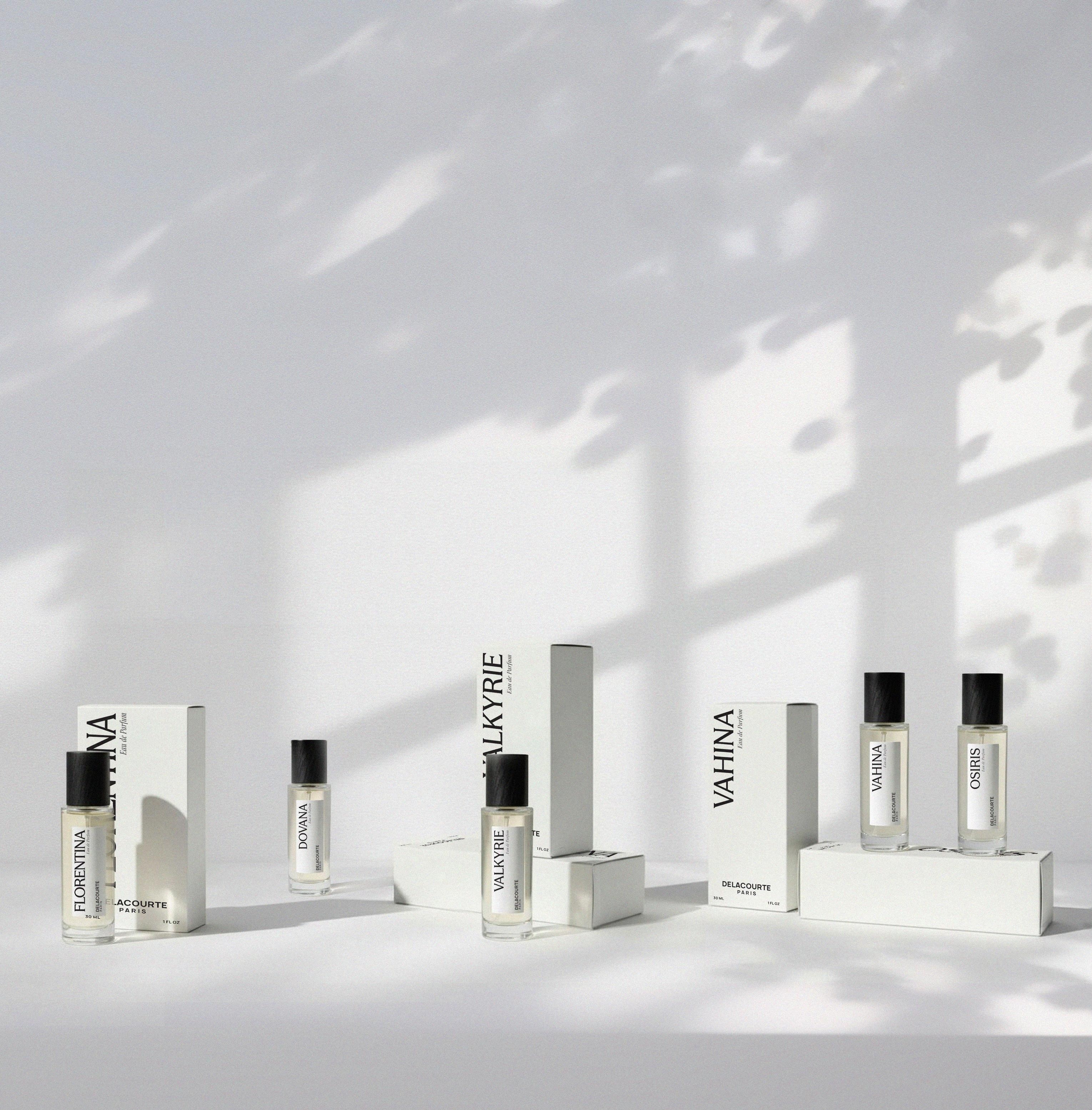
Vanilla in Delacourte Paris perfumes: Valkyrie, Vahina, and Osiris
2. Tonka Bean: The Powdery Almond
Tonka bean comes from South America, specifically Venezuela, Guyana, and Brazil. While vanilla is produced by an orchid, tonka bean comes from the fruit of Dipteryx odorata, a tropical tree. It is also called coumarouna or sarrapia.
Characteristics of Tonka Bean
The fruit of this tropical tree is shaped like a large almond, containing a single seed. This seed is black, oval, oblong, and shiny. As it dries, it wrinkles and begins to be fragrant. Its subtle scent intensifies over time. The processing of tonka bean is very close to that of vanilla. After harvesting, it is dried in the sun and sorted.
Multiple Uses of Tonka Bean
Initially, the seeds were ground into powder and sold in sachets to be placed in wardrobes between piles of linen.
- In Perfumery: The bean is treated by volatile solvent extraction to obtain tonka bean absolute.
- In Cooking: The bean itself can also be grated like nutmeg to be used in pastries, associated with chocolate, coffee, and desserts such as panna cotta.
- To Perfume Tobacco: For snuff and pipe tobacco (like Amsterdamer), though this practice is now banned in France and the US.
Tonka Bean, a Unique Perfume
Tonka bean is truly a fragrant composition in itself! Indeed, it is very rich in facets. It has woody, balsamic, vanilla, almond, pistachio, tobacco, hay, or honey notes.
The main molecule of this raw material is called coumarin. This is olfactorily very almondy and deceptively resembles the smell of the little jars of Cléopâtre glue from our childhood. The synthesis of coumarin was developed in 1868 to be used for the first time in Jicky with linalool and ethyl vanillin (cf. The Chypre Family).
The tonka bean note is also found in Vahina by Delacourte Paris.
3. Myrrh: The Sacred Scent
Mythical Origins of Myrrh
In Ovid’s Metamorphoses, myrrh is linked to the myth of the transformation of Myrrha, the incestuous daughter of the King of Cyprus, into a myrrh tree, before giving birth to Adonis, who emerged from the tree’s bark.
The Myrrh Tree: Commiphora Myrrha and Its Tears
Several species of myrrh trees or Commiphora are the source of this substance with a prodigious past. These trees are all small in size, whether Arabian or Abyssinian Commiphora. There are more than 100 species of Commiphora.
The most prized species are those that contribute most to the production of oleo-gum-resin in the form of natural exudation. The tree produces veritable tears, whose color fluctuates from light yellow to quite dark red. These fragile, almost crumbly, shiny tears give off a powerful aromatic odor.
Myrrh, a Scent of the Sacred
Myrrh is considered the most exquisite and precious perfume of all. It knew supreme use during Antiquity: the Worship of Gods. In turn, the Magi associated it with incense.
Beyond these sacred uses, myrrh holds an important place in perfumery. Indeed, perfumers use myrrh essence obtained by steam distillation of the gum harvested from the tree. It presents an intense and rising balsamic odor with licorice facets, woody notes, almost fruity, and incense notes.
4. Incense (Olibanum)
The Incense Tree: Boswellia
Incense is, like myrrh, a gum collected from “incense trees.” Indeed, the notion of “incense tree” includes a certain number of Boswellia species originating from various countries like Somalia, Yemen, Sudan, Ethiopia, and India.
Processing Boswellia Gum: The Essence
In perfumery, the gum harvested after incision of the tree trunk is distilled with steam to obtain the essence. This essence is a very powerful, dark, and aromatic base note with a camphorated, resinous, or smoky effect.
Various Uses of Incense
The uses of incense throughout the centuries have always corresponded to a certain ceremonial: worship of Gods, remedies, or perfumes.
Ancient Egyptians used it to heal themselves, to embalm their dead, and especially for fumigations in places of worship. Religions have never ceased to resort to incense. The Far East devotes quasi-sacred attention to it in private life.
5. Styrax
Styrax Balm
Like Peru balsam, Tolu, benzoin, or myrrh and incense, styrax balm is secreted in the bark of two species of trees called Liquidambar found in Syria, Asia Minor, and South America.
Processing Styrax Balm: The Essence
Styrax essence is obtained by distillation of the balm. Its odor is powerfully vanilla, balsamic, floral, but also animalic, leathery, and with notes of tar.
6. Benzoin
Benzoin Gum
Benzoin is a balm that flows naturally or by incision from the trunk of a tree of the Styracaceae family: Styrax benzoin. This tree grows in the regions of Siam and Sumatra. Exudation is actually a pathological reaction of the tree from which gum or “benzoin tears” are collected. This gum is white when liquid and turns yellow as it dries. When harvested, it is already semi-solid.
Characteristics of Benzoin
Siam Benzoin is the variety most sought after by perfumers because it has a pronounced vanilla facet. But it is also the rarest and therefore the most expensive! The “benzoin tears” develop a very suave perfume, highly appreciated in Buddhist temples where it is used, whereas incense is present in Catholic churches. Benzoin develops very soft vanilla notes, notes of almond, roasted coffee, but also honeyed, floral carnation notes. Its perfume is rich, liquorous, even medicinal.
Uses of Benzoin
Benzoin has long been considered a variety of incense or myrrh and a precious substance. It also plays a role in the treatment of lung and skin diseases. It is notably healing; it can be found in the composition of lip balms like Super Lips by Guerlain.
Processing Benzoin: Benzoin Absolute
In perfumery, the gum is treated by volatile solvent extraction to obtain benzoin absolute.
7. Opoponax
The Origin of Opoponax
Opoponax or opopanax is a gum that comes from a shrub growing mainly in Somalia and Ethiopia.
The Scent of Opoponax
Opoponax offers a balsamic, soft, and velvety scent. But it is also earthy, leathery, and close to myrrh.
Little Story About Opoponax
Formerly, doctors were convinced that opoponax could cure tumors and used it in the form of plasters.
8. Cistus Labdanum
Cistus labdanum comes from a shrub (its gum has been used since antiquity), found especially in Mediterranean countries, which secretes a sort of viscous gum that sheep are fond of. It participates in the manufacture of incense; it is important in oriental, chypre, and fougère accords. It exists in the form of concrete. From this concrete, cistus absolute is obtained (cf. Extraction). It also exists as an essence (cf. Distillation). Its scent is leathery, balsamic, animalic, warm, and intense.
Iconic Oriental Perfumes
Feminine Oriental Perfumes
- Habinita – Molinard
- Shalimar – Guerlain
- Youth Dew – Estée Lauder
- Opium – Yves Saint Laurent
- Coco – Chanel
- Must – Cartier
- Obsession – Calvin Klein
- Soir d’Orient – Sisley
- Coromandel – Chanel
- L’Instant – Guerlain
- Spiritueuse Double Vanille – Guerlain
- Cuir Beluga – Guerlain
- Angélique Noire – Guerlain
- Amber Intrigue – Tom Ford
- Myrrh & Tonka – Jo Malone
- Guidance 46 – Amouage
- African Leather – Memo
- Old Fashioned – By Kilian
- Stellar Times – Louis Vuitton
Gourmand Feminine Oriental Perfumes
- Angel – Mugler
- Miss Dior – Dior
- Mon Guerlain – Guerlain
- Good Girl – Carolina Herrera
- La Petite Robe Noire – Guerlain
- La Vie Est Belle – Lancôme
- Hypnotic Poison – Dior
- Love Don’t be shy – By Kilian
- Old Fashioned – By Kilian
- Angel’s Share – By Kilian
- Orchidée Vanille – Van Cleef
- Magenta Tanzanite – Armani Privé
- Black Tie – Céline
- Baby Cat – YSL
- Vanille Antique – Byredo
- Vanille Diorama – Dior
- Vanille Fatale – Tom Ford
- Tobacco Vanille – Tom Ford
- Material – Amouage
- La Baguette – Fendi
- Goddess – Burberry
- Vanilla Powder – Matière Première
- Novae Vanilla – Atelier des Ors
Masculine Oriental Perfumes
- Habit Rouge – Guerlain
- A*Men – Mugler
- Opium pour Homme – Saint Laurent
- Obsession for Men – Calvin Klein
- Le Mâle Elixir – JP Gaultier
- Camomille Satin – Dries Van Noten
- Le Lion – Chanel
- Tobacco Vanille – Tom Ford
Unisex Oriental Perfumes
The oriental family is a promise of sensuality and warmth for both feminine and masculine perfumes. Here are some mixed oriental perfumes:
- Ambre Narguilé – Hermès
- L’Ambre – L’Artisan Parfumeur
- Ambre – Parfum d’Empire
- Cuir Cannage – Dior
- Patchouli Impérial – Dior
- Fève Délicieuse – Dior
- Mitzah – Dior
- Eau Noire – Dior
- Ambre Nuit – Dior
- Ambre Nomade – Louis Vuitton
- Velvet Tonka – BDK
- Grand Soir – Francis Kurkdjian
- Ambre Sultan – Serge Lutens
- Amber Intrigue – Tom Ford
- Myrrh & Tonka – Jo Malone
- Guidance 46 – Amouage
- Muse – YSL