The Powdery Facet: Complete Guide to Iris, Violet, and Mimosa Notes
To understand what a facet is in perfumery, it is important to recall that a perfume is composed of an architecture, built around several components (between 5 and 10).
These different scents articulate with each other to form an accord, like in music. The main accord, also called the “main theme,” will give the fragrance its full dimension and define its olfactory family. In perfumery, perfumes are classified (according to the CFP – French Perfume Committee) into six distinct olfactory families:
- The Citrus family
- The Floral family
- The Amber or Oriental family
- The Chypre family
- The Woody family
- The Fougère family
Moreover, this main accord can be dressed with olfactory facets. The more numerous they are, the more faceted the perfume will be and its architecture complex. The powdery facet is one of the olfactory facets used to dress a perfume.
What Is a Powdery Facet?
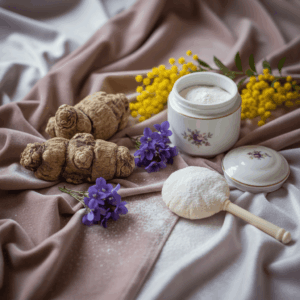
The name “powdery” comes from the first rice powders that were once scented with iris. The powdery facet, like a dry note, is quite nasal and slightly woody, with accents of violet. It is often compared to pastel tones and possesses very evanescent notes.
Iris is considered the goddess of powdery notes. Its note is mysterious and airy, and quite difficult to grasp. Iris flowers indeed exhale delicious perfumes, some of which even have a chocolatey note.
Furthermore, powdery facets can evoke women’s boudoirs: they are predominantly present in eaux de toilette and eaux de parfum for women. They are sometimes present in certain masculine perfumes, but mainly in niche perfumery.
NB: The powdery facet should not be confused with the vanilla facet, which is very gustatory.
Powdery Iris Notes in Perfumery
Iris Pallida
Iris Pallida, or Iris of Florence, originates from Italy. It is one of the most expensive raw materials in perfumery.
However, it is not the flower itself, but its root (the rhizome) or more precisely an underground stem on which so-called adventitious roots can form, that is used in perfumery. Rhizomes are harvested from plants aged 3 to 6 years, cleaned, then dried.
At this stage, the plants are still odorless and must be stored in bags for three years until completely dry to become fragrant. Then, after this period, the rhizomes are reduced to fine particles and treated by distillation to obtain a paste called “iris butter,” whose maceration in an organic solvent and extraction leads to iris absolute.
The elegance of the Florence iris surpasses all other varieties in quality. Its scent has multiple facets: notes oscillating between violet and mimosa, woody accents, as well as a slight note of raspberry and carrot. Very often, to replace or support the effect of iris in a perfume, carrot seed essence is added.
Iris is cultivated in Italy, on steep, rocky, and poorly exposed terrain, which excludes the possibility of mechanizing the cultivation. Planting takes place from mid-September to mid-October, and harvesting is carried out during the third year after planting, between mid-July and mid-August.
Iris Germanica
Iris Germanica is of less precious quality and rougher than the Florence iris. In Morocco, the cultivation of the Germanica variety is simpler because the plants are more robust than the Florence iris. The rhizomes are pulled up and cleared of their soil to be treated in two possible ways:
- Peeled Rhizomes: They are manually peeled and then washed. This step is long and tedious (one person can process up to 40 kg of rhizomes per day).
- Unpeeled Rhizomes: They are cut into slices, then dried for 10 days and stored in sheds under precise aeration and humidity conditions for three years.
The rhizomes ideally require six years of treatment before reaching their optimal quality. During air drying, irone, the most noble and precious part of the iris, develops.
There is a third variety of iris: Iris Pallida from China.
These three qualities of iris are very different: Iris Pallida from Italy is the noblest and most subtle, but it is also the most expensive variety. Iris Germanica from Morocco possesses a lower quality because the drying time of the rhizomes is only two to three years (sometimes less), and the irone content is lower.
Finally, Iris Pallida from China has a lower quality than that of Italy because the uprooting of rhizomes is done more quickly.
Some suppliers also create blends (communelles) of Iris Pallida from Italy and China.
Powdery Iris Perfumes
Here are some fragrances featuring iris in their composition:
- Infusion d’Iris – Prada
- Iris Ganache – Guerlain
- Dior Homme – Dior
- L’Heure Bleue – Guerlain
- Après L’Ondée – Guerlain
- Flower – Kenzo
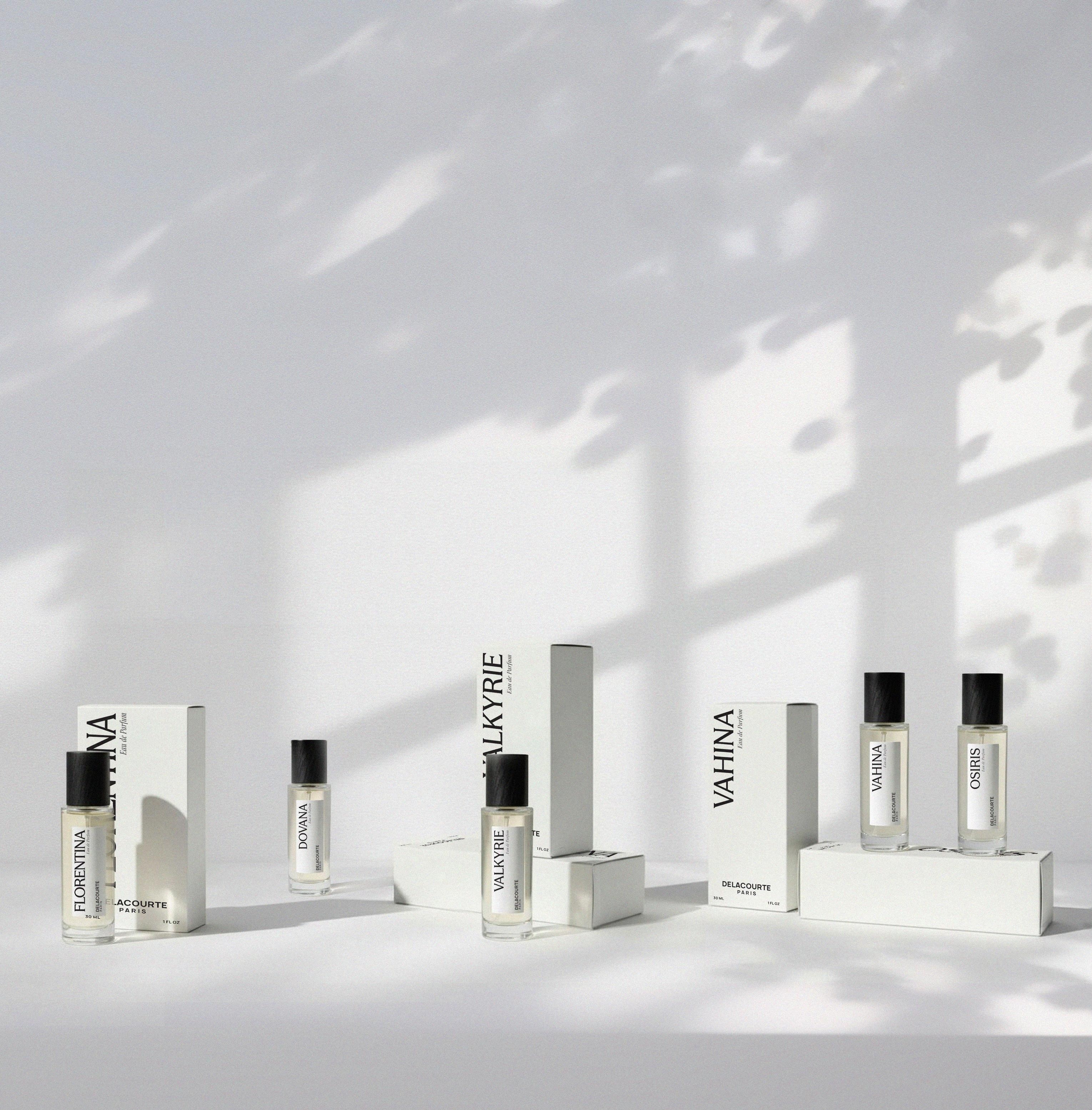
- Florentina – Delacourte Paris
- Dovana – Delacourte Paris
Mimosa in the Powdery Facet
Mimosa is a difficult flower to work with in perfumery because mimosa absolute has a scent quite far from that of the fluffy flowers.
In 1770, Captain Cook, conquered by the perfume of these small yellow flowers, brought back plants of this shrub native to Australia. Fossilized traces prove that it was already growing in this country some 250 million years ago.
Mimosa shrubs were reportedly brought back from Mexico by Napoleon III’s troops. The first mimosa plants came to bloom in the gardens of Joséphine de Beauharnais.
This flower quickly seduced the aristocratic salons of Great Britain and France. Empress Josephine had also tried to plant mimosas in the greenhouses of Malmaison. But its acclimatization in the south of France dates back only about 150 years. Since the end of the 19th century, mimosa has been the symbol of the French Riviera.
This flower is mainly cultivated in the south of France, India, Egypt, and Morocco. In perfumery, mimosa is treated by volatile solvent extraction to obtain an absolute.
However, it is also possible to treat the concrete (the first product resulting from extraction) by molecular distillation: a molecular distillation absolute is then obtained, olfactory different and almost colorless.
Mimosa offers, in perfumes, a green, powdery, honeyed, and almondy floral note. It also has a fairly pronounced green facet (close to that of the violet leaf) because its leaves are distilled at the same time as the yellow balls. This is why, in the mimosa note, vegetal scents recalling cucumber, or even melon, are perceptible.
Here is a non-exhaustive list of perfumes containing a very marked mimosa note:
- Mimosa Pour Moi – L’Artisan Parfumeur
- Champs Elysées – Guerlain
- Summer – Kenzo
- Farnésiana – Caron
- Beige Extrait – Chanel
Some Anecdotes About Mimosa
- Etymology: its name comes from the Latin mimus, which means “farce,” because some leaves retract as soon as they are touched, like a reflex.
- It is said that if mimosa blooms in winter on the French Riviera, it is because it has kept in memory its flowering period in Australia, where flowers bloom at the same time, i.e., in summer. Two qualities are used by perfumers: Acacia Dealbata and Acacia Farnesiana.
- In Spain, mimosa symbolizes reunions.
- Since 1946, mimosa has been the emblem of Women’s Day, which takes place every March 8th.
- The mimosa flower is offered on Grandmothers’ Day. Marcel Pagnol said: “Grandmothers are like mimosa: it is sweet and fresh, but it is fragile…”
- Mimosa is edible: mimosa balls are reconstituted in sugar and flavored. However, it is not possible to crystallize the flowers directly because the flower is too fluffy.
- There is a mimosa syrup that can deliciously accompany a glass of champagne.
Cassie in the Powdery Facet
Cassie is a flower from the same family as mimosas (the acacia family). However, its branches have thorns. Like mimosa, it is a flower quite difficult to work with in perfumery. Its scent is denser, more mysterious, with animalic notes close to ylang-ylang, and possesses sulfurous effects and aldehydic accents.
Among perfumes with cassie are:
- Cassie in Après L’Ondée
- Fleurs de Cassie by Frédéric Malle with 4% cassie absolute
Synthetic Products in the Powdery Facet
Violet
According to legend, Zeus, then in love with Io, ordered the Earth to create the most beautiful flower in her honor: the violet.
Because he loved this flower, Napoleon was sometimes nicknamed “Corporal Violet.” It then became the emblem of the Napoleonic imperial party.
In England, its scent was most popular in the Victorian era. Virtuous, violets are often associated with simplicity and modesty.
However, the violet does not yield its perfume (it is a “mute” flower). Therefore, methylionone and ionone molecules allow its reconstitution.
Violet was called “Iov” or “Ion” in ancient Greek, hence the name “ionone,” which designates a chemical compound.
Methylionone
The first ionone was discovered in 1890. Ionones allowed perfumers to reproduce the scent of the violet flower as faithfully as possible. There are also “alpha,” “beta,” “violet note” ionones, less easy to use than Methylionones.
This note is floral, powdery, close to raspberry, and woody.
Ionones and Methylionones combine wonderfully with even more iridescent notes, such as natural or synthetic irones, or even iris absolute notes.
Après l’Ondée by Guerlain was one of the first perfumes to contain these molecules, followed by L’Heure Bleue, Météorites, Vol de Nuit, Insolence, or Florentina.
We can also cite:
- L’Origan – Coty (1905)
- L’Heure Bleue – Guerlain (1912)
- La Violette de Toulouse – Berdoues (1936)
- Violetta di Parma – Borsari (1970)
- Detchema – Revillon (1953)
- Lagerfeld – Karl Lagerfeld (masculine) (1978)
- Paris – YSL (1983)
- Eternity – Calvin Klein (1988)
- Trésor – Lancôme (1990)
- Tocade – Rochas (1994)
- Iris Silver Mist – Serge Lutens (1994)
- Aimez-Moi – Caron (1996)
- Flower – Kenzo (2000)
- Verte Violette – L’Artisan Parfumeur (2001)
- Lolita Lempicka (2004)
- Insolence – Guerlain (2006)
- Misia – Chanel (2015)
Natural Heliotrope
The scent of heliotrope, whose plants can be found at some nurseries, lies between powder, vanilla, and almond. It is a delicious aroma, absolutely essential.
Heliotropin
It does not yield its perfume, but fortunately, its odor was discovered in 1869 by Fittig and Mielk. This raw material is synthetic but can also be obtained from Tahitensis vanilla. It is a floral, almondy note, between mimosa, heliotrope, and lilac.
Here again, this scent is present, among others, in Après L’Ondée, L’Heure Bleue, Insolence by Guerlain, and Florentina.
Musky Notes or White Musks
These molecules, just like Muscenone, give off a very enveloping powdery note with a “cashmere” effect.
Conclusion
Powdery notes bring softness and tenderness to perfumes and are very enveloping, like cashmere. They can be modern (in the form of musks) or more traditional, recalling rice powder or women’s boudoirs.