The Rose: Queen of Flowers and Legend of Nahéma
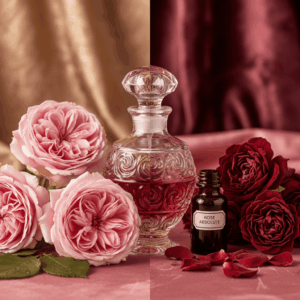
It was in the form of a wild rose variety that the rose appeared on earth, some forty million years ago.
The Rosa Damascena comes from a cross between Rosa Gallica, cultivated between Mesopotamia and Palestine, and Rosa Phoenica or Phoenician Rose, also cultivated in the Middle East. The Damascena rose is also called the Damask rose, as the Crusaders discovered it in that city.
History and Origins
It was highly appreciated by Nero, who made excessive use of it during his parties. A flower of every excess in antiquity, it was reclaimed in the 4th century AD by the Church, which associated it with the cult of Mary. But it is to the Arabs that we owe the propagation of the perfume rose. They reportedly introduced it to the Dadès Valley in Morocco, then to Bulgaria, and then Turkey.
The olfactory sophistication of the rose is impressive. Its chemistry is complex and makes it inimitable; with at least 300 molecules, it offers perfumers infinite possibilities for transformation: sometimes angel, sometimes demon, fresh and sparkling or carnal and deep.
It can reinvent itself infinitely. It is the undisputed queen of the perfumer’s palette, their muse, their diamond. The rose is considered one of the two queen flowers of perfumery.
Rose Varieties
Roses are classified into 2 main groups:
- Ornamental roses, about 700 varieties, cultivated for their beauty.
- Very fragrant roses, used in perfumery; perhaps less pretty, they are few in number: The Damask Rose (Rosa Damascena) and the May Rose called Rose de Grasse (Rosa Centifolia) or Rose Pays.
Production Zones
Rose de Grasse or Centifolia: It originates from the Caucasus. It was introduced to France at the end of the 16th century.
Rosa Damascena or Damask Rose: It is produced more intensively in Turkey, Bulgaria, Morocco, and Persia. Rosa Damascena originates from the Shiraz region in Iran. Shiraz was the capital of Persia from 1750 to 1794; distilleries existed there, it was then established in Syria (Damascus) then established in Bulgaria and Turkey.
These are large producers of rose water. Iranians have always been closely linked to the rose, as dried petals or rose water are major ingredients in Persian cuisine. Rose water is also used by them for medicinal purposes and for cosmetics.
It also has a sacred symbolism for holy places and during religious ceremonies. Iranians call this rose the “Flower of Prophet Mahomet”. The Kaaba is washed every year during a famous ceremony with rose water from Kashan.
Use in Perfumery
The rose is obviously used in floral perfumes. It can be fresh, “treated like morning dew,” or darker or more “orientalizing.” It wonderfully accompanies chypre accords, and notably, neo-chypres. All perfumers know that the rose forms an ideal duo with patchouli.
It can also be associated with oriental notes, as is the case for Nahéma for example, and more particularly for oriental florals. Finally, it can be used in fruity florals, or for soliflores. If Nahéma were to be created today, it would be impossible, so “overdosed” is the rose in this perfume.
The rose is currently targeted by new toxicological laws because it contains spicy notes that are now “limited”.
The Guerlain “Communelle”
A “communelle” is a judicious blend of different batches of natural essences. At Guerlain, since always, different essential oils of the same botanical origins or not, from different producers, or countries, are assembled, allowing to offer all the facets around a single theme.
The goal is also to create a “Guerlain standard”: a very identifiable signature, and also to ensure, from year to year, a consistency of quality.
Processing the Raw Material
The rose petal can be treated in two different ways:
1. By distillation
It takes about 3.5 tons of rose petals to obtain 1 kg of essence.
The petals are placed in a vat with water. The whole is heated to a precise temperature. The steam charged with odorous molecules rises in a column where it is cooled and condenses to give the essential oil.
Another product obtained during distillation: rose water, sometimes used in perfume formulas. The essence is more top-note oriented, fresh and volatile. For a good picker: the harvest is 5kg per hour, starting at 7 in the morning.
2. By volatile solvent extraction
It takes 700 kg of petals for 1 kg of absolute.
The petals are placed on several trays in a vat which is put under pressure. It is in a way a huge pressure cooker. A solvent passes through this vat to load itself with all the odorous molecules of the petals. The vat is then opened, the solvent is evaporated, and a sort of dark paste called concrete is harvested.
This concrete is washed with alcohol to get rid of waxes and be purified. We then obtain the absolute. The absolute is more muted, it will act as a heart note; however, it is denser and rounder.
Note: From the same quantity of flowers, one obtains 6 times more absolute than essential oil. That is why Rose absolute is less expensive.
Olfactory Description
Rose de Grasse (Centifolia)
More honeyed scent, rounder, warmer, a bit “waxy”.
Components: PEA, Geraniol, Citronellol, rhodinol, etc.
Bulgarian Rose (Damascena)
Versus the Turkish rose, it is more almondy, more lychee, more raspberry, nervier, a bit fresher in the top notes.
At Guerlain, different products from different plots are selected: some have an accentuated facet of fruit, wood, or geranium; those with an “artichoke and hay” accent will be discarded, while those possessing almondy and lychee fruit notes will be favored.
Every year, the work starts over to select and then assemble the batches, to obtain the “Guerlain quality” of the Bulgarian rose which was reintroduced at Guerlain.
From the beginning, Pierre-François-Pascal Guerlain, Aimé, and especially Jacques Guerlain obviously used the Rose de Grasse, but also large quantities of Bulgarian rose. Only Jean-Paul Guerlain had favored the Turkish rose more.
Components: Citronellol, Geraniol, PEA, rose oxide, Beta-damascenone, beta-ionone, etc.
Persian Rose
Rose with a wilder, darker scent, with artichoke and hay connotations.
Some Perfumes with a Dominant Rose Note
- Aldehydic Rose: N°5 by Chanel (1921), Liu by Guerlain (1929)
- Rose/Jasmine: Joy by Patou (1929)
- Oriental Rose: Chamade by Guerlain (1969): first use of hyacinth and blackcurrant bud in perfumery and Nahéma (1979) with an overdose of roses (Turkish absolute, Grasse rose absolute, Bulgarian essence, first use of the molecule: damascone)
- Chypre Rose: Aromatics Elixir by Clinique (1971), Rose de Nuit by Serge Lutens (1993), Une Rose by Frédéric Malle (2003), Rose Barbare by Guerlain (2004), Portrait of a Lady by Frédéric Malle (2010)
- Woody Rose: Voleur de Roses by L’Artisan Parfumeur (1993), Rose 31 by Le Labo (2006)
- Vegetal Green Rose: Pleasures by Estée Lauder (1995), Sa Majesté La Rose by Serge Lutens (2000), Eau Plurielle by Diptyque (2015)
- Fruity Blackcurrant Rose: Rose Ikebana by Hermès (2004), Le Jour Se Lève by Louis Vuitton (2016)
- Fruity Cherry Rose: La Petite Robe Noire by Guerlain (in exclusive boutiques 2009): co-creation I did with Delphine Jelk. International launch in 2012 by T. Wasser
- Powdery Rose: Ombre Rose by JC Brosseau (1981), Flower by Kenzo (2003)
- Musky Rose: Chloé by Chloé (2008), Rose des Vents by Louis Vuitton (2016), Dovana by Delacourte Paris (2017)
- Violet Rose: Paris by Yves Saint Laurent (1983), Trésor by Lancôme (1990)
Nahéma by Guerlain
Its History
In the Tales of the Thousand and One Nights, Scheherazade was called by the Sultan of the Indies to narrate one of her fabulous stories. She told him the story of Nahéma.
Once upon a time, in a very distant land, there was the Grand Chamberlain of the Palace who had twin daughters. Their beauty was perfect and so identical that he composed their names with the same letters: Mahané and Nahéma. But they had very different characters: Mahané was sweet, docile, and conciliatory while Nahéma was tempestuous and determined, endowed with a fiery character.
One evening, an old dervish asked for hospitality and was welcomed at the Palace for the night. To thank their father, he gave Nahéma and her sister a precious wooden box, admirably beautiful, and told them this: “Be careful, this box contains your destinies – but beware, once its secret is revealed, it will be impossible to change it.”
When the two princesses were of marriageable age, a young prince came to the Palace. He met the two sisters and courted them. Difficult to choose, they were so different; the ideal would have been to have both, as they were very complementary. The prince, still hesitant, left the palace without giving his answer.
The wait became long for the two sisters. Mahané lingered on the beach and remained calm. Nahéma, on the other hand, was very impatient. One day, stamping with impatience at not having an answer from the Prince, Nahéma took her box and stole her sister’s, to pierce the secret of her destiny.
Nahéma then left into the desert with both boxes, but exhausted, she dropped her sister’s box which broke on the ground and from it spilled water. Water being the symbol of submission and docility, because water takes the shape of the container into which it is poured.
Then, Nahéma opened hers and saw a small flame in the shape of an orange and pink flower. Symbol of the passion that devours everything. Nahéma is not a woman who lets herself be chosen; she is a daring and indomitable woman who cannot be satisfied with compromise.
She also understood that it would be her sister who would be married by the prince, for her qualities of gentleness and submission. Then Scheherazade asked the Sultan this question: who would you have chosen between Mahané the tender and Nahéma, the passionate? Neither, for in you I have found the ideal: both passion and tenderness.
Description
The association of passion and tenderness was the creative idea for the composition of this fragrance: troubling, velvety, unique, obsessive like the masterpiece of Ravel’s Boléro.
It is first an overdose of selected roses: essences, absolutes, to which have been added innumerable rosy notes, all sublimated for the first time by “damascone” (a molecule used for the first time by Guerlain) bringing a fruity touch and remarkable tenacity.
In the heart, the fresh and green scent of hyacinth. Then fruits, peaches, and passion fruits. The base of the composition is supported by sandalwood and patchouli and always present: the Guerlinade.