Perfume Extraction Processes: From Flower to Essence
A perfume can be created from natural raw materials, or from synthetic products. Regarding natural raw materials, different processes exist to extract the essential oil, or essence.
What Are the Different Extraction Processes to Make a Perfume?
Here are the different extraction processes for raw materials in perfumery:
1. For Natural Products:
2. And for Synthetic Products:
Raw Materials on the Perfumer’s Organ
Let’s recall that there are, in perfumery, 1,000 natural raw materials and 3,000 synthetic raw materials available. Depending on their tastes, the perfumer will select about 1,000 raw materials, synthetic or natural, for their perfume organ (furniture allowing the professional to store and classify their bottles of essential oils).
New raw materials are discovered and marketed every year, while others disappear, notably due to increasingly strict legislation.
1. Expression (Cold Extraction)
Expression is a fairly old extraction process, which began in the 19th century. It is a mechanical treatment allowing the recovery of essential oil (or essence), found in the skin of citrus fruits (also called “zests” or “epicarps”).
This type of treatment is practiced only for citrus fruits (cf. Expression). And to extract the essence from bergamot zests, the method used is essentially the pelatrice (a machine composed of a mechanical scraper), with the reinforcement of centrifuges. For oranges, the whole fruit must be pressed.
There used to be different treatments for extracting citrus peel:
- The sponge treatment (which consisted of emptying the fruits of their pulp, and extracting the essence from the skin thanks to sponges that absorbed the product).
- The spoon treatment (which consisted of harvesting the essence by scraping the skin of citrus fruits with a spoon).
2. Distillation
Practiced since Antiquity, this extraction process was perfected in Arab civilization from the 8th century. Distillation is today a major technique of traditional perfumery.
This process allows treating certain flower petals, as well as seeds, barks, leaves, and roots. However, not all raw materials in perfumery can be treated by distillation.
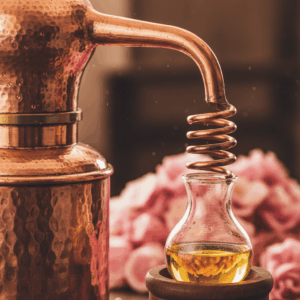
The alembic, an apparatus designed to separate products by heating then cooling, allows obtaining essential oil (or essence), as well as floral water, in the case of orange blossom and rose.
3. Enfleurage
Let’s start by recalling that there are two types of enfleurage: cold and hot.
The enfleurage technique has been practiced since Antiquity, and it has been commonly used since the beginning of the 18th century. This method, widely developed at the time, was perfected in Grasse, in the South of France. However, the technique was abandoned around the 1930s, as soon as the volatile solvent extraction process became reliable.
Enfleurage consists of trapping flowers in a layer of fat, by placing them on plates surrounded by wooden frames, or by macerating them in hot oil. The fat used has the effect of absorbing the scents of raw materials, and allows obtaining a very precious and expensive product called “pomade absolute”.
Today, some small producers are relaunching the activity of enfleurage in Grasse, but this remains very confidential and reserved for major houses.
4. Volatile Solvent Extraction
Volatile solvent extraction consists of dissolving the fragrant components of the plant in a solvent which is then evaporated. This method, which replaced enfleurage, became truly operational in the 19th century.
It consists of immersing flowers in a large tank, called an “extractor”. Once the extractor is closed, the content is immersed in a solvent such as ethanol, hexane, or benzene, which carry the molecules of the plants.
The product obtained is called: absolute. It is then washed with alcohol to obtain the precious concrete (cf. Solvent Extraction).
5. Supercritical CO2 Extraction (Sofact)
This extraction process is the most recent one in existence. It allows reproducing the smell of the raw material as precisely as possible. It is a clean and gentle modern technology, carried out by solvent (cf. CO2 Extraction).
This technique allows obtaining an absolute very close to the natural smell of the raw material, which is very little heated, and leaves no residue. Products treated by CO2 are considered to be luxury products.
6. Synthetic Molecules
Modern perfumery was born at the end of the 19th century. At that time, perfumers incorporated synthetic ingredients into their formulas. This allowed widening the perfumer’s palette, offering more creativity, and obtaining more abstract olfactory forms.
There are two types of synthetic raw materials:
- Synthetic raw materials obtained solely by chemical reactions.
- Isolates coming from natural products.
Synthetic molecules have many advantages:
- They offer more creativity to the perfumer.
- They enrich the perfumer’s palette and give abstraction to the perfume.
- They help promote sillage.
- They allow replacing nature when it is deficient (for example with fruits, violet, lily of the valley, etc.).
- They bring stability to the perfume.
- They sublimate natural products.
7. The Head Space Technique
The Head Space technique, or “espace de tête”, aims to reconstitute the natural scent of a raw material (cf. Head Space).
The goal is to capture fresh molecules on a living raw material, such as a flower, and to analyze them, with more or less significant equipment, and notably thanks to chromatographic analysis in the laboratory.
Subsequently, a “copy” of this analysis is made, by selecting the most interesting molecules, or the easiest to reproduce. The Head Space method also allows analyzing more complex and original scents, such as the atmosphere of a forest, or a beach, for example.
There is also a process called “Jungle Essence”, allowing the analysis of rare scents, and which can be likened to the Head Space technique.
To Go Further in Perfume Knowledge
Sylvaine Delacourte also provides you with a complete guide dedicated to perfumery and perfume composition, with the following themes: