Tuberose in Perfumery: The Narcotic and Sensual Flower
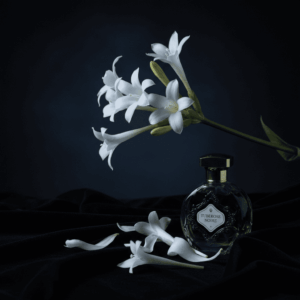
The tuberose is also called the Madonna lily. The tuberose is singular, proudly erect. It is planted in lines, the bulbs are exactly 15 cm apart from each other, not one more.
It is the most scented stem of the plant kingdom which has the particularity of exhaling its perfume 48 hours after being cut. Thus during the Renaissance, young women were forbidden to cross fields of tuberoses with erotic emanations at nightfall.
Where does tuberose come from?
Tuberose is exotic and narcotic, with the effect of a drug; it is found in South India and Egypt, the Comoros, Morocco, Tunisia, and again in Grasse in France. It was in 1632 that Father Théophile Minuti introduced it to lower Provence; it was so noticeable that the date of its arrival was recorded.
Tuberose comes from Mexico. The Aztecs apparently used its essential oil to scent their chocolate.
It was introduced to Europe during the conquest of Mexico by the Spanish around the 16th century and then to Asia. It was formerly called the Indian hyacinth. It was first cultivated in Grasse; today, it is still cultivated there, but it is also found in Italy, Spain, Egypt, Morocco, and especially in South India. It requires a hot and dry climate to develop.
Under the reign of Louis XIV, it embalmed the corridors of Versailles; the King’s gardeners brought 10,000 tuberose bulbs for the Trianon plantations.
Since the 19th century, tuberose production has increased, although it is cultivated only for its scent in perfumery. It is used a lot in bouquets, even if it is not exactly the same variety; the one for bouquets has double flowers.
In India, tuberose is harvested from May to December. The name of this flower, in Hindi, means night fragrance. In India, tuberose is widely used for festivals, religious rituals, and weddings and mainly for ornamentation in garlands; it decorates the bridal chamber of newlyweds. It is a flower considered erotic.
The use of tuberose in perfumery
One can obtain the natural scent of tuberose. It is then very expensive. Formerly, it was treated by enfleurage (cf. enfleurage). Now, it is obtained by volatile solvent extraction.
Tuberose, originating from India, possesses a narcotic smell; it is a bit medicinal in top notes, like a scent of ointment, but after a few seconds the tuberose offers a sulfurous scent between honeyed nectar and confit, generous to excess, exotic. Tuberose is poisonous and extremely sensual.
Reconstitution of the note
Some brands cannot afford natural tuberose but they can then always resort to reconstitution which will be, whatever the flower, always different from the scent of the natural flower.
To get the idea of a tuberose, the perfumer will have to orchestrate different notes: natural jasmine or a jasmine composition, ylang-ylang, indole, coconut, orangey note style Methyl Anthranilate, heliotropin, mimosa, and still other trace elements.
The descriptive sheet of tuberose
Botanical name of tuberose: Polianthes tuberosa
Botanical family of tuberose: Agavaceae
The tuberose flower has 5 petals per flower. There are 20 flowers per tuberose spike. It takes 1000 tuberose flowers to obtain 1 kg of absolute.
Flowering of tuberose
Tuberose flowering takes place between May and December with a peak in August. Picking is done by hand, at sunset, when its perfume is at its peak, at the moment when the corollas open. Tuberose is thus foraged and pollinated by moths.
To give an idea, a thousand plants give on average 30 to 40 kg of flowers.
In winter, the tuberose is taken out of the ground then stored and replanted in spring; it takes 3 years to obtain the tuberose flower. Note that this plant measures between 1m to 1.50m in height. Tuberose is a fragile flower that loves cleanliness and requires daily maintenance with a lot of manual weeding.
This flower was part of the Grasse landscape like jasmine, rose, or mimosa but its cultivation had become too costly in France; labor is expensive and yields are too low. But recently, thanks to certain Grasse producers, it can be found again sheltered by the Tanneron massif, near Grasse.
Some small producers have even relaunched, anecdotaly, enfleurage (thanks to the association of exceptional flowers of the Grasse country). But Grasse cannot supply all the demand; current provenance remains mainly in India.
Processing and manufacturing of the raw material
Tuberose can only withstand volatile solvent extraction which allows obtaining tuberose absolute (cf. Extraction). Its absolute is one of the most expensive in the world.
Olfactory description of tuberose
Smell of white flower in the same way as jasmine, orange blossom, neroli, frangipani, gardenia, magnolia, lily. White flowers are absolutes of femininity.
Tuberose has a medicinal and camphorated facet. It also has green and earthy accents, slightly spicy. Tuberose can also have an almondy side and can sometimes be perceived as a kind of fruity jasmine. Tuberose is very sensual, obsessive, carnal, milky, narcotic, even animalic, and can evoke the femme fatale.
Use of tuberose in perfumery
Perfumers adore it or fear it; one must know how to tame it by coaxing it with softer, rounder notes or on the contrary play the overdose.
Tuberose is often used to create white floral accords. It is rather associated with feminine perfumes. Tuberose is an extroverted and flashy flower; it brings opulence and character to a fragrance.
It can also be used to give an exotic, suave, solar, carnal, or voluptuous side to the perfume. It is found in heart notes but its sillage is so powerful that it is also perceived in base notes.
Perfumes containing tuberose
- Fracas by Piguet
- Poison by Dior
- Tendre Poison by Dior
- Jardins de Bagatelle by Guerlain
- Mayotte by Guerlain (discontinued)
- Joyeuse Tubéreuse by Guerlain
- Giorgio Beverly Hills by Karl Lagerfeld
- Chloé by Karl Lagerfeld
- Tubéreuse Criminelle by Lutens
- Carnal Flower by Frédéric Malle
- Nuit de Tubéreuse by L’Artisan Parfumeur
- Gabrielle by Chanel
- Fleur de Peau by Diptyque
- Do Son by Diptyque
- Twilly by Hermès
- La Fille de l’Air by Courrèges
- Fragile by Jean Paul Gaultier
- Turbulences by Vuitton
- Tubéreuse Mystique by Bulgari
- Amarige by Givenchy
- Gucci Bloom
- Café Tuberosa by Atelier Cologne
- Good Girl Gone Bad by Kilian
- Honour by Amouage
- Tubereuse Impériale by BDK
- Rouge Malachite by Armani Privé
- Alto Astral by Byredo
- Palermo by Byredo
- Reine des Nuit by Byredo
- The Wedding Silk by Kayali
- Nouveau Monde by Vuitton
- My Way by Armani Privé
- Tubéreuse Nue by Tom Ford