Flowers in Perfumery: The Complete Guide to Floral Notes
Flowers are among the most used raw materials in perfumes. There are different categories of flowers in perfumery:
- Green / spring or vegetal flowers
- White or sensual flowers / solar flowers
- Roses
- Spicy flowers
- Powdery flowers
- Atypical or rare flowers
Spring Flowers: The Flowers of Renewal
Spring flowers, also called “flowers of renewal,” evoke freshness, spontaneity, and cheerfulness.
They consist of green and vegetal notes.
Unfortunately, some of these flowers, which are nevertheless very fragrant, do not yield their soul.
They are called “mute flowers” such as lilac, buddleia – a more honeyed lilac -, honeysuckle, lily of the valley (there is now a natural lily of the valley, but it is quite disappointing!), hyacinth, as well as privet flowers, which are a little less green but nevertheless spring-like – mock orange, sweet pea, wisteria.
Whatever the extraction process used (steam distillation, volatile solvent extraction, or others), none allows reconstituting the original scent of these flowers.
If the perfumer wishes to obtain their scents, they must create what is called “a reconstitution” or “a reproduction.” Everyone will therefore perceive and restore it in their own way.
A reconstitution is the draft of a perfume; it consists of about ten constituents, both synthetic and natural. Without this work, the perfume Diorissimo by Dior (1956), which is truly an example of a “soliflore,” would not have seen the light of day.
In this spring floral family, only two flowers are natural in perfumes: the narcissus and the daffodil, whose scents are quite similar.
Narcissus: The Flower of Character
History: In Greek mythology, Narcissus, proud of his beauty, paid no attention to the young nymphs who adored him. One of them, Echo, wounded by his coldness, gradually disappeared until only her voice was perceptible.
The gods, angry, condemned Narcissus to fall in love with his reflection in the clear water of a pool. Upon his death, he was changed into a flower: the narcissus, which then became the symbol of selfishness.
Origins: Narcissus comes from Central Europe, North Africa, and Asia. The main producing countries are France (in Auvergne), Morocco, and Egypt.
Harvest: Narcissus grows wild throughout the Aubrac region, from an altitude of 1,000 meters. Gatherers pick the flower heads in spring with special combs (sorts of large rakes) and recently, with a mechanized cart. The largest production is now located in Auvergne.
This flower is highly sought after by perfumers who use it mainly in prestige perfumery as in certain floral or chypre perfumes (cf. Chypre facet).
Narcissus, delicate in appearance, diffuses a powerful scent, with a very green (cf. Green facet), very earthy, spicy, animalic scent, with accents of jasmine and ylang-ylang. It is very difficult to work with.
The Daffodil: The Sister of Narcissus
The daffodil (jonquil) is a flower that yields its perfume through volatile solvent extraction and offers fragrances that are particularly distinctive and endowed with unequaled spring freshness.
Are you narcissus or daffodil?
Are you boy, are you girl?
I am him and I am her,
I am narcissus and daffodil,
I am flower and I am beautiful
Girl.
– Quote from Robert Desnos
White Flowers: Sensual Flowers
These flowers are also qualified as sensual, or narcotic flowers, because they often share a molecule, indole, a natural animal note. Among white flowers are found:
- Jasmine
- Tuberose
- Ylang-ylang
- Frangipani
- Tiaré flower
- Gardenia
- Magnolia
- Orange blossom
Jasmine: The Flower
There are two varieties of jasmine:
- Jasminum Grandiflorum: which can come from Grasse, Egypt, India, or Italy.
- Jasminum Sambac: from India with a more “orange and solar” scent.
In order to harvest this natural material, pickers must get up very early and the most skilled gather 500 to 700 kg of flowers per hour. To obtain 1kg of absolute, 10,000 flowers are necessary.
Tuberose: The Narcotic Flower
Tuberose is exotic and narcotic, and comes from southern India and Egypt. In India, it is harvested every morning from May to December. In Hindi, the name of this flower means “night fragrance“.
Tuberose exists in “natural” form in perfumery: it is then very expensive. Formerly, it was treated by enfleurage. Now, it is obtained by volatile solvent extraction.
This tuberose exhales a narcotic smell, a bit medicinal at the start (a bit “ointment-like”), but after a few seconds, it offers a singular scent between a honeyed and candied nectar, exotic, poisonous, and erotic.
Some brands cannot “afford” natural tuberose. In this case, it is always possible to resort to reconstitution.
It is a mixture of different notes: natural jasmine, or a composition of jasmine, ylang-ylang, indole, coconut, and an orange note (such as Methyl Anthranilate), heliotropin, mimosa, and still other trace elements.
Ylang-Ylang: The Solar Flower
The ylang-ylang flower comes from a tree and has the shape of a large disheveled star. It is, for Indonesians, the “flower of flowers” (this is also the meaning of its name). Very exotic, it displays an exuberant and extroverted nature.
It also inherited from volcanoes (of Madagascar or Mayotte), an explosive floral side that gives a lot of color to perfumes. It is harvested when the flower turns from tender green to yellow, a sign that it has reached its olfactory maturity.
Its scent is halfway between jasmine and tuberose. Ylang-ylang, with its creamy and carnal notes, is reminiscent of solar monoi (cf. Solar facet). It has a sensual, lascivious, and intoxicating dimension while being wild and narcotic.
Frangipani: The Flower of the Islands
The frangipani flower is a sacred flower in India, whose abundant flowering is called for by ardent prayers. Like jasmine sambac, the whiteness of the flower symbolizes the purity of the soul. This sacred and delicate flower does not yield its perfume.
Perfumers must resort to “a laboratory flower,” by proceeding to “a reconstitution,” that is to say, a formula integrating about ten components.
Tiaré Flower: The Exotic Flower
On a tropical shrub grows the Tiaré flower of white color, national symbol of Tahiti. It is now available as a natural product, but it is used sparingly, because its smell is ultimately quite disappointing and far from faithful to the original suave and intoxicating smell of the flower.
There is also a product made by a process close to enfleurage, produced locally.
Gardenia: The Indomitable Flower
Gardenia is a small shrub with very fragrant white flowers. It comes from China, Japan, the Philippines, Indonesia, India, and California. The gardenia absolute obtained from the extraction of the gardenia flower is absolutely not faithful to the smell of the flower in its natural state.
It is simply used to isolate styrallyl acetate: a green rhubarb note. Perfumers use gardenia reconstitutions whose main constituents are: the white flower accord, green notes accompanied by molecules called tiglates (mushroom notes).
Magnolia: The Fresh Flower
Magnolia belongs to the Magnoliaceae family, and comes from a tree native to the Far East, and China. In perfumery, it is the Michelia alba variety that is interesting. Its picking is done from May to June and from August to November. The flowers are treated by distillation to obtain magnolia essential oil.
This note is floral, with a significant “citrus” facet. It presents great lemony freshness, tinged with green notes. Then, a sweet solar floral facet, with vanilla accents, is revealed. Leaves are also used in perfumery, even if the perfume is a bit more difficult to use than that of the flowers.
Orange Blossom: The Multi-Faceted Flower
The bitter orange tree, from which the orange blossom comes, is a magical tree, because it provides 4 different raw materials at once:
- Bitter orange, whose skin is treated by expression and which gives bitter orange essence.
- Orange blossom absolute.
- Neroli essence.
- Petitgrain essence.
Its botanical name is Citrus aurantium. The bitter orange tree was originally native to the Far East, but it is cultivated today in the Mediterranean basin. The main producers of orange blossom are Tunisia and Morocco. But Italy, Egypt, or the South of France also produce it.
In mythology, the fruits of the bitter orange tree were called “golden apples,” a gift from Jupiter to Juno for their wedding.
Processing and manufacturing of the raw material: Usually, white flowers are too fragile to withstand steam distillation. Orange blossom is the only one that lends itself to the following two modes of extraction: distillation and volatile solvent extraction.
Steam distillation of the flowers produces neroli essence. Volatile solvent extraction allows obtaining orange blossom absolute. Finally, by distilling the entire branches (leaves and flowers), petitgrain essence is obtained.
Olfactory description of orange blossom:
- Petitgrain essence: lavender-like (cf. Aromatic facet), green and vegetal, very fresh citrus, and slightly smoky.
- Neroli essence: fresh, airy, lavender-like, sweet, (a bit marshmallow-like), slightly hesperidic, suave, fresh floral. One can also find a powdery aspect to it.
- Orange blossom absolute: more “indolic” (animal note of white flowers), it is darker in the top notes than neroli. It possesses a narcotic, animalic, and sensual side. Its evolution is clear in the top notes, and more honeyed afterwards.
Use: Neroli will rather be associated with citrus fragrances and Eaux de Cologne. It is also used to reconstitute certain flowers like tuberose, hyacinth, tiare, and frangipani.
Orange blossom absolute will be privileged for chypre or oriental accords, or for white floral perfumes. It is rounder and more sensual than neroli. It is also possible to use it to accentuate fruity notes such as apricot (cf. Fruity facet).
Roses and Rosy Notes: The Changing Flower
Among rosy notes are found:
- Rose
- Rose Geranium
- Peony
The Rose: The Queen of Flowers
Origins: Considered as one of the two queen flowers of perfumery, the rose comes from different regions: the South of France, Bulgaria, Turkey, or Morocco. Two types of roses are used in perfumery: the May rose, or Rose Centifolia, which comes from the town of Grasse, in France, and the Damask Rose (Rose Damascena) which comes from Bulgaria, Turkey, or Morocco.
Processing and manufacturing: The rose is one of the few flowers to be able to withstand both volatile solvent extraction and steam distillation, which allows obtaining rose essence. Nevertheless, this last technique remains a costly choice, because it takes about 4 tons of rose petals to produce one kilo of essence.
Moreover, it must be harvested very early in the day, from 6 am. It is also possible to obtain rose absolute, thanks to volatile solvent extraction.
Olfactory description of the rose:
- May Rose from Grasse: a honeyed scent, rounder, warm, and a bit waxy.
- Damask Rose (Bulgaria, Turkey): a fruitier smell, more lemony and acidic, more nervous and fresh in the top notes.
Pelargonium Rosat or Geranium: The Masculine Rose
Native to Africa, rose geranium is used for the fragrant properties of its leaves and stems. It is cultivated in many countries but essentially comes from Egypt. Its scent is a rosy note, but also green, aromatic, almost minty, and it can evoke lemongrass and lychee.
It is, in a way, a masculine rose, which associates very well with aromatic notes. Rose geranium is often found in perfumes with a fougère accord.
Peony: The Fresh and Fruity Rose
Peony is also a rosy note. However, it does not yield its perfume by extraction.
To use it in perfumery, it will therefore be necessary to make a reconstitution with rose essence and fresh elements naturally contained in the rose (phenyl-ethyl alcohol, geraniol) to which fruity elements like raspberry (cf. Fruits) and sometimes slightly powdery notes such as ionones or heliotropin can be added.
Spicy Flowers
Carnation, Wallflower, and Immortelle are part of the so-called “spicy” flowers used in perfumery.
Carnation: The Rebellious Flower
Carnation absolute from Egypt is a natural product that exists in perfumery. However, it is quite little used, because it does not smell like the spicy carnation we all have in memory. The scent of carnation is often reconstituted with an association of rose and spices (clove, vanillin, and heliotropin).
Be careful not to confuse this Egyptian carnation with the marigold (tagetes), which is also natural, but does not offer a scent similar to the carnation we know.
Wallflower: The Soft Flower
Wallflower is a very spicy perfume with a carnation note, with accents of vanilla, and musk. It only exists in “reproduction.”
Immortelle: The Flower of the Maquis
Immortelle is a yellow flower that grows in the shrublands (maquis) of Corsica, Spain, and France. Its botanical name is “Helichrysum“. In perfumery, it is treated by distillation to be used in fragrance compositions.
Its scent is very spicy, liquor-like, with a tobacco and honeyed facet. It also possesses a slight “curry” scent; it is a very difficult material to work with. You will find it in the perfume Sables by Goutal.
Powdery Flowers
Powdery flowers used in perfumery are iris, mimosa, cassie, violet, and heliotrope.
Iris: The Noble Flower
It is not exactly the flower that will be treated, but the rhizome of the plant (Iris Pallida), specifically an underground stem on which adventitious roots can form, which comes from Italy or China. Its use requires three years upstream to grow the root and three years of drying. It is one of the most expensive raw materials in perfumery.
Iris Pallida can recall violet and mimosa, by its characteristic powdery smell. Woody accents (cf. Woody facet) and a slight note of raspberry, but also of carrot, are also attributed to it. At the origin of the so-called “powdery” note in perfumes, iris served to perfume the first rice powders, hence the use of this term in perfumery.
Mimosa: The Flower of the Riviera
Its name comes from the Latin mimus, which means “farce” (joke), a reference to some of its leaves which retract when touched. There are two qualities: dealbata and farnesiana. Mimosa is a difficult flower to work with in perfumery. Essentially cultivated in the South of France, India, Egypt, and Morocco, this flower is treated by volatile solvent extraction.
The scent of mimosa is floral, powdery, and almond-like with a quite pronounced green facet (accents of cucumber, or even melon, because the leaves are distilled at the same time).
Cassie: The Cousin of Mimosa
The cassie flower is a flower of the acacia family, just like mimosas (unlike the latter, there are thorns on cassie branches). Like mimosa, cassie is a fairly difficult flower to work with in perfumery. Its smell is denser, and mysterious, with animal notes close to those of ylang-ylang, sulfurous effects, and aldehydic accents.
Violet (Ionone): The Shy Flower
Ionones or methyl ionones allow obtaining violet scents in perfumes. The first ionone was discovered in 1890. Ionones allowed perfumers to reproduce fairly faithfully the perfume of the violet flower. Indeed, the violet used in natural form does not yield all its “soul.”
Heliotrope (Heliotropin): The Vanilla Flower
Heliotrope, also called heliotropin, is the name of a plant of the Boraginaceae family. The flower does not yield its perfume when treated naturally in perfumery, but a synthetic raw material was discovered in 1869 by Fittig and Mielk, and can also be obtained from vanilla (Vanilla Tahitensis).
Heliotrope possesses a floral, almond-like scent, close to mimosa and lilac.
Rare and Atypical Flowers
Among rare flowers used in perfume composition, we can cite:
- Reseda (Mignonette – the retro flower): This herbaceous plant with fragrant flowers spreads around it a slight cloud of honey, lily of the valley, and narcissus.
- Champaca (the strange flower): Michelia champaca is a very fragrant white flower, used in natural form. Very amber-like, it sports a scent of hay, dew, and honeyed notes, with an ylang-ylang effect, like a heady, spicy jasmine and an animalic base note.
- Broom (Genêt – the honeyed flower): A shrub with fragrant and toxic golden yellow flowers found mostly in the South of France. It possesses a fruity, bitter fragrance, close to orange blossom, lime blossom, and with notes of honey (cf. Beeswax) and tobacco.
- Pittosporum (the bush flower): Small tree with beautiful glossy foliage. It is impossible to obtain an essence or an absolute from it. There are therefore reconstitutions. Its perfume is floral, between orange blossom and jasmine.
- Mahonia (the mysterious flower): Evergreen shrub with leaves resembling those of holly. It exhales a slight smell of honey, lily of the valley, and narcissus, and exists only in reproduction.
- Karo Karoundé (the charismatic flower): Spicy flower from South Africa, used as a natural product. It offers a perfume close to narcissus, very green and quite “animal leather.”
The Case of Honeysuckle
Its perfume scents the air but like lily of the valley and lilac, it is a mute flower, which does not yield its perfume. Difficult to pierce its secret! One must therefore try to reproduce its scent by mixing natural and synthetic notes, to try to get closer to its delicate smell which lies between fresh jasmine and orange blossom with slightly honeyed touches.
List of Cult Floral Perfumes
Here is a list of perfumes classified according to the flowers they contain:
Lily of the Valley
- Diorissimo Dior
- Muguet Guerlain
- Muguet de Porcelaine Hermès
Hyacinth
- Chamade Guerlain
Narcissus
- Mont de Narcisse L’Artisan Parfumeur
- Cologne Indélébile Frédéric Malle
- Eau de Narcisse Bleu Hermès
- Narcisse Noir Caron
- Eau de Rochas Rochas
Daffodil (Jonquil)
- Vol de Nuit Guerlain
- Velvet Orchid Tom Ford
- Eau de Printemps L’Artisan Parfumeur
- Dolce Rosa Dolce Gabbanna
- Je Reviens Worth
Tuberose
- Tubéreuse Criminelle Lutens
- Fracas Piguet
- Le Premier Parfum Chloé
- Poison Dior
- Nuit de Tubéreuse L’Artisan Parfumeur
- Jardins de Bagatelle Guerlain
- Parfum Terracotta Guerlain
- Atelier des Fleurs Tuberosa Chloé
- Do Son Diptyque
Ylang-Ylang
- Cruel Gardenia Guerlain
- Terracotta Guerlain
- Samsara Guerlain
- Songes Annick Goutal
- Organza Givenchy
- Amarige Givenchy
- N°5 Chanel
Jasmine
- J’adore Dior
- Jasmin des Anges Dior
- Splendida Jasmin Noir Bulgari
- Shalimar Souffle Guerlain
- A la Nuit Serge Lutens
- Le Parfum Elie Saab
- Jasmin Rouge Tom Ford
- Eau des Sens Diptyque
- La Chasse aux Papillons L’Artisan Parfumeur
Mimosa
- Mimosa pour Moi L’Artisan Parfumeur
- Champs Elysées Guerlain
- Mimosa Pour Moi Indigo Atelier Cologne
- Les Infusions Mimosa Prada
- Atelier des Fleurs Herba Mimosa Chloé
Cassie
- Fleurs de Cassie Frédéric Malle
- Après l’Ondée Guerlain
Gardenia
- Cruel Gardenia Guerlain
- Gardenia Chanel
- Passion Annick Goutal
- Songes Annick Goutal
Rose
- Rose Kabuki, Rose Gypsy, Rose Sakura – Dior (exclusives)
- Miss Dior Roses N’Roses Dior
- Izia Sisley
- A la Rose Francis Kurkdjian
- N°5 Chanel
- Joy Patou
- Paris YSL
- Nahéma Guerlain
- Idylle Guerlain
- Rose Barbare Guerlain
- Drôle de Rose L’Artisan Parfumeur
- Voleur de Rose L’Artisan Parfumeur
- Lipstick Rose Frédéric Malle
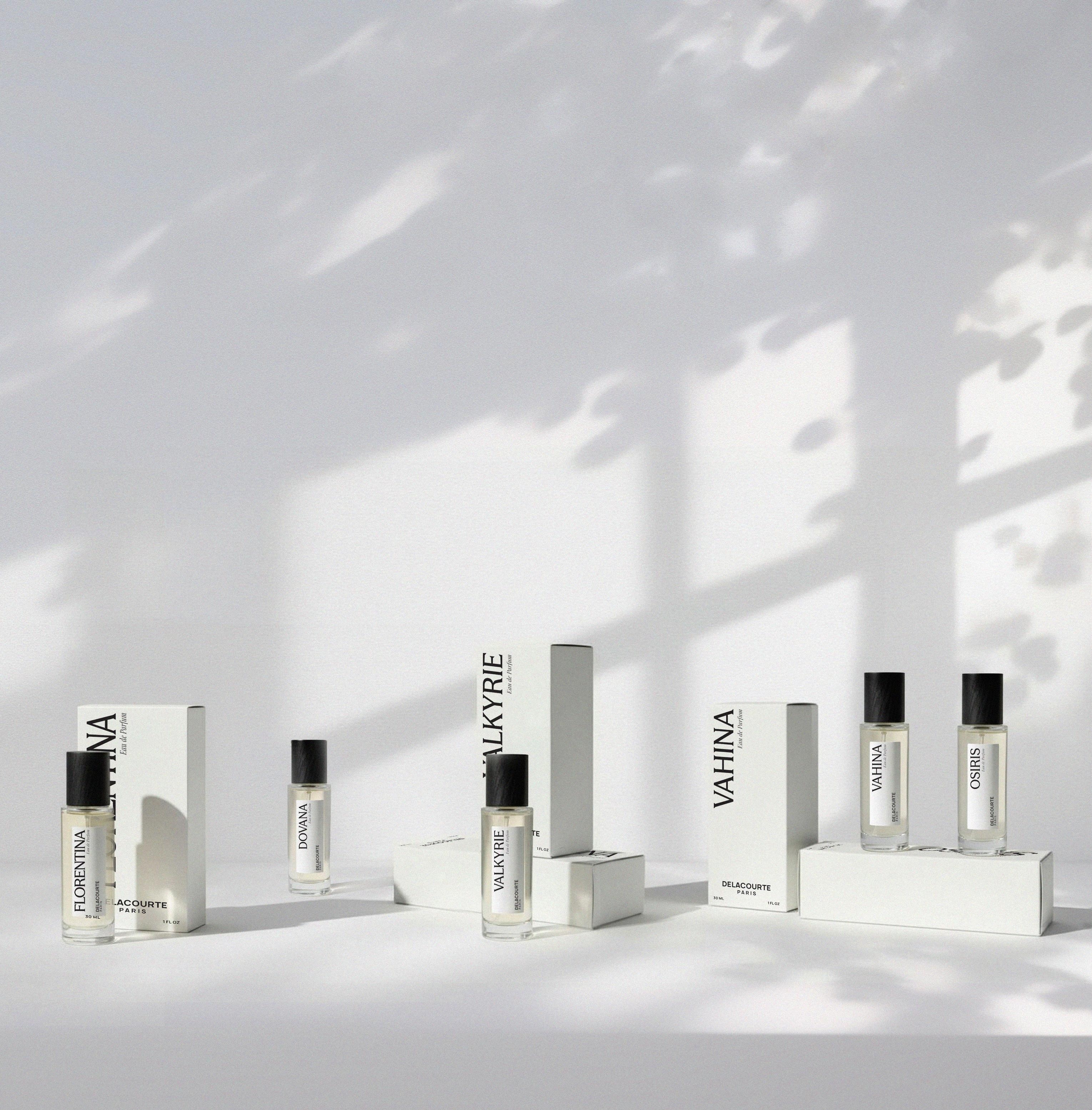
- Dovana Delacourte Paris
Geranium
- Géranium Pour Monsieur Frédéric Malle
- Vetiver Geranium Creed
- Eau de Minthe Diptyque
- Equipage Géranium Hermès
Carnation
- L’Air du Temps Nina Ricci
- Opium YSL
- Bellodgia Caron
- Tabu Dana
- L’Oeillet Prada
- Après L’Ondée Guerlain
- L’Heure Bleue Guerlain
- Lui Guerlain
- Florentina Delacourte Paris
Champaca
- Champaca Comme Des Garçons
Violet / Iris
- Insolence Guerlain
- Misia Chanel
- Florentina Delacourte Paris
- Comète Chanel
Iris
- Après l’Ondée Guerlain
- L’Heure Bleue Guerlain
- Iris Ganache Guerlain
- Iris Pallida L’Artisan Parfumeur
- Infusion d’Iris Prada
- Iris Silver Mist Serge Lutens
- Iris Gris Jacques Fath
- Bas de Soie Serge Lutens
- Homme Dior
- N°19 Chanel
- Comète Chanel
- Iris Ukiyoé Hermès
- Florentina Delacourte Paris
- Dovana Delacourte Paris
Orange Blossom and Neroli
- Florentina Delacourte Paris
- Vahina Delacourte Paris
- Fleurs de Citronnier Serge Lutens
- Fleur d’Oranger Serge Lutens
- Histoire d’Oranger L’Artisan Parfumeur
- La Chasse aux Papillons L’Artisan Parfumeur
- Néroli Annick Goutal
- Cologne Mugler
- Mi Fa Réminiscence
- Infusion de Fleur d’Oranger Prada
- Bouquet de la Mariée Guerlain
- L’Heure Bleue Guerlain
- L’Heure de Nuit Guerlain
- Atelier des Fleurs Neroli Chloé
- Atelier des Fleurs Nuit D’Oranger Chloé