Travel to India: Inspiration Notebook and Scents of Spices
From a very young age, I wanted to discover the world, even though strangely, no one in my family passed this passion on to me. I am so happy that my children have also been bitten by this desire for elsewhere.
Discovering new cultures means enriching oneself at all levels: open-mindedness, but also openness to new rites, landscapes, discoveries of scents hitherto unknown, or unprecedented associations. Each destination has enriched my olfactory heritage, breathed new inspirations.
Everything can be inspiring: landscapes, nature, colors, local art, museums, flowers, fruits, spices, drinks, cocktails, local dishes. Curiosity is the essential fuel to sustain passion. As soon as I return, I always have this compelling desire to project myself into a next trip.
India, Land of Scents and Contrasts
The North and Rajasthan
I have made about 5 trips to India in the North in Rajasthan: Jaipur, Jodhpur, Udaipur, with their stunning vestiges, sumptuous palaces, stalls of precious stones and embroidered fabrics.
The highlight was the visit to the Taj Mahal, one of the most beautiful wonders in the world, which offers a different spectacle depending on the time of day. An intense memory indeed; I have told the story of Shalimar by Guerlain so many times during my career, whose tragic outcome takes place at the Taj Mahal.
The South and the Cities
Goa, which offers paradisiacal beaches with a hippie atmosphere. I also went to the South, in a lush Kerala, where poverty is less blatant and where a certain sweetness of life reigns.
Big cities make your head spin and are exhausting, often quite sad, because tainted with great poverty like Mumbai, Delhi, Bangalore, juxtaposed next to debaucheries of wealth. In these cities, it was impossible for me to take photos; there were unbearable scenes of daily life at every street corner.
A Unique Olfactory Heritage
It is such a varied country that it is difficult to summarize everything I discovered there. India is rich in powerful scents; the scents are sometimes very pleasant, others especially in cities can be confusing.
Indian men and very coquettish women like to wear perfume; one begins to see selective perfumeries where major international brands are sold and also recently niche perfumes.
- Flowers: India is a major producer of flowers, such as tuberose and jasmine, flowers braided into garlands, revered both for temples but also for weddings and various festivals.
- Spices: Indian spices are also very renowned among perfumers; I actually visited a factory in South India, and I better understood the processing of these spices for perfumery, a great memory!
The Chai Recipe (Masala Chai)
Who says spices says Chai (pronounced like “char” without the r), it is a drink originating from India whose Hindi root of the name means tea. In India, one speaks more precisely of Masala Chai.
The history of this recipe dates back more than 5000 years; originally this Chai tea recipe was used as a remedy in traditional Hindu medicine, Ayurvedic medicine, and did not contain tea, only milk with an infusion of spices.
Now Chai is a drink composed of sweet black tea enhanced with spices and hot milk. Indians drink this Chai from morning to night, in small cups, in all circumstances, as a welcome, in shops, on the train, at Ayurvedic doctors, etc.
How to Make a Good Chai?
Making a good Chai requires a precise technique:
- Boil water for a few minutes with spices, a few peppercorns, 3 cardamom seeds; some also add cinnamon and cloves and sometimes ginger.
- Then add 3 cups of milk; I put plant-based milk.
- Let boil a second time for a few minutes, then filter and pour.
From Drink to Perfume: The Creation of Vangelis
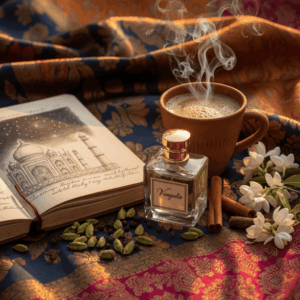
This recipe inspired me to create the perfume Vangelis from the Vanilla Collection, a tribute to this drink and to India.
In this fragrance which addresses both women and men, the notes are orchestrated to recreate this accord:
- Dominant Woods: patchouli, cedar, vetiver, and the precious sandalwood which is used for wedding chests and also for religious ceremonies.
- Crackling Spices: cardamom, pepper, juniper, ginger, clove.
- Softness: They are associated with a subtle milky note and a natural vanilla from Madagascar which brings the sweet note necessary to achieve this Chai accord.
I keep in my memory other olfactory souvenirs of these trips to India which will be, I hope, sources of creation for my future olfactory adventures.