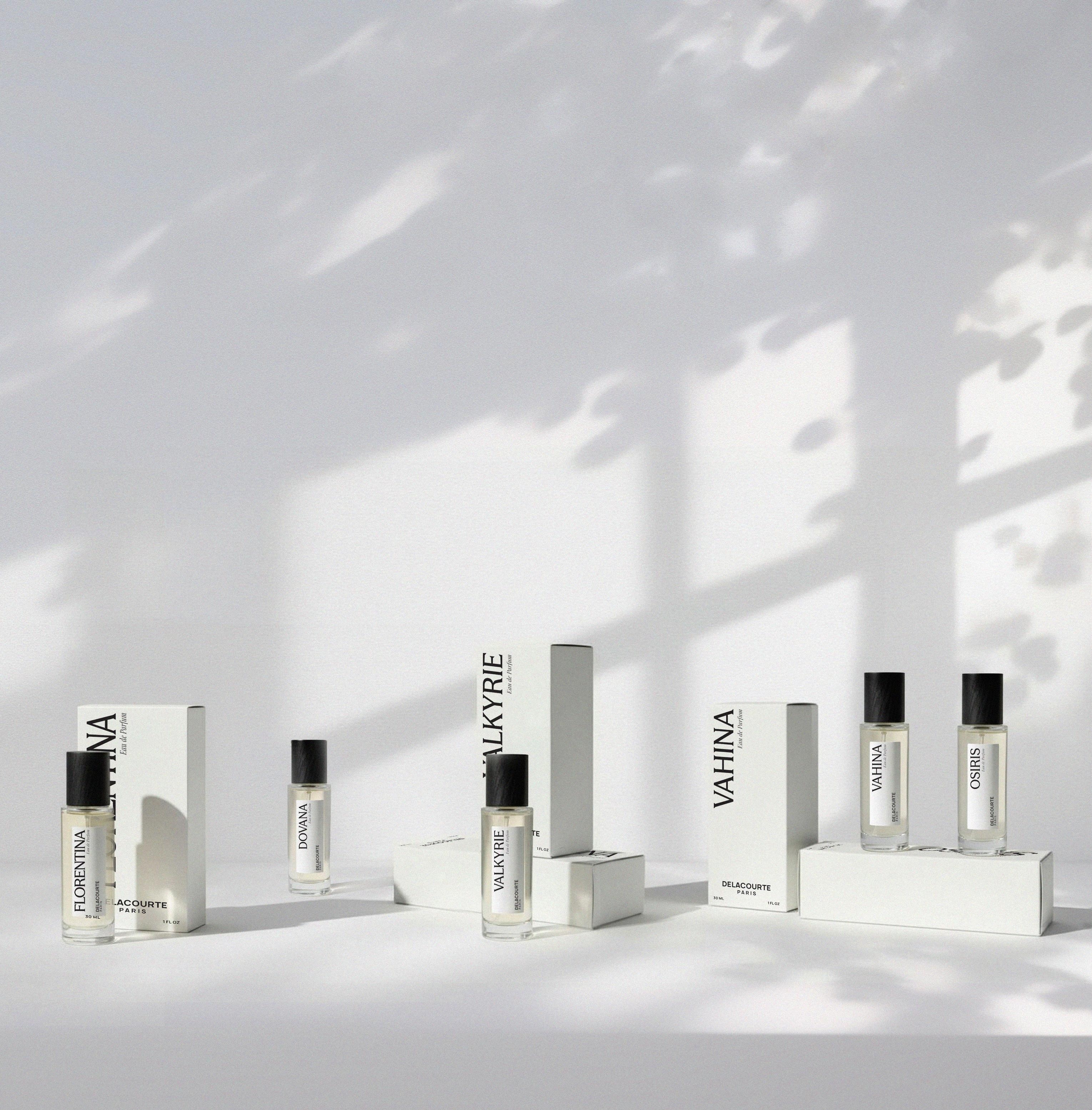
Perfume Manufacturing: Techniques, Concentrations, and Bespoke
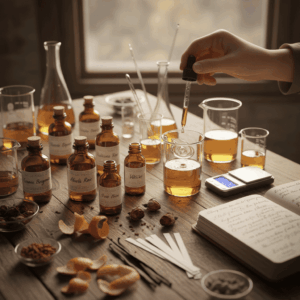
Making a perfume is first of all understanding the manufacturing techniques, the notions of concentration but also everything that can go into the composition of the perfume itself.
To accompany you in the world of perfumery, Sylvaine Delacourte presents everything you need to know about perfume manufacturing.
Reminder on Perfume Concentrations
Let’s start with a reminder on perfume concentrations. These different concentrations are classified here from the freshest and most volatile to the most tenacious and powerful.
- Eau de Senteur: Intended for babies and toddlers, it can be with or without alcohol and is very lightly concentrated.
- Classic Eau de Cologne: Composed of 99% natural ingredients, citrus fruits, and aromatic notes. This is the reason why this product does not last well (concentration of 2 to 6%). It can be used as a splash to refresh oneself.
- Modern Eau de Cologne: Has more top and base notes, and some synthetic molecules. Therefore, this Eau de Cologne has more tenacity with a concentration of about 4% to 10%.
- Eau Fraîche: Concentration of 7% to 15%, consists of many hesperidic notes, aromatic notes; this construction often has chypre base notes.
- Eau de Toilette: Is concentrated from 6% to 20%, less tenacious, it is more generally smelled by people who are in the wake than by the person themselves.
- Eau de Parfum: Which can be concentrated from 15% to 30% is a good compromise because it possesses both tenacity and sillage.
- Perfume Extract (or pure perfume): Is concentrated from 20% to 40%, it is intimate and is only smelled by the person wearing it or people close to them. Very few houses now offer this product, as it is often presented in small quantities and is very expensive.
Perfume Manufacturing Techniques
From the oldest to the most recent, here are the raw material extraction techniques (cf. Manufacturing techniques):
- Enfleurage: Consists of bathing flowers in a fatty substance to exhaust their perfume. Example: tuberose pomade absolute.
- Distillation: Is a technique that heats raw materials using an alembic; the product obtained will be the essence or essential oil. Example: rose essence.
- Expression: Consists of pressing the skin or juice of citrus fruits. Example: bergamot essence.
- Volatile Solvent Extraction: Consists of placing fresh or dry raw materials in extractors. Petroleum-based solvents will then withdraw scents from them, in two stages. First a wax called concrete, then the concrete will be washed with alcohol and become absolute. Example: rose absolute.
- Head Space: Consists of analyzing living matter, flower or ambiance like the scents of a forest, using more or less significant sensors, then analyzing the data given to reproduce them as closely as possible.
- Sofact or CO2 Extraction: Is a fairly recent method that approaches the volatile solvent extraction method but here replaced by CO2, an odorless gas. Moreover, in this method, the raw material is not heated. The quality will therefore be optimal and the scent very faithful to the raw material from which it comes.
Synthetic Materials
There are two types of synthetic raw materials:
- Chemical Synthesis: Materials obtained solely by chemical reactions, such as esters, aldehydes, lactones, macrocyclic musks (used for certain white musks), or methylionones for violet notes.
- Isolates (of natural origin): Coming from natural products, like indole found in jasmine, geraniol present in rose or geranium, linalool and linalyl acetate in lavender and bergamot, as well as certain musks, found in animal musk.
Many synthetic raw materials are therefore constituents of natural products.
Making Your Perfume Yourself: Precautions
It is tempting to want to make your perfume yourself and playing the apprentice perfumer is very fun. Be careful however with the compositions you will make, as they can cause allergies.
Even if raw materials are safe, mixing them together can cause allergic reactions. This is why, before being launched on the market, perfumes are tested in the laboratory.
Do not forget that both natural and synthetic can cause allergies. If you are about to make a composition yourself, put your perfume sketch on your clothes and not on your skin.
The Creation of a Bespoke Perfume
The bespoke perfume service has always existed, initially for kings and queens or wealthy VIPs. Now this luxury is more accessible and different actors offer it (cf. Bespoke creation).
You mainly have two categories:
1. Public Workshops
Those created during perfume workshops lasting from 1 hour to half a day. These workshops are open to all; you can mix accords or raw materials with the advice of a person passionate about the world of perfume.
This will allow you to create a perfume sketch and leave with your creation. The perfume obtained is to be worn on clothes and not on the skin because it will not have been tested by dermatologists.
2. Bespoke by Professionals
Those created by professionals; each perfumer will have their technique to identify the personality and precise desires of the client.
- Francis Kurkdjian: offers a bespoke perfume for about 15,000 euros.
- Flair: For 50 ml of Eau de Toilette or Eau de Parfum and for 15 ml of extract, count about 2,200 euros.
- Guerlain: offers 2 liters of perfume in a 500 ml crystal bottle and 20 glass bottles, for 55,000 euros.
- Cartier: count 60,000 euros for 2 gold and crystal bottles.
Bespoke Perfume by Sylvaine Delacourte
In parallel with her Collections around the most beautiful raw materials of perfumery, Sylvaine Delacourte has been creating bespoke perfumes for over 15 years for a private clientele from different cultures and countries.
She offers this possibility to create a bespoke perfume starting from 25,000 euros with dermatological testing and a bespoke bottle included.