How to Make Your Own Perfume? Guide, Precautions, and Simple Accords
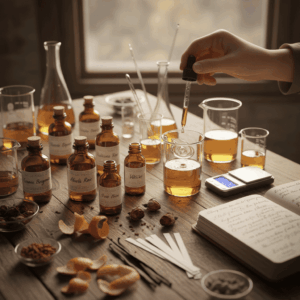
Whether you are a connoisseur or a neophyte, you may be curious to create your own perfume yourself. This experience can be very fun, but also very instructive, allowing you to discover the scientific side hidden behind the composition of a fragrance. Here are some recommendations for making your perfume yourself.
The Reality of the Perfumer’s Profession
First of all, you should know that a “real perfume” requires one to two years of orchestration, to achieve a balanced formula between top notes, heart notes, and base notes. Creating a perfume therefore requires a lot of time and patience.
Each perfume requires a formula composed of 30 to 100 different ingredients that will allow creating a harmonious composition, arousing an emotion. It is important not to copy an already existing perfume on the market, and to dare to experiment to think outside the box, and perform a true act of creation.
Contrary to popular belief, the shorter the formula of your perfume, the higher its quality. Furthermore, it is of course normal not to be satisfied from the first creation. Making a perfume requires a certain talent, which develops over many creations.
Indeed, “with the same 7 musical notes, one can compose Mozart’s music or simply make noise”.
Precautions to Take Before Starting
Certain precautions should be taken before you start creating a perfume yourself. First of all, be vigilant with the compositions you will make and the materials you will choose. Sometimes, certain natural raw materials or synthetic products can cause allergies.
Usually, perfumes are therefore tested before being marketed (each test represents a significant cost, ranging between 2,000 and 3,000 euros).
To avoid risks of reactions, test your perfume on your clothes rather than directly on your skin.
How to Orchestrate Your Perfume Yourself?
We advise you not to make a perfume from too many raw materials, at the risk of embarking on too complicated a job that could disappoint you. It is indeed very difficult to respect the olfactory pyramid and to orchestrate base notes, top notes, and heart notes well in order to create a harmonious and balanced fragrance.
The simplest way if you are starting out is therefore to direct yourself towards raw materials that you like very much, that correspond to you, and that belong to your olfactory family.
Moreover, in perfumery, the sum of 1+1+1 is not equal to three scents, but will be the result of an alchemy. When the latter is done well, it will be very difficult to identify the three components.
Which Accords to Create in a Perfume? (Recipe Ideas)
Here are some examples of surprising accords in the same fragrance that you can test:
- The Tea Accord: Associate a fresh jasmine note with a note of violet and bergamot.
- The Mojito Accord: Associate lime, rum, mint, and sugar.
Simple and Classic Accords That Work
To avoid cacophonies and in order to obtain a harmonious composition, we recommend that you make simple accords with 3 or 4 components maximum, or by reproducing accords that have very often proven themselves. Here are some examples:
- Cologne Accord: Bergamot essence, or orange essence, petitgrain essence, neroli essence, and orange blossom absolute (cf. Eau de Cologne).
- Fresh Woody Accord: Bergamot essence, petitgrain essence, and cedar essence.
- Hesperidic Woody Accord: Grapefruit essence and vetiver essence.
- Simple Oriental Accord: Vanilla absolute and patchouli essence.
- Floral Chypre Accord: Rose essence, rose absolute, and patchouli essence.
- Floral Woody Accord: Rose essence, jasmine absolute, and vetiver essence.
How to Choose Your Raw Materials and Alcohol?
Raw materials can be very different depending on the suppliers and present large quality gaps.
Furthermore, alcohol is necessary to diffuse the raw materials. It will act as an excipient and will allow the fragrance to diffuse. Pure alcohol or 80° alcohol is difficult to find in France (unlike in Italy where it is on sale in supermarkets).
For this reason, some people resort to organic vodka, frequently used to dissolve essences. The other alternative can be to associate it with an odorless fatty substance. The sillage will be more discreet and will give a more intimate presence (this realization is called concrete).