The Ouessant Black Bee: An Ecological Treasure and its Exceptional Honey
You know that I fell in love with the island of Ouessant. I recently discovered the specificity of Ouessant honey provided by the black bee, which nearly disappeared.
How is the Ouessant Island Black Bee Different?
This calm and serene black bee possesses unique physical and behavioral characteristics:
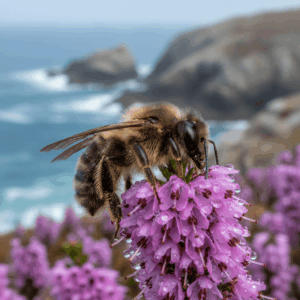
- Morphology: It has a rather voluminous and dark abdomen in brown/black colors for better absorption of solar rays.
- Resistance: They possess long hair to bring back honey in bad weather and wings with powerful thoracic muscles to work in the wind and transport significant quantities of pollen and nectar. Its large size allows it to forage over a wider range, up to 10 km compared to 3 km for another bee.
- Health: Its significant fat reserve allows it to endure the rigors of winter, and it remains free from disease, parasites, and hybridization.
“This very hairy hymenopteran, hence its dark color and name, has the main fault of being too efficient,” explains Jean-Luc Hascoët, the beekeeper of the Ouessant apiary who watches over the 150 hives of the conservatory of the Breton black bee of Ouessant.
“It goes out earlier in the morning and returns later in the evening. But above all, it does all the work in two months while the yellow bee starts slowly in the spring and finishes the honey flow at the end of autumn. Beekeepers are baffled at first,” explains this 42-year-old man.
History of an Ecological Rescue
In Ouessant, Apis mellifera mellifera has found a refuge. It was in 1978 that the first two hives were installed by a passionate amateur, Georges Hellequin. This beekeeper collected wild specimens of Apis mellifera mellifera in the Monts d’Arré in central Brittany for their preservation.
The CNRS conducted research on the DNA of the Ouessant bee. The 100% purity of the variety was established, crowning the selection work of the associative conservatory created in 1989, at a time when the varroa parasite, or “bee vampire,” was decimating entire colonies on the continent.
“Our bees serve as a zero base for all kinds of studies,” explains the conservatory’s salaried beekeeper. Regularly, hundreds of queens raised at the conservatory and up to 500 small hives per year are shipped to laboratories, individuals, and professionals in France and Europe.
Thus, the black bee has repopulated a large part of Brittany, its region of origin, “mostly due to a trend effect” but at the cost of hybridization of about 2% and 8% to 10% in the Nantes region, according to the conservatory beekeeper.
An Exception in the Face of Global Decimation
Once on the continent, black bees do not escape the hecatomb that has struck apiaries over the last four years. Beekeepers in Europe and America have lost 30 to 80% of their apiaries without the cause of these disappearances being clearly identified.
For Jean-Luc Hascoët, those responsible for the mortality of continental bees are phytosanitary products and other insecticides massively spread on intensive crops. “It is a glaring truth for me. In Ouessant, losses are 2 to 5%, normal losses,” he exclaims. Yet, the island currently has only one farm.
Ouessant, a Bee’s Paradise
The island flora is free from chemical aggressions, rich in pollen and nectar; therefore, the black bee is exceptionally fed and is endowed with extraordinary dynamism and amazing reproductive capacity.
Ouessant honey, made by endemic black bees, thus possesses a very specific bio-element profile. It is very rich in total amino acids compared to other honeys. Let us recall that amino acids are the constituents of proteins and the major constituents of keratins and collagens which ensure resistance and firmness.
Unique Flora for a Unique Taste
The black bee forages on specific flowers there:
- Thrift (Armeria)
- Spring Squill
- Sea Campion
- Sheep’s-bit (Jasione)
- Rock Samphire
- Particularly Heather
The Ouessant apiary ships this honey with a complex and subtle flavor, slightly minty, all over France.
The beekeeper I met told me something that surprised me greatly: Paris honey is not threatened and is of quite good quality. Indeed, bees find numerous flowers, sometimes even exotic ones on Parisian balconies, and in Paris, there are no pesticides unlike in our countryside.
A Protected Species and Scientific Heritage
The black bee of Ouessant Island is protected:
- 1989: Creation of the Black Bee Conservatory Association.
- 1991: A municipal decree bans the introduction of colonies, queens, or swarms originating from the continent.
Classified as a Biosphere Reserve of the Iroise Sea by UNESCO in 1988, the sentinel island, virgin of any pollution, with a perfect ecosystem, today shelters a pure and non-hybrid bee, Apis mellifera mellifera. It lives in its natural state, by the sea, amidst vegetation wet with sea spray which gives a slight iodized taste to its honey.
Jacques Kermagoret, President of the Association Conservatory of the Breton Black Bee, explains: “This bee imported to the island of Ouessant in 1978, to escape the varroa, a sinister parasite destroying bee livestock worldwide, is here sheltered from diseases and hybridizations. It is a unique heritage in Europe made available to the scientific world.”
If you are looking for this famous honey, the best thing is to go look for it at the island’s mini-market if you find any; I advise you to stock up, Ouessant honey is rare.
Guerlain’s Abeille Royale and the Black Bee
To follow the dynamics of its unique research program around the bee and its products, Guerlain became particularly interested in the honey of the island of Ouessant produced by the black bee. Guerlain essentially has hives in its perfume factory in Orphin, near Rambouillet.
Recognized as one of the purest, Ouessant honey was selected by Guerlain Research as a benchmark to guarantee the quality of honeys in the Abeille Royale range. The Breton Black Bee is one of the species to be protected today, thanks to the A.C.A.N.B. (Association Conservatory of the Breton Black Bee).
Among the actions of the Abeille Royale Research Platform, it is an exclusive partnership with the A.C.A.N.B. that allows Guerlain to advance its work in understanding the bee and the parameters that influence the quality of their production.