Pepper in Perfumery: From Spicy Note to Sensual Sillage
We continue our overview of raw materials used in perfumery with pepper. Origin, processing, and use in perfumery—you will know everything about pepper.
Botany and Origin
Botanical Name: Piper Nigrum
Botanical Family: Piperaceae
Pepper makes one wrinkle one’s nose as soon as its name is mentioned. This small berry is the queen of spices; it is popular in all cuisines of the world. It is a spice that does not lack zest. Pepper alone accounts for a quarter of the world spice trade.
History and Provenance
Pepper was one of the first spices to arrive in Europe. Known since antiquity by the Greeks and Romans, its price at the time was equivalent to that of gold. The search for this precious pepper motivated major exploration missions in colonial empires.
In fact, pepper is a vine cultivated in India, Sri Lanka, Indonesia, Cambodia, Malaysia, Madagascar, Brazil, and Cameroon. Vietnam has become a major player over the years and even the number one in pepper production, which has led to a fall in prices. 300,000 tons of pepper are produced each year.
Different Types of Pepper (Piper Nigrum)
It is a climbing plant that needs stakes; this vine plant produces clusters of berries that are harvested by hand and then dried. A vine can produce 1 kg to 1.5 kg of pepper per year.
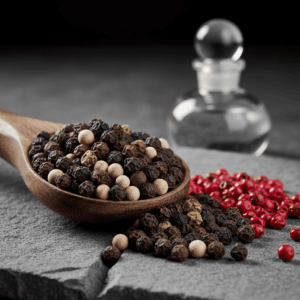
A pepper plant yields 4 different peppers; there are various varieties of plants yielding pepper, but only the fruit of Piper Nigrum is legally called pepper. Flowering takes place in May-June. From the same plant, one can obtain essential oil of white, green, red, or black pepper.
- Green Pepper: obtained by wet preservation of immature and still green berries. It remains green for about 6 months. It can be consumed fresh, dried, or in brine.
- White Pepper: it is a mature pepper that has been soaked in water to get rid of their pericarp, then dried. It is the mildest pepper.
- Black Pepper: obtained by harvesting the berries just before maturity. It will wrinkle, harden, and become black.
- Red Pepper: obtained after 9 months, at maturity and dried away from the sun.
There are two other species of pepper: long pepper, Piper Longum, and cubeb pepper, Piper Cubeba.
Other Peppers in Perfumery
Two other peppers are now used in perfumery. Their botanical variety being Rutaceae, they are close to citrus fruits.
- Timut pepper with pronounced grapefruit accents
- Sichuan pepper
False Pepper (Pink Peppercorns)
On the other hand, pink peppercorns (baies roses), considered in perfumery as a fresh spice (Schinus Molle), come from another variety of tree, which grows in Mauritania and on Reunion Island. Pink pepper does not belong to the Piperaceae family.
It is actually called false pepper. Pink pepper comes from a tree that can reach 15 m in height, whose evergreen foliage is fragrant. Its fruit is dried when ripe to obtain essential oil.
Processing and Manufacturing of the Raw Material
Black pepper essence is obtained by steam distillation of dried ripe fruits. Pepper can also be obtained in the form of an extract obtained by supercritical CO2 extraction. This product obtained by CO2 is truly an extremely pure product that reproduces the smell of pepper intact.
Olfactory Description and Use
Black pepper and white pepper share this spicy and woody side, but white pepper CO2 is more intense, warmer, almost animalic. It is a note that traverses the perfume; it participates in top notes, heart, and base notes.
It gives a warm spicy side to the perfume. It associates very well with woody, chypre, and oriental notes.
False pepper (pink peppercorn), on the other hand, is rather a cold, lemony spice, with bergamot accents slightly lavender-like. It really acts as a top note of the perfume.
Use in Perfumery
Pink pepper and black pepper are used for both feminine perfumes and masculine perfumes. Pepper is often associated with spicy and aromatic notes to bring freshness or nuance certain notes.
Pink pepper is a fresh spice that has been widely used by perfumers; Miracle by Lancôme was one of the first perfumes to claim it. It then became an almost classic note alongside citrus fruits, because it gives zest, nervousness, and lift to the perfume, without being too distinctive.
Main Chemical Constituents
- Eugenol
- Limonene
- Beta-Caryophyllene
- Alpha and Beta Pinenes
Perfumes Containing Pepper
To conclude, here is a non-exhaustive list of perfumes containing pepper:
- Poivre and Parfum Sacré by Caron
- Flower by Kenzo
- Vitriol d’Oeillet by Serge Lutens
- Poivre Samarcande by Hermès
- Black Pepper by Comme des Garçons
- Poivre Piquant by L’Artisan Parfumeur
- Vétiver by Guerlain
- Héritage by Guerlain
- Gourmand Coquin by Guerlain
- Sables by Annick Goutal
- Vangelis by Delacourte Paris