The Era of Synthesis: The Revolution of Modern Perfumery
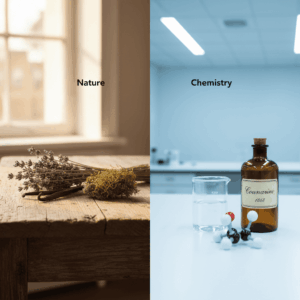
For nearly a century, all innovations in the field of creation have been based on the discoveries of new odorous bodies resulting from research in organic chemistry. This is without underestimating the important role of traditional natural products, indispensable for quality perfumery.
Many new natural products have allowed creative perfumers to move forward with unpublished accords. For example: blackcurrant bud (1970) used for the first time in Chamade by Guerlain, Canadian pine needle absolute, seaweed absolute, eucalyptus absolute, etc.
Each year, we discover new natural raw materials or we rediscover revisited classics, like clear patchouli or patchouli heart: a patchouli stripped of earthy and old-fashioned notes. I recently smelled beautiful natural fruity notes that were not conceivable when I started in this profession: pear ester, apple, etc.
False Ideas About Synthesis
- I recently went to a famous store, and I heard “this perfume is 100% natural!”. When I asked what was in the composition, the advisor told me about lilac, lily of the valley, and freesia (cf. Mute or atypical flowers).
- Many also think that synthetic products are “cheap”. This is false.
- Synthetic products are obtained from petroleum (this is partly true: aldehydes for example) but many molecules have been identified in natural products.
A Bit of History: Timeline of Discoveries
- In 1833/34, Dumas and Peligot isolate cinnamic aldehyde from cinnamon essence.
- In 1844, Cahours finds in anise essence its main constituent: anethole.
- The English chemist William Henry Perkin synthesizes in 1868 the odorous principle of tonka bean: coumarin.
- Coumarin is used for the first time in 1882 in Fougère Royale created for Houbigant.
- In 1869, discovery of heliotropin used in Après l’Ondée which also contains the molecule of anisic aldehyde discovered in 1887.
- In 1876, chemists Tiemann and Reimer industrially manufacture vanillin.
- 1880: discovery of leather notes which are present in Russian leathers (quinolines). Do not forget that there were several Russian leathers, that of Chanel, of Guerlain, and many others.
- In 1888, Chemist Baur creates an artificial musk much less expensive than Tonkin musk (the latter is henceforth prohibited).
- In 1889, Jicky by Guerlain uses in many natural products (which give a unique alchemy with the skin), the first synthetic products: coumarin, vanillin, and linalool to boost real vanilla and tonka bean.
- In the 1900s, Moureu and Delange discover octine and methyl heptine carbonate, with a violet note (leaves).
- In 1903, Blaize and Darzens participate in the creation of aldehydes.
- In 1908, creation of hydroxycitronellal starting from citronella essence, etc. At this date, creation of the peach note which will be used for the first time in Mitsouko.
Synthesis presents real advantages: synthetic products can be obtained at any time in the quantities desired. For natural products, it is much more random: harvests can suffer shortages. For example: during the great earthquake in Iran, the entire Galbanum harvest was wiped out.
Pioneers of the Industry
The Piver Dynasty
Everything starts in 1774 in Paris with a perfumery named “A la Reine des Fleurs”. At the head of this boutique: Michel Adam, a dynamic man who succeeded in a few years in establishing himself as the official supplier of the Court of Louis XVI then, in the wake, of foreign Courts.
Family spirit obliges, his son succeeds him in 1799 before giving way to a close relative, Pierre Guillaume Dissey, then to the Piver dynasty, inaugurated with Louis Toussaint Piver.
Under the impetus of these enterprising men, the L.T. Piver brand takes off and sets out to conquer the world. It is the beginning of a tremendous success. Branches are created in England, Belgium, Spain, Austria, Russia, Brazil. In the 19th century, there are more than a hundred L.T. Piver locations in the world.
In Paris, numerous retail stores open. Among the most loyal customers, one finds both Sarah Bernhardt and the Bonaparte family. On the manufacturing side, a flower processing factory is set up in Grasse and another in Aubervilliers, specializing in the manufacture of various cosmetic products. In 1926, 1,500 workers work there, producing daily some 50 tons of products.
Georges De Laire and Louis Roure
Georges De Laire is the first industrialist to create synthetic products: He opens a Chemistry factory (Heliotropin, Terpineol, Phenyl Ethyl Alcohol).
Louis Roure, one of Claude Roure’s sons, is the first to introduce chemistry into the Roure house. Convinced of its interest in the composition of perfumes, he creates, in 1902, in Argenteuil, a synthetic products factory. To avoid such boldness frightening his perfumer clients, he gives it the name of his friend Justin Dupont.
The Dupont company will have renowned productions such as ionones, methylionone, created around 1905, as well as alpha amylcinnamic aldehyde, acetivenol.
In 1926, when the clientele had understood that organic chemistry allowed for original and more diversified notes, the two Houses merged. Synthetic bases such as ambar, jasmine invar, Mugone, Neroli D, Rose JD, Tuberonal, increase its fame.
Ethylvanillin, developed by Justin Dupont, allows Jacques Guerlain to create Shalimar.
Visionary Creators
Germaine Cellier
After studying Chemistry, Germaine Cellier, from Bordeaux, joins Roure in 1930. She is in charge of synthetic products. She will use them boldly through overdoses. Her meeting with Robert Piguet, a former model maker at Poiret who founded his own house, leads to a bold creation.
For this couturier who talks to her about privateers, ships, distant adventures, she creates, in 1944, Bandit, a leathery chypre where she dares to introduce 1% of Isobutyl quinoline: the famous leather note.
In 1954, she does not hesitate to put in Vent Vert created for Pierre Balmain, 8% of Galbanum. Germaine Cellier is the first great female perfumer.
Léon and Xavier Givaudan
In 1898, Léon and Xavier Givaudan open in Zurich their first synthesis laboratory for perfumery. In 1905, they hire Marius Reboul, a young chemist, endowed with an excellent olfactory memory and a vivid imagination. He will create original Bases, facilitating the elaboration of perfumes by mixing synthetic and natural raw materials.
The introduction of synthesis in perfumery has repercussions on the profession of perfumer which is perceived as more scientific, more intellectual, more abstract, and more artistic. The perfumer becomes an artist. Like music, perfume unfolds in time. Correspondences are made between musical notes and olfactory notes. The perfumer’s working instrument is moreover called an organ.
Ernest Daltroff
Ernest Daltroff was born into a wealthy family from Russia. Emigrated to France and having become a chemist, he creates the perfume house Caron with his brother Raoul Daltroff (employed in packaging). He will remember for a long time that, in his childhood, his mother often put a drop of her perfume behind his ears.
In 1902, he buys in Paris an old perfumery on Rue Rossini, the Maison Emilia, which he transforms into Maison Caron, named after a fashionable acrobat, with the collaboration of a former milliner, Félicie Wanpouille (1874-1967). He creates Narcisse Noir in 1911. Tabac Blond in 1919 (very elitist perfumery designed for export).
She will take over the house when in 1939 Daltroff will be forced to go into exile in the United States to flee anti-Jewish persecution, and when it risks liquidation. She will direct it until her death and she will be called Madame Daltroff for a long time. She also designed many perfume bottles, in Baccarat crystal.
François Coty
François Coty is another great creator who knew how to ally natural and synthesis. His journey is that of an ambitious man who knew the most extraordinary success before sinking into resounding ruin. His life is comparable to that of Napoleon, originally from Corsica like him, of short stature like him, who knew enormous success before falling into spectacular ruin.
After an internship in Grasse at Chiris, he launches into this activity. In 1904, he presents his “Rose Jacqueminot” to the purchasing manager of the Grands Magasins du Louvre. Furious at being rejected, Coty allegedly broke the bottle on one of the counters. The scents released by this gesture of anger seduced many customers and opened the way to dazzling success for him. The following year, two successes were launched: L’Ambre Antique and especially L’Origan built around Iralia, Diantine, Orange Blossom, violet, jasmine, rose, carnation.
In 1917, he creates a perfume Chypre, after those created by Guerlain: an accord composed of oakmoss, patchouli, jasmine, vetiver, sandalwood, bergamot, vanillin, coumarin.
Coty presents himself as an Artist, Industrialist, technician, economist, financier, and sociologist. All these titles are mentioned on his business card.
During the crisis of the 30s, the wind turns. His 3 passions: Politics, journalism, and the stock market as well as a ruinous divorce got the better of him. After having collected castles, mistresses, amassed a colossal fortune, created subsidiaries abroad, become a press boss, this “Napoleon of perfumery” dies like his illustrious compatriot stripped and abandoned.
Conclusion
- Synthetic products have brought to perfumery notes that have enriched the perfumer’s organ: the violet note, the lilac, lily, lily of the valley, fruits note, etc. That cannot be obtained naturally.
- Synthesis has also enriched the organ with original notes: aldehydes, etc.
- Warning, some synthetic products are much more expensive than natural products.
- Synthesis has also allowed giving tenacity to the perfume, as well as sillage.
- Natural products are alive and give an extra soul, synthetic products are more linear, stable, and do not evolve like naturals. The ideal is a good combination of both, while favoring a large quantity of naturals.
- Great discoveries like hedione 1962 (Firmenich) (isolated from jasmine) allowed the creation of the sublime perfume: Eau Sauvage by Dior.
- Damascones 1970 (isolated from rose) (Firmenich) were used for the first time brilliantly for the creation of Nahéma and Jardins de Bagatelle.
- Sandalore added to natural sandalwood allowed the creation of Samsara.
- Ethyl maltol was created in 1969: famous caramel note used for the first time in Angel (the list is far from being exhaustive).
- Each year, we can discover new synthetic molecules (there are currently about 3000/4000) and each year too, we discover new natural raw materials (about 1000).
- All these discoveries contribute to the development, renewal, and enrichment of creation in Perfumery.