The Hesperidic Facet: Complete Guide to Citrus Notes (Citrus)
Each fragrance is made up of various components that form “the accord.” The main accord defines the essence of the perfume, its “soul,” and allows perfumes to be organized into 6 olfactory families (according to the French Perfume Committee – CFP): the hesperidic, floral, amber or oriental, chypre, woody, and fougère families.
This main theme can be dressed with several facets (the more numerous they are, the more complex the perfume will be), including the hesperidic facet.
The Olfactory Pyramid and the Hesperidic Facet
While perfumes tend to evoke dreams and arouse emotions, they are based on precise scientific and physical concepts. Indeed, a perfume is complex, refined, and delicate, and it represents above all a set of notes chosen for their fleeting or, conversely, tenacious side.
A fragrance is very often represented in the form of an olfactory pyramid whose tip is constituted by top notes, the middle part by heart notes, and the base by base notes. This diagram seems simple and educational, but it is actually much more complex than it appears. Indeed, the notes interlock with each other, respond to each other, and sublimate each other.
The Hesperidic Family
The hesperidics form the oldest family in perfumery.
The hesperidic facet or hesperidic family is present in almost all perfumes. It dresses the perfume in top notes, is volatile, therefore not very tenacious, and gives a smile to perfumes.
The hesperidic facet dresses both feminine and masculine perfumes, and is of course found in greater quantities in Eaux de Cologne or in fresh waters. The hesperidic facet then becomes the main theme and therefore determines the family to which the perfume belongs, i.e., the hesperidic family.
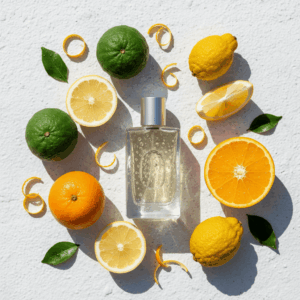
Hesperidics, such as lemon, bergamot, orange, or grapefruit, give the first impression to the perfume, also called “the smile,” or “the flight” and providing fresh and tonic scents.
Hesperidic notes are composed of citrus fruits and should not be confused with fruity notes, which are based on peach, apple, pear, and red fruits, among others (cf. Fruits). Fruity notes provoke a different “olfactory effect” in the fragrance.
Origin of the Name “Hesperidic”
The hesperidics take their name from the three nymphs, daughters of Atlas and Hesperis charged with watching over the garden of the gods. This fabled orchard hid within it golden apples (oranges) which represented immortality and fertility, fiercely guarded by the hundred-headed dragon, these hesperidics that Heracles later stole.
This Greek legend gave the name to the hesperidic facet. The latter groups together all citrus notes with such characteristic freshness and dynamism. This facet can also bear the name “Citrus” in other classifications. Citrus notes are all produced from the essential oil contained in the zest of the fruits.
The Hesperidic Facet and Its Citrus Fruits
Here are the main citrus fruits used in perfumes belonging to the hesperidic facet:
Bergamot
The name “bergamot” is said to come from the Turkish “beg-armûdi” meaning “lord’s pear.” It is also said that bergamot takes its name from the city of Bergamo where it was originally cultivated.
This citrus comes from the bergamot tree, a tree that has been cultivated for 600 years in Calabria (in the region of Reggio di Calabria), in southern Italy. It produces bergamots, fruits with greenish, almost yellow skin.
The pulp is not consumed because it is too bitter, and only the zest of bergamot is used in perfumery. This fruit comes from a natural cross between the lemon tree and a bitter orange tree.
The zests of fresh, almost ripe bergamots are extracted cold, using huge presses. The juice of the bergamots, qualified as essence or essential oil, is then rejected from these presses (called machina). The product obtained is dark green, its smell is delicious and very faceted (cf. Expression).
This essence will then be treated and its color will change from dark green to pale yellow. Phototoxic components, such as bergaptenes, tended to cause numerous stains on the skin (especially when the essence had been incorporated into solar products like Bergasol) (cf. Perfume for Summer).
Now, these bergaptenes are removed from bergamot essence, and from all other citrus fruits. Note that to produce one kilo of essence or essential oil, 1,500 kg of fruits are necessary.
Bergamot is called the fine flower of hesperidics. It possesses an extremely elegant, faceted, and fruity note. Its note is also green, slightly floral and acidic, even bitter, but also sweet and round.
It is the Mediterranean citrus par excellence, symbol of freshness, whose smell is fruity, floral, tangy, sweet, and explosive at the same time. Bergamot is the perfumer’s favorite note and its smell is a perfume in itself. However, as with any natural product, its quality depends on how it was cultivated, treated, and blended.
It is also possible to isolate the main constituents of bergamot (synthetic molecules) in its effluvia (linalyl acetate and linalool), which give it a very fresh note, common to lavender.
The name bergamot is said to come from the Turkish “beg-armûdi” meaning “lord’s pear.” It is also said that bergamot takes its name from the city of Bergamo where it was originally cultivated.
Bergamot is also used in other products: bergamot candies are the specialty of Nancy and certain scents of Earl Grey tea benefit from these delicious aromas. The skin of this citrus was also widely used in the 18th century for the creation of sumptuous decorated boxes, which can be admired at the International Perfume Museum in Grasse.
The Communelle
A communelle is a judicious blend of different batches of a natural essence, creating a “standard” with a very precise smell. This allows, first of all, to obtain a strong identity, to give an olfactory seal to perfumes and also to ensure, from one year to the next, a constant and homogeneous quality.
The buyer of raw materials and the perfumer can select green citrus or riper citrus in these communelles. The scent of the blend will therefore be quite different depending on the selection made. Furthermore, many communelles come from fruits bought from different growers who own plots in Reggio di Calabria.
Shalimar by Guerlain, the “great oriental,” contains 30% bergamot in its formula, contrasted with oriental scents (cf. The Oriental Family) and sensual notes (vanilla notes, resins, incense, opopanax).
Sweet Orange
Sweet orange, native to China, comes to us today from Florida and Brazil. Its scent is exactly similar to that of orange juice. It is the most cultivated citrus fruit in the world and 60% of orange juice production, as well as orange essence, is provided by Brazil in the province of San Paolo. It is a booster that wakes up the nostrils. Sweet orange is used on different supports.
Bitter Orange or Bigarade Orange
Bitter orange, called “bigarade,” is more faceted than sweet orange; it comes from a tree, the bitter orange tree, found in Tunisia or Italy. Its scent is linked more to its skin than to its pulp. Three other products are born from this magical tree: petitgrain (which often comes from Paraguay) and in floral notes, neroli and orange blossom absolute.
Mandarin
Mandarin is a very sunny hesperidic note. This citrus possesses more character than bergamot. It is also more bitter and greener. This note is also more striking because its scent is impregnated with the peel of the citrus fruit. Finally, mandarin brings a big smile to the perfume. It possesses a characteristic medicinal nuance, and thus truly signs a composition.
There are different varieties of mandarins: the first essence is called green, then yellow, and finally red. This citrus is native to China; its name is said to come from the color of the robes worn by mandarins and was introduced to Europe much later than the orange tree. Mandarin is mainly present in Italy and Brazil.
The name Tangerine given in the USA is said to come from the city of Tangier, in Morocco where cultivation is intensive.Mandarin essence is obtained in the same way as bergamot, by expression: the skin is crushed by machines that harvest the precious nectar it contains.
Mandarin is a very present note in the perfume L’Instant De Guerlain, developed with perfumer Maurice Roucel and created in collaboration with Sylvaine Delacourte. This feminine perfume with exotic white flowers is composed of jasmine, tuberose, magnolia, with a sensual and oriental base consisting of vanilla notes (created with benzoin resin), and sandalwood.
Mandarin blends particularly well with white flowers, especially orange blossom.
The name “mandarin” originates from China: the fruit was formerly offered as a gift to Mandarins during festivals.
Clementine
This citrus used in hesperidic perfumes has a scent very close to that of mandarin. Brother Clément, a White Father native to Algeria, succeeded in creating a sort of seedless mandarin, hence the name clementine. The scent of clementine is also juicier than that of mandarin. It is a cross between mandarin and orange. Juicy, sparkling, it blends well with certain fruity notes.
Yuzu
Yuzu is a small Japanese yellow lemon, very expensive, even when bought locally. There are few yuzu productions and only a few niche brands can use it naturally in their fragrances.
Indeed, Japanese yuzu production could not support a large international launch. Consequently, some brands can only use a “reproduction” of the citrus.
Yuzus are exquisite and complex citrus fruits. They possess a multi-faceted scent, comparable to a mixture of several citrus fruits, with the mandarin note as dominant. This is a distinguished scent.
In Japan, yuzu is also used in teas, finger bowls, and sorbets, to garnish sashimis, or even to relax in a hot bath.
Lime
Lime is a small lemon with green and smooth skin, whose perfume nevertheless evokes a yellow-orange color. It has the particularity of recalling the taste of Coca-Cola. You have surely already tasted it in certain dishes, or in the famous caïpirinha.
This citrus possesses relief and character. Once its detergent facet is tamed, it subtly dresses the freshness of hesperidic compositions.
Mexican lime, called green lemon, lime, or key lime, is the most cultivated fruit in Mexico. There are several kinds of lime trees, and the main lime-producing countries outside this country are Brazil, Peru, and Haiti.
Lime is the only citrus whose essence is created by distillation, but it is also possible to obtain it by expression. Finally, it is a citrus that is particularly suitable for men’s perfumes. In the fragrance Guerlain Homme with its Mojito accord, lime blends very well with vetiver (cf. The Woody Facet).
Green lemon blends particularly well also with mint, blackcurrant, a vibrant wood like patchouli; it acts “like a ray of sunshine” on the composition.
Lemon
The origin of lemon is found somewhere between southern China and India; it was introduced to the Mediterranean basin during the Arab invasions in the 10th century. This citrus gives a very acidic and fusing citric note.
The lemon note is also rising, tonic, and lively. Lemon is celebrated every year during the Menton Lemon Festival in February. It comes mainly from Argentina but also from Spain, USA, and Italy.
Citron (Cédrat)
The citron comes from a tree called the citron tree. Very close to lemon, this citrus has thick skin and possesses a marked acidity, but finer than the scent of a lemon. Citron comes from Morocco, Tunisia, Italy, Corsica, and China. Furthermore, this citrus is more often used in cosmetics than in perfumery.
Verbena
Verbena is a plant and not a citrus fruit, yet it gives a charming note, both lemony and airy. A note in the same register: Litsea cubeba.
In perfumes, citrus smells can be brought by other naturals, this is the case of verbena (see above), ginger (fresh spice) can reinforce the tonic and fresh start of a lemon. Lemongrass can reinforce the tonic side of a cologne, lavender can also support bergamot in heart notes.
Pomelo or Grapefruit
This citrus is the result of a hybridization between pomelo and sweet orange. Florida is the largest producer of grapefruit. Little used as a natural product in hesperidic fragrances, perfumers often associate grapefruit with vetiver, or blackcurrant.
Grapefruit marries particularly well with the rhubarb note, also with white flowers.
Fragrances of the Hesperidic Family
There are a large number of fragrances with a hesperidic facet. This is particularly the case for many classic and modern Eaux de Cologne, mixed fresh waters, and many feminine perfumes.
Classic Eaux de Cologne
Hesperidic notes have very often been used accompanied by aromatic notes (cf. The Aromatic Facet) and neroli in the first scented compositions, which were Eaux de Cologne. There is no official version on the exact origin of the name Eau de Cologne; for some, the first Eau de Cologne was marketed by Paolo Feminis who brought it back from Cologne (recipe for Aqua Mirabilis) and bequeathed it to his nephew Johann Anton Farina.
For others, the true Eau de Cologne was created by Giovanni Maria Farina and Feminis would be just a myth. Difficult to draw a conclusion, both theories are plausible.
Here are some references of classic Eaux de Cologne with a hesperidic facet:
- Eau Impériale Guerlain
- Eau du Coq Guerlain
- Eau de Cédrat Guerlain
- Eau de Cologne Roger Gallet
- Eau de Cologne 4711
- Eau de Cologne Chanel
- Eau de Cologne Dior
- Blenheim Bouquet Penhaligon’s
- Colonia Acqua Di Parma
- Agua Lavenda Puig
Modern Eaux de Cologne
Regarding modern, more tenacious Eaux de Cologne, we can cite the Mugler Colognes: Come Together as well as L’Eau de Cologne du Parfumeur by Guerlain, Cologne Bigarade and Cologne Indélébile by Frédéric Malle.
Mixed Eaux Fraîches
Eaux fraîches are often, in their classic scheme, dressed in base notes with warmer compositions such as chypre accords (cf. The Chypre Family), woody or fougère, or patchouli (cf. Woods), oakmoss, or even tonka bean (cf. The Gourmand Facet).
Here are some references of mixed Eaux fraîches with a hesperidic facet:
- Eau Sauvage Dior
- Eau pour Homme Armani
- Eau Guerlain
- Ô Lancôme
- Eau Hermès
- Eau d’Orange Verte Hermès
- Eau Cartier
- Eau Givenchy
- Les Eaux Fraîches Roger Gallet
- Les Eaux de Politesse Serge Lutens
- CK One Calvin Klein
- Light Blue Dolce & Gabbana
- Paris Venise Chanel
- Paris Biarritz Chanel
- Paris Deauville Chanel
- Les Aqua Allegoria Guerlain
- Chance Chanel
- Eau de Soleil Blanc Tom Ford
- Neroli Portofino Tom Ford
- Les Escales Dior
- Les Jardins Hermès
- Les Eaux de Cologne Atelier Cologne: Orange Sanguine
- Citron Noir Hermès
- Yuzu Man Caron
- Dimanche à la Campagne Guerlain
- Bronze Goddess Estée Lauder
Classic Perfumes, Eaux de Toilette, and Eaux de Parfum
Here are some classic perfumes, eaux de toilette, and eaux de parfum possessing a very significant hesperidic facet:
- Chance Eau Vive Chanel
- Chance Eau Fraîche Chanel
- Shalimar Souffle de Lumière Guerlain
- Eau Fraîche Addict Dior
Conclusion
The hesperidic facet can finally be qualified by its sparkle, its smile, its cheerfulness, its vibration, but also by the energy and dynamism it brings to fragrances.