Saffron or Red Gold in Perfumery: A Precious and Leathery Spice
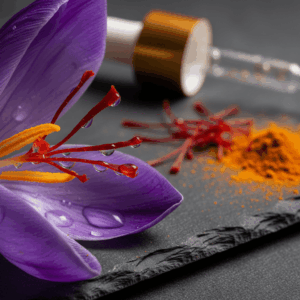
Saffron or Red Gold of Persia is the most expensive spice in the world. Its use dates back to the dawn of time, 1500 BC in ancient Greece, and it is coveted for its singular perfume.
It is used as a spice in cooking but also as medicine, as a dye, or in cosmetics. Saffron indeed also has the power to spice up perfumes.
History and Mythology
Saffron was discovered in frescoes on the Greek island of Santorini, in the excavations of Akrotiri, dating back to 1500 BC. But long before that, traces of saffron are found in pigments discovered on prehistoric paintings 50,000 years old.
It is said in Greek mythology that Hermes wounded one of his friends; three drops of blood then fell on the ground, and at that spot appeared a magnificent mauve flower, whose heart was provided with 3 red pistils. Saffron then became a symbol of resurrection.
Saffron was present in the formula of the famous perfume Kyphi, the first known eau de toilette in the world. Cleopatra used saffron in her bath to give a lovely tint to her skin. Saffron is also used in offerings to Buddha.
Its presence can also be noted in the Song of Songs. Saffron was also used in recipes for preparing products against the plague.
Origin, Botany, and Harvest
Botanical Name of Saffron: Crocus Sativus
Family: Domestic Crocus
Its origin is rather Mediterranean, certainly originating from Crete. The Greek term Krokos meaning filaments would have given the name crocus. It is a bulb plant whose flowers can bloom in a single day. They are usually harvested in the morning, at the end of autumn, so that the petals remain well closed.
The three red filaments of saffron, from the Persian Za’Faran, will then be delicately removed, during an operation called pruning (émondage). Then these precious pistils will be dried in a ventilated room. The pistil, the female reproductive organ, consisting of 3 stigmas per flower, is the only part consumed.
The low yield of its cultivation, the fact that its harvest, then pruning are done manually, explains its expensive price of 20,000 to 40,000 euros. It takes nearly 150,000 to 200,000 flowers to obtain 1 kg of saffron pistils or stigmas.
Producing Countries
The countries that harvest saffron are, in order of importance, Iran (60 tons per year), Spain, India, Greece, Morocco, and Italy.
In France, there are more and more initiatives, in the south of France, in Aveyron. There are even saffron cultures in Paris on the roofs of large buildings. I was lucky enough to be invited by the company Bien élevées founded by 4 sisters. I was able to harvest, then prune the saffron pistils, and I realized how delicate the various operations were.
Before leaving this magical place, we tasted a saffron herbal tea accompanied by saffron-flavored madeleines, a delight! Their saffron harvest is sold in Monoprix stores.
Warning: One must be very careful, because many qualities of saffron are falsified, mixed with other products, hence the importance of buying pistils or filaments alone and not buying saffron powder.
Properties and Cuisine
This spice is recommended as herbal tea to help digestion. It protects the liver and helps fight cholesterol. It fights colds, soothes coughs, and is also used in massage cream to soothe pain. Saffron makes its appearance in cosmetic creams for its antioxidant, anti-wrinkle properties.
It is widely used in cooking, perfect with fish, in couscous but also in risotto alla Milanese and in numerous Italian dishes.
Saffron in Perfumery
Natural saffron is not authorized in perfume because it contains safrole, which is a component that causes allergies. The olfactory constituents of saffron are safranal and lanierone.
The raw material authorized in perfumery is safranal, the olfactory principle of saffron and isolated from the raw material. Safreine developed by Givaudan is a synthetic molecule.
Olfactory Description
It is a dark, leathery, spicy note, with tarry effects, with a small honeyed touch. A scent often found in masculine perfumes, but sometimes also in feminine perfumes.
It is a striking, assertive scent, rather a base note; it often accompanies woody perfumes, worked with woody notes of oud wood, very common in Middle Eastern perfumes.
Saffron or safranal can accompany leathery, oriental, chypre, gourmand, woody notes, possibly floral notes with character like iris, rose, violet.
It is a note that can accompany citrus notes like orange for example; the perfumer’s talent will then be important to calm the ardor of this spice. It can accompany other spices like cinnamon, clove, pepper etc.
Perfumes Containing Saffron
Here finally is the list of fragrances and perfumes containing saffron:
- Saffron by Jo Malone
- Safran Troublant by L’Artisan Parfumeur
- Black Saffron by Byredo
- Eau de Néroli Hermès
- Al Oudh by L’Artisan Parfumeur
- Safran Nobile by L. Loison
- Rose Safran L’Occitane
- Crystal Saffron Matière Première
- Bois Corsés Diptyque
- Ambre Safrano BDK