Tonka Bean in Perfumery: Magic Seed and Coumarin
It is a magic seed with multiple facets; it is a vanilla and gourmet note. You will learn everything about this seed, as well as its main constituent, coumarin, a product isolated from the tonka bean and reproduced synthetically, widely used in perfumery since always.
The Magic Seed: Botany and Origin
Tonka bean is found in South America and particularly in Venezuela, Guyana, Mexico, and Brazil. It comes from the fruit of a tropical tree called Dipteryx odorata. It is also called coumarouna, coumaru, Cayenne guaiac, or sarrapia. The same name is used for the tree, coumarou, which yields the fruit of which the bean is actually the seed.
It grows along the banks of Amazonian rivers. 20 to 30 m high, it has a red trunk, a kind of teak, 50 to 70 cm in diameter, large leaves reminiscent of walnut leaves, and quite fragrant flowers as soon as the fruits are ripe.
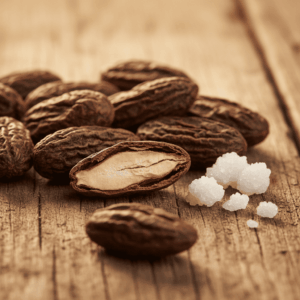
Its fruits are shaped like a large almond and each contains a unique black seed, oval, oblong, shiny, which wrinkles as it dries. It is then that it begins to smell and its perfume will intensify.
Harvest and Processing (The Job of Sappapiero)
Papilionaceous type flowers turn from white to pink and give way to fruits which, when ripe, mostly fall to the ground. The harvest takes place in May. Ripe fruits fallen on the ground are collected. They are dried for a year and the shell is broken either with a stone or with a hammer to extract the seeds.
The recovered beans are then sun-dried, then immersed in containers with 65° strong alcohol for 24 hours. They are then air-dried, which causes a beautiful white frosting, resulting from the appearance of coumarin crystals.
A tree yields between 15 and 75 kg of fruit per year. The person who harvests tonka beans is called a sappapiero. Annual production varies between 60 and 100 tons; this depends strongly on the climate.
Scent and Chemistry: Coumarin
The scent of tonka bean is multi-faceted, vanilla-like, tobacco-like, gourmet, almondy, woody, with scents of gingerbread hay and pistachio.
The main molecule of this raw material is called coumarin. The tonka bean contains 46% coumarin, which is olfactorily very almondy and strongly resembles the smell of small pots of Cléopâtre glue from our childhood. The younger generation, alas, does not know this scent, because the smell of school glue is now very different.
Coumarin gives off a warm, gourmet perfume, with hay, tobacco, and pistachio accents; it is a very tenacious base note.
Discovery and Synthesis
In 1856, chemists Friedrich Wöhler and Justus Von Liebig discovered coumarin in tonka bean seeds. In 1868, English chemist William H. Perkin succeeded in synthesizing it.
The tonka bean contains 46% coumarin, but you can find it in lesser quantities in the Liatris plant (25%), also in sweet vernal grass (8%) and cinnamon (0.45%). It is considered allergenic by IFRA regulations, so it is part of allergens.
Its percentage is limited to 1.5% in the finished product. Coumarin comes in the form of a white powder. Coumarin is composed of a lactone and an ester group.
History: The Birth of the Fougère Family
In 1882, perfumer Paul Parquet used coumarin in Fougère Royale by Houbigant. This perfume would be at the origin of a new perfume family, the fougère family.
The synthesis of coumarin was developed in 1868 and was used, as well as linalool and ethyl vanillin, in Guerlain’s Jicky perfume. The latter also belongs to the fougère family. Tonka bean, which is gourmet, also suits oriental, or floriental notes well.
Multiple Uses: Cooking, Tobacco, and Pharmacy
Locally, inhabitants use it to treat certain infections; it is a product with tonic properties, also an anticoagulant. Initially, these seeds were reduced to powder sold in sachets to be placed in wardrobes between piles of linen.
In perfumery, it is the bean that is treated by volatile solvent extraction to give tonka bean absolute.
In cooking and baking, the bean itself can also be grated just like nutmeg to be used associated with chocolate (in a dark chocolate ganache for example), coffee, cakes, and desserts (panna cotta).
It can also be associated with salty notes to release its aromas and flavors. Be careful to use it, like nutmeg, in reasonable quantities because tonka bean can be a bit dangerous in high doses.
To scent snuff and also Amsterdamer pipe tobacco, a practice now banned in France and the United States. I like to slip tonka beans into my car near the heater; it’s a delight.
Perfumes Containing Tonka Bean
Here is the list of perfumes that contain tonka bean:
- Guerlinade by Guerlain (cf. Guerlinade)
- Jicky by Guerlain
- Shalimar by Guerlain
- L’Heure Bleue by Guerlain
- Samsara by Guerlain
- Mon Guerlain by Guerlain
- Vétiver Tonka by Hermès
- Tonka by Le Labo
- Code by Armani
- Lion by Chanel
- Le Mâle by Gaultier
- Hypnose by Lancôme
- Hypnotic Poison by Dior
- Fève Délicieuse by Dior
- Allure Homme by Chanel
- Tonka by Réminiscence
- Vahina by Delacourte Paris