Visit to Maison Guerlain: A Journey into the Heritage of 68 Champs-Élysées
For a weekend between October 5th and 16th, 2011, the doors were opened to reveal the secrets of our heritage and our know-how. With “Scented Tales” workshops for adults and children, conferences were held by Thierry Wasser, Olivier Echaudemaison, and Sylvaine Delacourte, followed by a tour of the boutique and the institute.
The History and Architecture of 68 Champs-Élysées
The House of Guerlain was created in 1828. Pierre François Guerlain built his first factory at Place de l’Étoile where he manufactured skincare, makeup, and perfume products.
The building housing the Guerlain boutique and spa was built in 1914 by Charles Mewes, to whom we also owe the Ritz hotels in Paris, London, and Madrid. In addition to the ground floor boutique, it housed the apartments of several family members.
Maison Guerlain comprises three levels, totaling more than 600 m2. The ensemble is listed in the supplementary inventory of Historic Monuments as a noteworthy 20th-century luxury business.
This boutique has changed very little since its creation. It is the third boutique, the first being on Rue de Rivoli in 1828, located on the site of the current dining room of the Hotel Meurice, then the second on Rue de la Paix in 1841. We currently count 15 exclusive boutiques in Paris.
It consists of no less than 17 different marbles, all from Carrara, Napoleon III friezes, and marble counters surmounted by displays signed by Andrée Putman.
The Ground Floor: The Soap Cabinet
Here is a very particular piece of furniture, which in fact only exists in this boutique; it is a soap cabinet, unique of its kind. Guerlain was a great creator of soaps, and this cabinet was designed so that customers could smell the one that interested them.
Each box is made of tin, known to keep the scent intact. We have placed on this cabinet some old soaps called Sapoccetti. They were wrapped by hand and sold in boxes of three. Jacques Guerlain liked to sit near this cabinet when he went to the shop to have clients smell his latest projects.
Upstairs: The Gold Ribbon
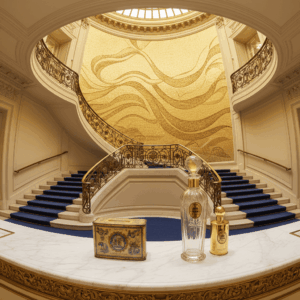
The staircase leads you to the upper floor, called the mezzanine, and already you can glimpse the fine gold mosaics. You arrive at the upper level of the mezzanine, and there, the astonishing gold ribbon composed of 350,000 tesserae gilded with gold leaf, created by Maxime d’Angeac, offers itself to your eyes.
Guerlain Makeup: A Historical Epic
The first piece presented is an adorable Paris porcelain pot from 1840 containing solid lip color called Roselip which was applied with the finger. In fact, at that time, lips and cheeks were colored with the same product and discretion was required. Later in 1914, women would find at Guerlain a very fixative product for the lips: rose extract for lips.
The Lipstick Revolution
But Guerlain’s great innovation was inventing, in 1870, the first bullet-shaped lipstick as we know it today.
Like his ancestors who were pewter potters, and to whom we owe the conical mold for casting candles, Pierre François Pascal worked the lipstick material so that it adopted the bevelled shape with the tube protecting it.
This first lipstick was called Ne m’oubliez pas (Forget me not). We present here its version from the 30s, because the first version is part of an exhibition currently in China. The shape is identical, the material too, but its size is slightly larger.
Lipstick would become the fetish product of the Guerlains, their makeup flagship. Exposed today are not the entire collection but key pieces, always beautiful and sometimes amusing.
- Thus this Rouge d’Enfer which was the subject of a patent in 1924 because the closing of the cap depended on its two small chains. Very representative of the Roaring Twenties.
- It was followed in the 30s by Jeu de Dames, which was all the rage in the USA where it was exclusively marketed.
- At the same time, here is a fun new lipstick with its refills of tiny sheets of paper to fix the red on the lips.
- Always ahead of their time, the Guerlains designed an incredible Rouge Automatique with sublime mechanics because it was refillable—you can see a refill, by the way—and with slender architecture reminiscent of American buildings of the 30s. This year Olivier Echaudemaison, our artistic creator, was inspired by it to design this automatic lipstick in very numerous colors.
Then lipstick experienced a new boom in the 70s with this striated gold packaging which heralded 30 years later the creation of Kiss Kiss designed by designer Hervé van der Straeten.
Note also that lipstick has always been a tool of seduction and sometimes even worn like a jewel. As demonstrated by the lipstick created by jeweler Boucheron for Guerlain in the 30s with its gold case and the Kiss Kiss Gold and Diamonds of the 2000s made exclusively to order like its 25 custom-created shades.
Next to it arises the beauty of Rouge G designed by jeweler Lorenz Bäumer in 2009. This lipstick combines both the beauty of the object and technical prowess, with a built-in mirror.
Eye Makeup and Kohl
After the mouth, the eyes. In the mid-19th century, eyes were practically not made up. Makeup was reserved for actresses and demi-mondaines. In any case, it had to remain discreet.
This did not prevent Guerlain from designing the Pyrommée in 1840, freely inspired by oriental Kohl. This attraction to the Orient is also found in perfumes, and the current Terracotta Kohl is also an interpretation of this famous Kohl found around the Mediterranean basin.
Eye makeup would become, over the years, an important element for women’s beauty. Collections followed one another and today we present liquid eyeshadows from the 30s and the latest six-color case designed by Linda Madhavi last year.
The Art of Complexion and Powders
Powders were also the first makeup products created by Guerlain. In the 19th century, makeup had to be discreet, not to say invisible. But it was fashionable to dare a little red on the cheeks and not to shine. It was around the middle of the 19th century that Guerlain developed ranges of blush and powders.
This work on the complexion would become a trademark for Guerlain, who would never cease offering powders and especially foundations that were increasingly high-performance while remaining necessarily invisible.
Let’s go back in time to the first solid blushes on mortar from 1840. They were first in Paris porcelain, they were then named Chines and made of green glass decorated with fine gold.
Their names are also evocative of an “elsewhere” in vogue in this mid-19th century, Rouge de Carthame, Rouge de Damas. Later in 1914, customers adopted Rose du Moulin which you see here in its adorable box.
But the complexion at that time was, as I told you, mainly based on powder. Since the 18th century, women lived in a cloud of powder whether on wigs but also on the face and body to sometimes mask dubious hygiene.
Guerlain offered several, some of which became true references like Ladies in all Climates in 1890—note the modernity of the name—and the Poudre aux Ballons of 1918 whose iconic box features the illustration of the first Guerlain factory located at the Barrière de l’Étoile.
But the one that marked its era is the powder C’est Moi scented with the great extracts of those 20s like Mitsouko or Shalimar. You can see on the drum of the beautifully decorated box the sovereign, Louis XIV, who inspired it, in his dazzling symbolism.
The tiny box served as a sample. The adventure of powder would continue with exceptional creations, which would mark the world of makeup.
The Terracotta and Météorites Saga
Every woman knows Terracotta, this bronzing powder invented in 1984. The Guerlains, always ahead of their time, sensed before everyone else that makeup should be easy, fast, and that the tanning trend would intensify.
Terracotta, so often copied but never equaled, is enriched each year with new creations, improves the quality of its texture, offers new shades. And in the wake, men were not forgotten with the creation in 1987 of Terracotta for Men, considered the first male makeup.
Terracotta is therefore a story that continues to make people dream, just like Météorites created in 1987, this loose powder presented in the form of small balls of different colors. Each color has its own function like pink to give a healthy glow, green to hide imperfections.
To manufacture this powder which did not exist, Guerlain engineers had to design a round-shaped machine in which the powder, dye, perfume, and water are mixed. An assistant stirs the ingredients by hand to obtain balls of uniform size.
The boxes are inspired by a box that belonged to Catherine de’ Medici and which can be seen at the Louvre Museum. They are still filled by hand and weighed individually.
Foundation
But no beautiful complexion without an irreproachable foundation. Guerlain endeavored to develop foundations that were increasingly fluid and discreet. From the covering Issima in the 80s to Lingerie de Peau in 2010, what a long way we have come; the new generation foundation is no longer seen, it belongs to the intimate domain like the skincare products that I invite you to discover now.
Many advertisements were created by great poster artists like Darcy, Cassandre, or Nikasinovitch for the oldest ones and photos by Giovanni Gaster or Paolo Roversi for more recent advertisements, notably that of Shalimar.
Guerlain Skincare Products: Tradition and Innovation
In his first boutique on Rue de Rivoli at the current location of the Hotel Meurice dining room, Guerlain enjoyed immense success with the European aristocracy, not only for his perfumes and makeup but also for his skincare and hygiene products as innovative as they were effective.
People snatched up his bear grease cream which seemingly had the power to stop hair loss. Pierre François Pascal went to Russia himself, on foot and by stagecoach, to buy this precious commodity.
He did not hesitate, moreover, to crisscross Europe in search of natural ingredients like rose, iris, cucumber, and many others that would compose his perfume, makeup, and skincare creations.
In the same spirit of offbeat creations, there was the toothpaste opiate to whiten teeth. There was even a product to make hair and beards stand up.
As for Baume de la Ferté, from 1870 it protected the breasts of wet nurses for nearly a century before being converted into lip protection against the ravages of the cold. This product, whose formula based on Bordeaux wine tannin with added benzoin resin remained unchanged, is still sold.
Let’s not forget the Iris body powder of 1860 which was used on the body and hair and Rosat oil for Nails. But Guerlain gradually abandoned these so-called hygiene products to devote itself specifically to skincare.
Thus, Empress Sissi, whose porcelain complexion delighted court painters, used only the famous strawberry cream designed in 1840 to protect and whiten her complexion. The very idea of whitening the skin would be the basis of whitening treatments widely used nowadays in Asia.
Still in the 19th century, products linked to nature were in vogue as you can see here with rose milk or cucumber milk which remained fashionable for nearly a century. Noblesse oblige for a perfumer, all creams were slightly scented with rose or violet and this spirit of perfuming remains current.
Moisturizing Cream and Innovations
After Nivea created by Guerlain, a fairly similar formula, the cream Secret de Bonne Femme in 1904, the first moisturizer on the cosmetics market, product names were no longer as explicit. Beaten and filled by hand, this cream had an exceptional longevity of nearly a hundred years.
Designed like whipped cream, it did not withstand air travel, because like a soufflé its texture did not resist pressurization. It was the leader of many creations around hydration like Cremalbat in its black pot from the 20s, or later the super nourishing cream or the Super Aqua line.
Anti-Aging Care
From 1987, Super–Aqua Serum imposed the idea that hydration is the first anti-wrinkle weapon. A cult product and bestseller for 25 years, its formula is a perfect symbiosis between fluidity, the effectiveness of a serum, and the extreme comfort of a cream. It is still unequaled on the market.
Then, the 50s saw the development of anti-aging care, the first of which was Emulsion d’Ambroisie, presented in a curious pot shaped like an egg cup which allowed the cream to be protected from air and therefore oxidation.
This ancestor of serums was followed by a long line of which the latest born, the Orchidée Impériale Longevity Serum of 2011, demonstrates not only the strong technological development in cosmetics but the research in terms of packaging, with an airtight pack, an upside-down gesture like Emulsion d’Ambroisie and patented.
It was in the 70s that skincare and makeup products became increasingly important in Guerlain’s history so that in 1974 a factory located in Chartres was entirely dedicated to them. This creation allowed tackling with strength and power the crucial years that were the 80s.
Guerlain then offered premium anti-aging care with the Issima line which was enriched over the years with various recognizable products in their blue pot designed by sculptor Robert Granai reminiscent of the shapes of a spaceship.
As you may have realized, since 1828, Guerlain has drawn inspiration and ingredients from Nature to formulate excellent skincare. Today, Guerlain research goes even further in its research on anti-aging and focuses on the most prodigious phenomena of nature which it studies with a high level of science through dedicated scientific platforms.
Rare orchids with prodigious longevity, capable of keeping their beauty intact for up to 200 years, bee products with healing power, natural pearl with whitening action, Guerlain research studies, selects, and assembles unique know-how.
The Orchid and the Bee
Take the example of the orchid. Ten years ago, Guerlain created a multidisciplinary research platform called the Guerlain Orchidarium with three centers headed by the most eminent experts:
- The Experimental Garden in Switzerland is an orchid library housing the collection of more than a thousand Guerlain orchids, of 80 species from around the world.
- The Fundamental Laboratory in France allows deciphering their biological properties.
- The Exploratory Reserve in China, more precisely in the Yunnan region where precious Guerlain orchids are protected and cultivated in their wild environment.
There are more than 30,000 species but for its Orchidée Impériale skincare line, Guerlain selected the Vanda Teres and the Vanda Coerulea which means 10,000 generations in Chinese that you see here.
It lives in the shade of treetops, managing the absence or abundance of water, while the Teres flourishes in the sun while being able to manage thermal shocks. Each implements its own survival molecules.
After the orchid, the bee, architect of life and at the origin of products like honey, royal jelly, and propolis which are among the best natural healers in the world. This is why Guerlain research has focused on studying and analyzing the close link between the bee, its productions, and its ecosystem.
This led it, among other places, to the island of Ushant (Ouessant) where the purest honey in Europe is produced and which enters into the composition of the Abeille Royale range.
Whether Super Aqua Serum, Orchidée Impériale, or Abeille Royale, these ranges are all worthy heirs to the Guerlain know-how acquired over these 183 years.
Guerlain Perfume Bottles: Masterpieces of Glass
The famous Bee Bottle of Eau de Cologne Impériale created for Empress Eugénie in 1853. This creation earned Pierre François Pascal Guerlain the envied title of supplier to the imperial court. This bottle is still present in the catalog and you can personalize it by replacing, for example, the label with a date or initials, and fill it with all the fragrances in the catalog, of course to order.
Since 1853, the bee has become our symbol and is found on certain creations as you could see with the Abeille Royale cream.
Here is the new bee with gold wings from 2011 presented in its Baccarat bottle and published in 55 copies. Last year the bees had crystal wings. The fragrance, of course, is different each year.
This bee also inspired a talented gemologist who designed this extraordinary scented jewel. An exceptional jewel that brings together three skills: that of the watchmaker, the perfumer, and the jeweler. It is worn as a clip or necklace; just press the pear diamond for it to deploy its wings and its perfume. It is called the Secret de la Reine.
We have selected the bottles that seemed to perfectly evoke the magical world of Guerlain in a few minutes:
- Created by Baccarat, the Turtle (Tortue) which housed the Parfum des Champs Elysées, celebrated the opening of the boutique in 1914. The story goes that the Guerlains, unhappy with the delay in the work led by architect Charles Mewes, wanted to make fun of him, and decided to choose the slowest animal on earth.
- Still in the bestiary register, you have the so-called Snail (Escargot) bottle which housed the perfumes Mouchoir de Monsieur and Voilette de Madame in 1904. Jacques Guerlain created them for a couple of friends who were getting married and with their agreement marketed them a few years later. While Voilette has disappeared, Mouchoir de Monsieur is still present in our boutiques.
- The small Duck (Canard) bottle dated 1928, of which only three copies are known in the world.
Jicky and Modernity
But the most important creation for perfumery in general is that of Jicky in 1889. To understand Jicky well, it is important to situate oneself in the context of the time. At the end of the 19th century, Europe, particularly France and Great Britain, was in full industrial revolution. Photography was developing, transport was changing rapidly with the appearance of the train, the car, and soon the plane.
It was during this period that a new way of conceiving nature was born in literature, music, and painting. The artist no longer sought to capture the resemblance in it but to focus, for example, on changes in light, like the Impressionist movement.
Aimé Guerlain, like his father and later his nephew Jacques, was passionate about the arts in general and his circle of friends consisted of painters, musicians, but also scientists.
When he created Jicky, he did not want to reproduce a simple smell as his father Pierre François Pascal did with his extracts of gardenia, rose, or jasmine. He therefore decided to add to his formula composed of many natural products a few synthetic raw materials called: coumarin, vanillin, etc.
This is why Jicky is qualified as the first modern perfume because from its creation, perfume became conceptual and no longer figurative. It was about arousing emotion as a painting can.
If Jicky is an olfactory work of art, you can see beside it, Bouquet de Faunes in its superb and rare bottle signed by Lalique in 1922 and admire the crystal work whose stopper is surmounted by pewter rivets.
Jacques Guerlain was the greatest collector of Impressionist paintings; here is a perfume created in homage to Diaghilev, the creator of the Ballets Russes in 1937. This sumptuous blue Baccarat crystal bottle covered with gold leaf represents a bow tie (Nœud Papillon). Beside it, another blue Baccarat crystal bottle from 1922 whose neck and stopper are lacquered gold while the motifs are painted with fine gold.
Let’s stay in blue, which is one of the House’s fetish colors, with this latest creation for Christmas, Shalimar: Midnight Blue. A superb realization in Baccarat crystal of the Jicky bottle for one of our iconic perfumes, Shalimar created in 1925 and whose success has never wavered. This bottle will be published in 30 copies.
Then you have the amazing LIU in its black Baccarat bottle created in 1929 in homage to China and which represents a Chinese tea caddy that belonged to the Guerlain family. Liu being the name of the Chinese slave in Turandot, Puccini’s opera. The perfume Liu is still sold in the “Parisiennes” collection.
And to remain in the exceptional, a so-called Moorish (Mauresque) bottle decorated by hand, which was created to order with the choice of motif of course as well as the perfume. The so-called Butterfly (Papillons) bottle in opaline from Baccarat which housed several perfumes in the 50s like Shalimar, Mitsouko, or Vol de Nuit.
Raw Materials and the Guerlinade
Since its creation, Guerlain has always composed its perfumes around natural raw materials. With Jicky we introduced synthesis. But the latter never replaces nature. We use it because it gives power to creations and also because it opens up an incredible field of smells.
It can also recreate perfumes like those of violet, lilac, or peony which do not yield their secrets to perfumers.
The Guerlain creator, today Thierry Wasser, travels the whole world to acquire the most beautiful raw materials. Like his predecessors, Thierry Wasser goes to market and meets producers to obtain the best quality and to work with them on the best extraction or distillation method. This scent explorer goes:
- In January to Calabria for bergamot.
- In April to Tunisia and also to Calabria for orange blossom.
- In June to Bulgaria for rose. Autumn is devoted to vetiver and jasmine in India.
Rose has always been the fetish flower of Guerlain creators. From the Centifolia rose which is the Grasse May rose, to the Damascena found in Bulgaria, Turkey, and Morocco, it is present in all creations. Recently Thierry discovered a new rose: the Persian rose.
We present to you today some products in their raw state but we receive essences at the factory:
- Benzoin tears, saps extracted from the benzoin tree of Laos.
- Vanilla from Madagascar, with the tincture that we make ourselves at the Orphin perfume factory (near Rambouillet).
- Patchouli from Indonesia.
- Rhizomes of iris from Florence with the butter (“pommade”) that we dilute ourselves.
- Myrrh from Arabia and Somalia.
- Vetiver from Haiti and India.
- Tonka bean from the coumarina of Venezuela.
- Bergamot from Calabria.
Some are part of the Guerlain olfactory seal that we call the Guerlinade and which is found implicitly in all creations. This olfactory signature is an accord composed of tonka bean, jasmine, rose, bergamot, vanilla, and iris. Its dosage evolves according to the creator’s will, but it is thanks to it that one recognizes a Guerlain perfume even if one ignores the name.
The Guerlain perfumer is the only master on board. It is up to him to create according to his own desire, his own inspiration. A perfume is first composed in the head before being translated by smells.
Jacques Guerlain often said that a good perfume corresponds to an initial dream. Sources of inspiration can be very varied like a woman, very often, a landscape, a spice market, a city, anything that arouses an emotion.
The richness of imagination is crucial, even if the technical side of olfactory memory is also very important. But there it is a question of memorizing about 3000 smells, some of which come from synthesis. This requires a lot of work and concentration, but it is not enough if imagination is not there.
The perfumer writes his formulas and you can see leaving this room a book that belonged to the founder. It is the first time it has left its safe, to which only Thierry Wasser has the key.
Certain creations were designed for people like the Cologne Impériale for Empress Eugénie, the Russian Cologne of 1880 for Tsar Alexander II, Eau Hégémonienne 1890 for King Alfonso XIII of Spain, and in a lighter register Sous le Vent for Josephine Baker.
We still offer this service of custom perfumes, for celebrities and also for people who simply love Perfume.
The Guerlain Spa: First Institute in the World
Welcome to the Guerlain spa in this superb hall by Jean-Michel Frank. Before you are presented makeup products that show Guerlain’s creativity and audacity.
The majestic corridor, adorned with flower sconces by Diego Giacometti, takes you to the cabins which all bear the name of a perfume. A few words on this unique place. Inaugurated in 1939, the Guerlain Institute of 200 m2 is the first institute in the world. The Guerlains invented the concept of a space entirely dedicated to women’s beauty.
Talented artists decorated it. You can admire the great hall by Jean-Michel Frank, the perfume alcove by Christian Bérard (who was the set designer for the Ballets Russes) with its incredible painted tables and the sconces by Diego Giacometti.
It was renovated in 2005 by architect Maxime d’Angeac and Andrée Putman and evolved into a spa with the creation of two balneotherapy cabins. The care and massage method was created by a doctor, Dr. Daubiac; this 39-minute massage is still practiced and its characteristic is that each muscle receives 25 pressures.
Very innovative methods are now associated with this massage. There are also body treatments, and it is quite possible to stay half a day or a day in the same cabin to receive different treatments, manicure, waxing, makeup. Since the renovation in 2005, men are welcome.
Don’t forget when leaving the Champs-Élysées boutique to discover the new Guerlain pop-up store, which has donned its new decor. Red is very present there, obviously.
Thanks to Elisabeth Sirot.