Cedarwood in Perfumery: A Structuring and Elegant Woody Note
Cedarwood is an important wood in perfumery; it is considered a pillar by perfumers, a note that lends vibrancy to a fragrance. It supports the entire olfactory pyramid, capable of traversing a perfume from the top notes through to the base notes.
It is a wood increasingly used in feminine perfumes, alongside vetiver, sandalwood and patchouli (cf. Woody facet).
Botany and Varieties
There are several botanical names for the cedar used in perfumery:
- Juniperus Virginiana / Mexicana (Virginia or Texas Cedar)
- Cedrus Atlantica (Atlas Cedar)
- Cryptomeria (Japanese Cedar)
Virginia cedar and red or Texas cedar are the two principal species used in perfumery. They are, in fact, rather similar olfactively. Atlas cedar is truly different and more challenging to work with.
Origins and History
Atlas cedar is native to the Middle East, North Africa and the Himalayas; it was introduced to Europe in 1839. It is a handsome, majestic tree with highly fragrant wood. Its branches spread horizontally in superimposed tiers. The word cedar comes from the Latin cedrus, derived from the Greek Kedros.
The earliest use of cedar dates back to ancient Egypt, where it was extracted for cosmetic purposes as well as for funerary ceremonies and embalming. This tree holds a privileged place in numerous cultures, from Japan to Egypt by way of China and Greece. Cedarwood borders on the sacred. In Lebanon, it is the national emblem, adorning the flag.
Cedar in Japan
In Japan, it bears the name Hinoki wood, which is a variety of cypress native to Japan and closely related to conifers, whose scent is very similar to that of cedar. There is also Sugi cryptomeria, or Japanese cedar, meaning “tree of fire” owing to its highly flammable nature.
Both varieties of wood are widely used in Japan for the construction of temples, traditional bathtubs (ofuro), and also for their incense recipes.
Throughout history, most civilisations have used this great tree for construction, thanks to its rot-resistant qualities and extraordinary longevity — it can live for up to three thousand years. It is also a wood valued for its moth-repelling properties.
A charming detail: When your marriage reaches its zenith, precisely at the 49th year, you will celebrate the cedar anniversary, the one that precedes the golden jubilee.
Extraction and Molecules
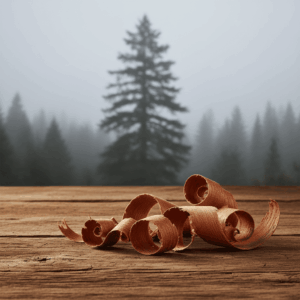
Cedarwood essence is obtained by steam distillation (cf. Distillation) from wood shavings. The wood is subsequently reduced to powder.
Chemistry has also enabled the isolation of numerous molecules from cedar. These molecules (cf. Synthetic notes), such as cedryl acetate, cedrol, Vertofix or Cedramber, can enhance other notes and prove invaluable in a composition. Principal chemical constituents: Alpha cedrene, cedrol, beta caryophyllene.
Olfactory Description and Uses
Cedarwood is a woody note that is dry, vibrant, soaring and distinguished, bringing structure and elegance to a perfume. It can traverse an entire fragrance from the top note to the base notes. It may be regarded as a pillar within a composition.
Alternatively, cedarwood essence can be used in overdose. It can be orchestrated with other woody notes (cf. Woody facet) such as patchouli, vetiver, sandalwood to create a perfume with a direct, unmistakably woody message. Cedarwood pairs beautifully with vetiver and with citrus notes, particularly grapefruit.
Uses in Perfumery
Cedarwood is often associated with masculine perfumes or woody families (cf. Masculine woody family). It is increasingly present in feminine perfumes; one of the first was Feminite du Bois by Serge Lutens in 1992.
It can be incorporated into every olfactory family: hesperidic, floral, oriental, chypre (cf. Chypre family). It can even prove interesting in an Eau de Cologne as a base note. Without cedarwood, one could not create half the perfumes on the market.
Therapeutic Properties
It is a lymphatic and venous decongestant, acting on cellulite. It is also antiseptic and fungicidal. There also exists a natural cedarleaf note with more aromatic qualities (cf. Aromatic facet).
This note is in fact used in naturopathy for its curative properties. It was the salvation of Captain Jacques Cartier’s crew, stricken with scurvy and stranded during the merciless winter in Quebec at the beginning of the 16th century.
Perfumes Containing Cedarwood
Here is a list of the principal perfumes containing cedarwood:
- Feminite du bois by Lutens
- Bois de Violette by Lutens
- Dolce Vita by Dior
- Tonka Imperiale by Guerlain
- Bois Marocain by Guerlain
- Santal Blush by Tom Ford
- Bois Farine by L’Artisan Parfumeur
- Rush for Men by Gucci
- Declaration by Cartier
- Light Blue by Dolce&Gabbana
- Eau des Merveilles by Hermes
- Cedre Sambac by Hermes
- Poivre Samarcande by Hermes
- Terre by Hermes
- Sycomore by Chanel
- Audace by Profumum Roma
- Palissandre d’or by Aedes de Venustas