Fruits in Perfumery: From Natural Notes to Synthetic Molecules
Fruits are part of the raw materials of perfumery. Some fruits can be used naturally, while others must be treated using synthesis, because it is impossible to extract their essence.
Definition of Fruity Notes
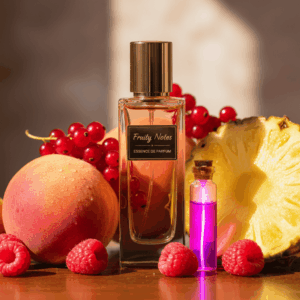
Fruits bring a lot of cheerfulness to perfumes and fruity perfume has a real flavor. In perfumery, fruity notes are very varied, and many types of fruits are used (red fruits, yellow fruits, aqueous fruits, exotic fruits, etc.).
Traditionally, fruity notes were mainly integrated into feminine perfumes. But today, masculine perfumes contain more and more fruity scents, notably apple, pineapple, melon, and watermelon.
Fruity notes have the particularity of being able to be combined, in a perfume, with all other olfactory families (hesperidic, chypre, oriental…). Moreover, fruity perfume is very popular in current perfumery, because its scents are “regressive”, recalling childhood.
They notably echo confectionery and pastries of yesteryear, and almost immediately provoke adhesion to the fragrance.
The Orchestration of Fruits
In a perfume, fruity notes can be orchestrated in several ways:
- Either in a fresh, subtle, and unsweetened way, to accompany citrus fruits or fresh flowers, for example.
- Or in such a way as to clearly highlight a gourmand signature (cf. Gourmand facet), which can, for example, be accentuated by a synthetic caramel note (veltol).
Thus, depending on their orchestration in a perfume and their use, fruity notes can highlight refinement and delicacy, or reveal a rather childish and mischievous side.
In a fruity perfume, fruity scents are mostly present in the heart notes (notes that develop over several hours). However, juicy and aqueous fruits will act from the top notes (which are more volatile).
Good to know: fruity notes should not be confused with hesperidic notes, which are obtained thanks to citrus fruits (cf. Hesperidic facet).
Fruits on the Perfumer’s Organ
You should know that there are very few natural fruity notes in perfumery. Fortunately, the discovery of synthetic fruity notes has allowed the perfumer to increase their possibilities of creating fruity perfumes.
Without the discovery of these synthetic products, there would not have been the superb perfume Mitsouko, by Guerlain, which was the first to contain the peach note (thanks to the aldehyde C14 molecule), in 1919.
Recently, natural raw materials have enriched the perfumer’s organ even more, including natural fruity notes, such as pear or apple ester, or natural frambinone (or raspberry). However, these products are very expensive.
Let us recall that 1000 raw materials, both natural and synthetic, are selected by the perfumer, among 4000 materials available in total.
Sub-Families of Fruits in Perfumery
All fruits used in perfumery can be grouped into several sub-families.
Red Fruits
- Raspberry (reproduced with frambinone in synthesis and natural isolate).
- Strawberry (or C16).
- Cherry (created with the association of strawberry and almond).
- Wild strawberry (constituted from C16 and orange blossom).
- Blackcurrant and blackcurrant bud (used natural), as well as blueberry and blackberry.
Yellow Fruits
- Peach (C14).
- Plum (created with “the base” of prunol, or prunella).
- Apricot (used in composition or with osmanthus, a flower giving an apricot and leathery note).
Exotic Fruits
- Coconut (C18), which can be used naturally.
- Mango, pineapple (natural allyl isolates allow illustrating pineapple).
- Banana (natural amyl isolates exist to illustrate banana).
- Passion fruit (which can be used naturally).
Aqueous and Juicy Fruits
- Melon and watermelon.
- Pear and apple (which both exist naturally).
- Lychee (constructed with notes around rose and the dimethyl sulfide molecule).
- Kiwi.
Other Fruits and Fruity Notes
- Fig (which is an association of green notes: stemone, coconut, and woody notes).
Certain other raw materials are not fruits, but can still give fruity facets. This is for example the case of marigold (tagetes – herbaceous plant with orange or yellow flowers which possesses a taste close to passion fruit), davana (aromatic herb from southern India), osmanthus (small shrub with white flowers), with its apricot note, resin, and fir balsam (slightly fruity woody note, from balsam fir, a conifer from Canada).
Fruits and Synthetic Molecules
Here are some synthetic products currently used in perfumery, allowing the reproduction of the scents of certain fruits:
- Allyl Amyl Glycolate and Allyl Caproate: to reproduce a pineapple scent.
- Ethyl Acetate: to obtain a banana note.
- Verdox; Ethyl Acetoacetate; Damascone Alpha: to reproduce an apple scent.
- Berry Base: for red fruits and mango (present in Angel by Mugler).
- Citroasis and Cassis Base: for the blackcurrant note.
- Veloutone: for a fruity musk scent.
Tip to know: to embellish your desserts, take a few strawberries and pour drops of orange blossom on them. The taste will be immediately changed to adopt a scent of wild strawberry.
List of Cult Fruity Perfumes
The list of perfumes containing fruity scents is very long. Here are some references according to the fruits used:
Perfumes with Yellow Fruits (Peach, Plum, Quince)
- Nahéma Guerlain
- Trésor Lancôme
- Mitsouko Guerlain
- Nina Nina Ricci
- Chance Chanel
- Femme Rochas
- Yvresse Yves Saint Laurent
Perfumes with Juicy Fruits (Pear, Apple)
- J’Adore Dior
- Petite Chérie Goutal
- Daisy Marc Jacobs
- Light Blue Dolce Gabbana
Perfumes with Red Fruits (Cherry, Blackcurrant, Raspberry)
- La Petite Robe Noire Guerlain
- Lost Cherry Tom Ford
- In Love Again Yves Saint Laurent
- Ombre Dans l’Eau Diptyque
- Insolence Guerlain
- Baiser de Russie Guerlain
- Lolita Lempicka
- Yes I Am Pink First Cacharel
- Because it’s you Armani
- Mure et Musc L’Artisan Parfumeur
Perfumes with Exotic Fruits (Coconut, Passion, Pineapple, Banana)
- Coco Fizz Guerlain
- Passiflora Guerlain
- Euphoria Calvin Klein
- Live Irresistible Givenchy
- Angel Mugler
- Bana Banana L’Artisan Parfumeur
Fig Perfumes
- Promenade des Anglais Guerlain
- Philosykos Diptyque
- Premier Figuier L’Artisan Parfumeur
- Jardins en Méditerranée Hermès
- Mandarino Di Amalfi Tom Ford
Others (Watermelon, Osmanthus, Mixtures)
- Jardin Après La Mousson Hermès (Watermelon)
- Osmanthe Yunnan Hermès
- Osmanthus Interdite Parfum d’Empire
- Vahina Delacourte Paris
- Kimonanthe Diptyque
- Si Fiori Armani
- Lady Million Paco Rabanne
- Black XS Paco Rabanne
- World Kenzo