Distillation in Perfumery: Process, Alembic, and Essential Oils
Distillation is one of the extraction processes used in perfumery. This technique consists of capturing the essential oil of flowers or plants using water vapor. This method, which is very old, is still used today.
Raw Materials on the Perfumer’s Organ
There are, in total, 1,000 natural raw materials (those concerned by distillation) and 3,000 synthetic raw materials.
Among this wide range of 4,000 available materials, the perfumer will select 1,000 to place on their perfume organ (furniture allowing the professional to store and classify their bottles of essential oils), among those they prefer or which will be technically essential for the creation of their fragrances.
Every year, new raw materials are discovered and marketed, and others disappear due to legislation, which is increasingly strict.
Raw Material Extraction Processes
There are different extraction processes for raw materials in perfumery:
- Distillation
- Extraction by volatile solvent
- Expression
- Enfleurage
- Head space
- CO2 or sofact extraction
History of Distillation: From Antiquity to the Alembic
Practiced since Antiquity, the extraction method by distillation is a very old process, which was certainly discovered by the Greeks. Indeed, distillation is carried out using an alembic (a large tank surmounted by a long bent pipe), which comes from the word “ambix“, which means “vase” in ancient Greek.
The Persians were also among the first to use distillation for the rose. This process was then improved in the Middle Ages, and was further perfected during the Arab civilization, from the 8th century (“alembic” comes from the Arabic “al ‘inbïq“, itself derived from the Greek). Distillation remains today a major technique of traditional perfumery.
What is Distillation?
The distillation technique allows treating certain flower petals, seeds, barks, leaves, as well as roots. However, not all raw materials in perfumery can be treated by distillation (they will then be treated with another extraction process – but only some raw materials deliver their perfume thanks to volatile solvent extraction).
Technical Operation
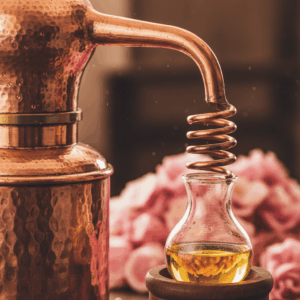
Distillation relies on the capacity of water vapor to capture essential oils. The flowers, or plants, are placed on a perforated tray, located on the upper part of the tank.
In the case of the rose, the petals are covered with water (1,500 liters of water are needed for 500 kg of roses), in an alembic, a large tank surmounted by a long bent pipe. The mixture is then brought to a boil. Rising, the steam released becomes impregnated with the odorant principles of the flowers as it passes and carries them into a coil, where a refrigeration system allows the condensation of the steam.
Decantation and the Florentine Flask
The liquid thus obtained is a mixture of essential oil (or essence), which is decanted into a vase called a “Florentine flask” or “essencier”. Since the oil cannot mix with water (they do not have the same density), it will remain on the surface (the oil constitutes about one third of the final product): this is the decantation phase.
The water, which is scented, is then a floral water which will have to be distilled again. In the case of the rose, this water is called “rose water”. It is widely used in cosmetics, and sometimes in certain fragrances.
Yield, Essence, and Absolute: The Example of the Rose
The rose (cf. Flowers) can be treated by distillation; this is notably the case for the Turkish Rose or Bulgarian Rose, of the botanical quality Damascena. Turkish rose essence treated by distillation will act mainly in top notes, more volatile, and in heart notes, because its scent is fresher, greener, and fruity, like a “lychee” or “pear” note (cf. Fruits).
Yield: You should know that 4,500 kg of fresh rose petals are needed to obtain 1 kg of essence by distillation. Given that the raw material is heated during boiling, it is normal that the final result does not give exactly the same scent as that of a rose just picked.
With the distillation technique, the final product obtained will necessarily be named “essence” or “essential oil”.
But the raw material can also be treated by volatile solvent (cf. Extraction). In this case, the product will then be called “rose absolute”. With this technique, the Centifolia quality, also called “Grasse rose”, will be preferred. It will act mainly in heart notes and base notes because its scent is rounder, sensual, and rich.
Flower Waters
More and more flower waters are claimed in the composition of a perfume. In a fragrance, rose water, or orange blossom water, are added last, instead of distilled water (and not in the oily concentrate).
Good to know: flower waters can be dehydrated and then rehydrated later. This allows them to be transported more easily and better managed (knowing that they are fragile products).
The Example of Orange Blossom
The perfume of orange blossom is, for its part, obtained thanks to these two treatments:
- Hydrodistillation of orange blossom will allow obtaining the product called “Neroli”.
- Its leaf will also be treated by distillation: the product obtained is called petitgrain.
- The treatment of orange blossom by volatile solvents will give a product called “orange blossom absolute” richer and more sensual than Neroli (cf. Floral family).
Eau de brout is the water recovered from the distillation of petitgrain. There is also eau de brout absolute. It is a floral note with some animal inflections.
Which Materials Can Be Distilled?
Here are some examples of raw materials that can be treated by distillation:
- Ylang-ylang
- Magnolia
- Vetiver
- Patchouli
- Mosses (cf. Woods)
- Many aromatic notes such as sage, lavender, mint, and lavandin
- Cinnamon and other spices
On the other hand, jasmine and tuberose, for example, cannot be treated by hydrodistillation. Only volatile solvent extraction can extract the scent of these flowers. More and more, for very beautiful perfumery brands, they are treated by enfleurage, in Grasse.
Good to know: Distillation allows obtaining essences that will bring a lot of freshness and lightness to the perfume, and which will act mainly in top notes and heart notes.