The Woody Family: Complete Guide to Notes (Sandalwood, Cedar, Vetiver, Oud)
The woody family is one of the olfactory families used to classify perfumes into categories, according to the classification of the French Perfume Committee (CFP). Here are the 6 existing olfactory families:
- The Hesperidic family
- The Floral family
- The Amber or Oriental family
- The Chypre family
- The Woody family
- The Fougère family
Each perfume is composed of an architecture of 5 to 10 components that assemble together. Like in music, this is called “an accord”. The main theme of a perfume is given by this main accord, which represents in a way the soul of the fragrance.
Each main theme can be dressed with one or several facets by the perfumer-creator, to make the architecture of their perfume more complex (the more a perfume is faceted, the more complex it will be).
The Case of the Woody Facet in a Perfume
It is common for the woody facet to also be the main theme of the perfume. In this case, the woody message will be clearly felt from the opening of the perfume, until its conclusion.
In the woody family, a wood can be predominant, but it is most often an assembly of several woody notes. The woody message can also be sublimated by subtle hesperidic, floral, fruity, spicy, or vanilla facets, without these taking precedence over the woody notes.
Woody notes are reassuring, structured, and nervous notes, which act, for the most part, as “stakes” in the composition, and thus give the perfume a backbone.
In the case of chypre fragrances, the perfume will always be dressed with a woody facet, notably with patchouli. A chypre perfume will therefore be, by definition, woody.
The Woody Family: A Masculine Family?
The woody family is mostly attributed to men, which makes it above all a masculine family. But it should be known that women tend to appropriate woody perfumes more and more.
1. Sandalwood
It is the only soft, milky, and creamy wood. Sandalwood, formerly from India and now protected by the Indian government, comes today from Southeast Asia.
There are different varieties of sandalwood. Santalum spicatum, which grows in Australia, looks more like a cedar or Santalum austrocaledonicum found rather in New Caledonia.
Natural sandalwood is a “very muted” note, very low in power, but of great tenacity. Particularly difficult to work with, it is a challenge for the perfumer-creator, because alone, it is not efficient in a composition. It is often accompanied by sandalwood molecules to sublimate the natural note.
About thirty years are necessary for the sandalwood tree to reach its final size, a circumference of 50 cm. To be used in perfumery, this wood must be cut into chips then treated by distillation.
Sandalwood Molecules
There are many synthetic sandalwood molecules but they cannot replace natural sandalwood. They serve to “boost” natural sandalwood, but these must be handled with caution, as they render quite “vulgar” notes. We can cite:
- Polysantol
- Sandalore
- Sandella
Sandalwood Perfumes
Here are some references of perfumes with sandalwood, in the woody olfactory family:
- Samsara by Guerlain (1989): Uses sandalwood for the first time in a feminine perfume. An overdose of wood, up to 20% of the formula in sandalwood, is accompanied mainly by ylang-ylang, jasmine, and a few sandalwood molecules.
- Bois des Iles by Chanel (1926): The very lovely Bois des Iles by Ernest Beaux offers sandalwood and vetiver coated with warm notes such as tonka bean, cinnamon, and vanilla.
- Santal Massoïa by Hermès (2011): Created by Jean-Claude Ellena, it is a woody scent in which round and mellow notes are highlighted. Sandalwood appears first as “this horizontal and carnal wood“, according to the perfumer, which he associates with the idea of Massoïa wood.
- Tam Dao by Diptyque (2003): Named after a national park in Vietnam, is a very powerful perfume built around sandalwood. It is very appreciated by women.
- Wonderwood by Comme des Garçons (2010): Unisex perfume, association of sandalwood, vetiver, patchouli, guaiac wood, cedar, agarwood (oud), and cypress.
- Santal Royal by Guerlain (2015): Marries sandalwood with oud wood.
- Santal 33 by Le Labo
- Concrète by Comme des Garçons
Sandalwood by Serge Lutens:
- Santal de Mysore (1991), a milky and spicy sandalwood.
- Santal Blanc (2001/2019) a white sandalwood accompanied by iris, cinnamon, pink pepper, and musk.
- Santal Majuscule (2012), a sandalwood mixed with rose with a suave woody trail with light chocolate notes.
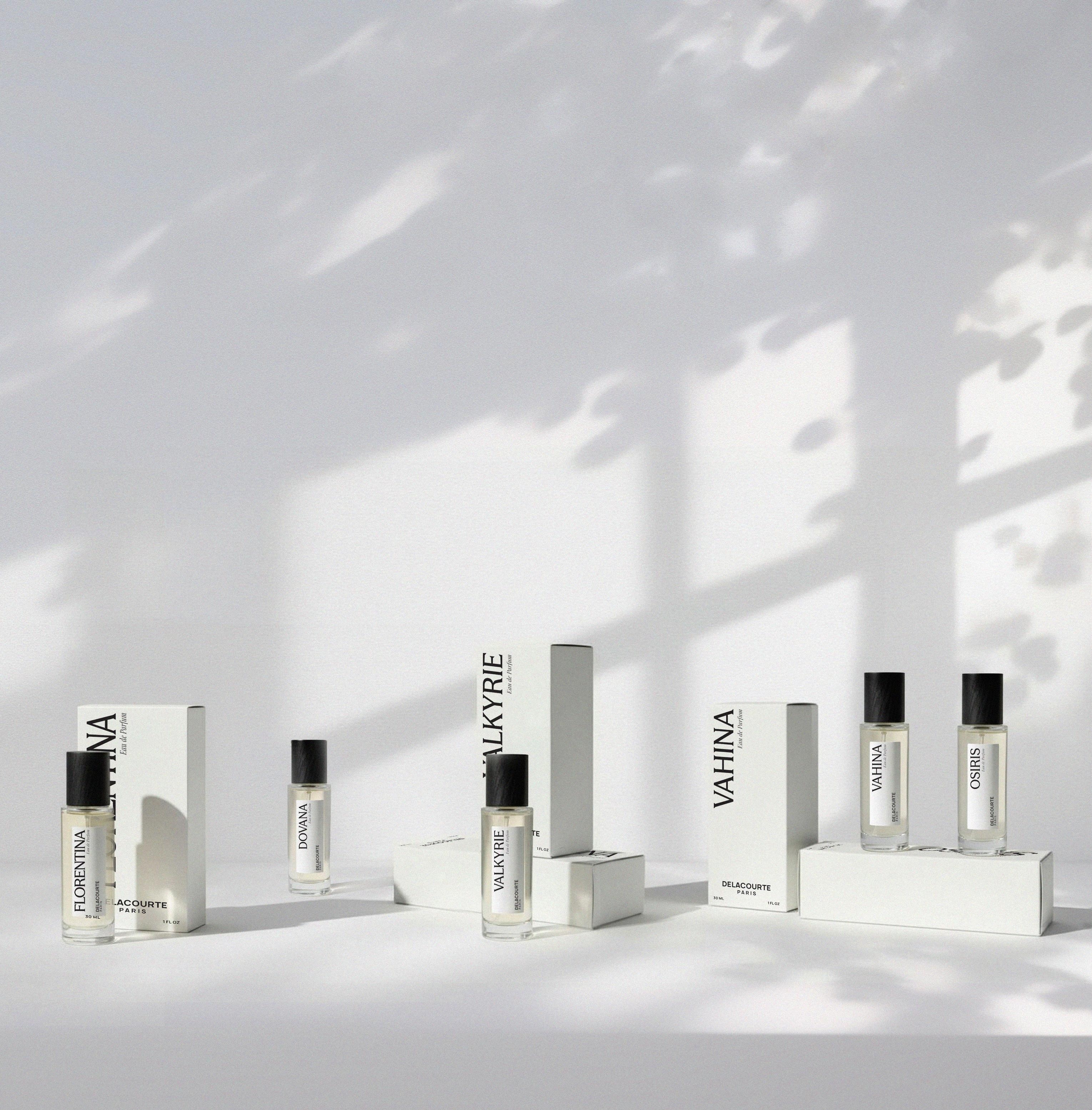
Sandalwood is present in Valkyrie by Delacourte Paris.
2. Cedar
The cedar note is rather a cold, stiff note, it evokes the pencil lead, the sawmill, wood shavings. It can also recall walks in the souks of Marrakech, where one can find very pretty boxes worked around this wood. It blends wonderfully with vetiver and citrus fruits, especially grapefruit. It accompanies all other woods, such as sandalwood, vetiver, and patchouli.
There are different cedars depending on the origin: Virginia cedar, Texas cedar, and Atlas cedar. Atlas cedar can reach 40m, it is used in carpentry and wood chips (by-products of carpentry) are used to obtain the essential oil by distillation. Its perfume has an animal, smoky note.
Regarding Virginia cedar, it is the one that most recalls the pencil lead, it can reach 25m. Olfactorily, Virginia and Texas cedars are quite close because they have the same origin. The essential oil of Atlas cedar is more powerful, more animal than that coming from Virginia and Texas cedars.
Cedar Molecules
Chemistry has also made it possible to isolate many cedar molecules. These molecules, such as cedrol, vertofix, or cedramber can also be interesting.
Perfumes Using Cedar
Here is a list of some woody perfumes using cedar:
- L’Eau des Merveilles by Hermès (2004): Evernyl, a synthetic moss, is associated with cedar, notably in this chypre perfume.
- Féminité du Bois by Shiseido (1992): Cedar is associated with fruit notes in Féminité du Bois by Shiseido. This perfume celebrates Atlas cedar evoking Morocco dear to Serge Lutens. Its composition spiced with cinnamon and clove and iridescent with violet notes makes it a “purist” woody perfume. This fragrance inspired Dolce Vita by Dior in 2005.
- Bois Farine by L’Artisan Parfumeur (2003): Jean-Claude Ellena creates Bois Farine in 2003 for L’Artisan Parfumeur proposing a cedar, vetiver, and hazelnut accord.
Cedar is also present in the fragrance Osiris from the Orange Blossom Collection by Sylvaine Delacourte.
3. Patchouli
The woody note of patchouli is quite “polarizing,” either you adore it or you hate it; for some, it recalls the hippie years of the 60s. It is an interesting woody note because it is dark, earthy, raw, vegetal, it can recall the cellar, mold. Patchouli gives a lot of character and sensuality to fragrances; it replaces oakmoss, now regulated, in chypre accords.
These are the leaves of a shrub. When these leaves are fresh, they deliver no perfume. They must be dried, or even slightly fermented, to obtain their wonderful perfume.
For a few years now, a refined “patchouli heart” exists, it is the natural patchouli note stripped of its slightly dusty notes. It becomes even more majestic, purer, slenderer!
Patchouli grows in a tropical climate, native to Malaysia, it is cultivated today mainly in the Indonesian islands (Sumatra, Java), India, Madagascar then Guatemala and Rwanda in smaller proportions. The leaves of the plant are harvested early in the morning then dried for 1 week before being distilled to obtain the essential oil of patchouli. It takes about 500 kg of dried leaves to obtain 9 kg of essential oil.
The patchouli leaf is odorless, and it must be allowed to ferment to obtain its scent (400 kg of leaves allow obtaining 100 kg of dry matter, and 2 kg of essential oil). Patchouli comes from the Orient and was discovered in the West by the English who had imported Cashmere shawls wrapped in patchouli leaves (these were then used to protect against insects). This is how the scent was discovered in Europe.
In India, wives of the upper Brahmin caste made fine tracings with patchouli on their arms to signify that they were ready to marry. Patchouli is reputed in this country as being the plant of fertility and desire. Patchouli is, indeed, a promise of sensuality all by itself! The dried leaves of the shrub produce a dark, earthy, camphorated, almost medicinal woody note.
Perfumes with Patchouli
Patchouli is one of the main components of the oriental accord, found in Shalimar and Habit Rouge by Guerlain (worn by many women), as well as in Opium by Yves Saint Laurent. Patchouli is also one of the main components of the chypre accord, in which it replaces oakmoss. In Aromatics Elixir by Clinique (1975), patchouli plays a duet with rose.
Patchouli is also found in chypre oriental perfumes such as Coco, Coco Mademoiselle, Coco Noir by Chanel, Miss Dior by Dior, For Her by Narciso Rodriguez, as well as La Petite Robe Noire by Guerlain, to name but a few.
Indeed, patchouli is omnipresent today in perfumes, whether feminine or masculine. Patchouli Eau de Toilette by Réminiscence, Patchouli Absolu by Tom Ford (unisex) possess an overdose of patchouli. We can also cite Patchouli Impérial by Dior, Coromandel by Chanel, Miss Dior Original by Dior, Patchouli Patch by L’Artisan Parfumeur, and Portrait of a Lady by Frédéric Malle, Tempo by Diptyque.
Finally, patchouli therefore possesses many qualities that allow it to be honored in many perfumes, both feminine and masculine.
4. Vetiver
Known and used since Antiquity, vetiver takes its name from the Tamil word “vettiveru.”
It is one of the most beautiful woody notes in the perfumers’ palette: it conveys a timeless elegance that defies time and fashion.
Furthermore, its harvest is called “the excavations,” because farmers must turn over the earth to extract the roots. They separate the aerial stems from the roots over 50 cm long, which will then be washed and distilled. 100 kg of roots are necessary to obtain 1 kg of essential oil.
Today, many confections are made from vetiver, such as fans, woven baskets, or vetiver screens that locals water to bring out the natural freshness of the plant, which then functions as a sort of natural air conditioning. Vetiver is also used in Mali, and drunk in decoction by women (with the aim of purifying the body and increasing pleasure).
Vetiver, whose root is used, has a nervous woody scent. Its earthy and humid note recalls fresh hazelnut with more or less smoky accents.
It also has a grapefruit, almost rhubarb facet. Vetiver from India or Haiti, or vetiver from Reunion commonly called “Bourbon vetiver“, are the most appreciated in perfumery, but the one from Reunion is very rare. Java vetiver is drier and much rougher, which makes it less interesting. It is also 15% cheaper than the one from Haiti.
The scent of vetiver is very interesting because it really gives a vibration to the perfume, from top notes to base notes.
Guerlain is among the first to have paid tribute to vetiver. Indeed, Vétiver by Guerlain (1959) marries this fresh woody note with citrus, tonka bean, nutmeg, and a tobacco accord. This unique accord differentiates it from other vetivers on the market.
Synthetic Woody Notes Derived from Vetiver
Fortunately, perfumery can also use very beautiful woody notes from synthesis.
Chemistry has isolated vetiveryl acetate, a vetiver molecule, and this one, paradoxically, is more expensive than the natural product! It is a nervous, rising note, extremely fresh and pure.
Vetiverol is also used, it is the heart of vetiver stripped of its dusty note.
Perfumes with Vetiver
Here are some references of woody perfumes composed of vetiver:
- Guerlain Homme by Guerlain (2008): Co-created by Sylvaine Delacourte, contains vetiver.
- Guerlain Homme, L’eau Boisée by Guerlain (2008): The version L’Eau Boisée of Guerlain Homme, fresh and woody interpretation includes an overdose of vetiver.
- Vétiver pour Elle by Guerlain (2004): Created by Jean Paul Guerlain now unavailable was a response to women who wished to have “their Vetiver.” It can be described as a floral woody perfume, the base notes are tonka bean and vetiver.
- Vétiver Oriental by Serge Lutens (2002): Vétiver Oriental by Serge Lutens (2002) is built on the bitter chocolate note of Java vetiver.
- Vétiver Extraordinaire, by Frédéric Malle (2000): In Vétiver Extraordinaire, from Editions de Parfums Frédéric Malle, Dominique Ropion its creator uses more than 25% vetiver associated with other woody notes! Vetiver elegantly rubs shoulders with tonka bean, with the smell of cut hay.
- Vétiver Tonka, Hermessence Collection by Hermès (2004): Vétiver Tonka in the Hermessences collection, Jean-Claude Ellena presents for Hermès a perfume in which vetiver likes to surround itself with cedar, orange, grapefruit, pepper, and balsamic notes like benzoin.
- Bal d’Afrique by Byredo: A Gourmand Vetiver.
- Terre d’Hermès, by Hermès (2006): Similarly, Terre d’Hermès stages vetiver with the same actors. In this hesperidic woody scent, we find the citrus and spice note with slightly smoky and leathery effects.
The vetiver root is also very present in Florentina by Delacourte Paris.
5. Other Woody Notes
Pine or Cypress Notes
Sylvestral pine or cypress notes are rarely found in perfumery. Yet these are very interesting notes like:
- Pine essence with fresh, rising, bitter, and balsamic notes that provide a great “breath of fresh air” effect in a creation.
- Fir balsam is a natural note of pine needles, very mouth-watering and slightly sweet.
- Borneol and isobornyl acetate with the smell of pines heated in the sun, recalling Mediterranean pine forests.
Perfumes around pine or cypress:
- Pino Sylvestre (1955) and Acqua di Selva (1949): two great classics. Pino Sylvestre, recognizable by its green bottle whose shape recalls spruce, was created by Lino Vidal in 1955. The pine needle note is very present. And Acqua di Selva by Visconte Di Modrone, in which we find cedar and vetiver in base notes. These two classic and popular perfumes marked perfumery.
- Fille en Aiguilles, by Serge Lutens (2009): Created by Christopher Sheldrake in 2009 for Serge Lutens takes up this theme.
The Fig Accord
The fig or fig tree accord is highly sought after both in fragrances to wear or in home fragrances. It is actually a composition, based on different woods, including sandalwood associated, sometimes with cedar wood. Coconut is important in the accord as well as the green note: stemone.
To smell the two perfumes based on fig or fig tree note: that of Premier Figuier by L’Artisan Parfumeur (1994, first fig tree note in a perfume) and Philosykos by Diptyque. Now, it is a note found in many eaux de toilette and fragrances, like Un Jardin en Méditerranée by Hermès.
Oud Wood
Many woody perfumes are now based on oud wood or agarwood. We also speak of “oudh wood,” “agar wood,” “aloes wood,” “jinko,” or even “gaharu,” but all these names designate the same material.
These woods were widely used by Kodo rituals in Japan. They are also widely used in the Middle East: during “bakhoor” fumigation, this fumigation aims to perfume their clothes.
These Oud woods have now invaded “western” perfumery for a decade, these oud notes are now highly appreciated by those who want very dark, pronounced, extremely tenacious, and powerful notes.
It is a dark and very fragrant resin that develops in a variety of trees called aquilaria, when they are infected by a fungus, phialophora. The resin that then develops in the heart of the tree is a defense reaction against the fungus.
The raw material obtained is very precious and therefore very expensive, which is why it is rarely used natural. Moreover, few brands use it in this form, and the oud wood of perfumes is often a reconstruction (cf. How to store perfume?).
Oud wood is the trendy note of the moment, and perfumes containing it are so numerous that it would be tedious to list them. Generally speaking, it is a note appreciated by both men and women.
Guaiac Wood
Guaiac wood is a wood with smoky notes, a bit leathery. If overdosed, it can give a note with a bit of a “smoked ham” effect.
Guaiac wood is present in Osiris by Delacourte Paris.
Birch Wood
Birch wood, as its name might suggest, is not a woody note, but a dark leather note. But this is now prohibited by legislation and good reconstructions replace this natural note successfully. The birch wood note is therefore now an accord consisting of natural dark woody notes like Guaiac wood, cade wood, but also synthetic notes, like safranal, suderal, pyrogenic styrax, isobutyl, etc.
6. Synthetic Woody Notes
Here are the different synthetic woods used in the woody family:
- Sandalwood Molecules: Many synthetic sandalwood molecules exist, but they cannot replace natural sandalwood. They serve to “boost” natural sandalwood, because the latter is muted, and needs to be supported. These must be handled with caution, as they render quite “sickening” notes. We can cite: Ebanol, Polysantol, Sandalore, Sandella.
- Evernyl: Evernyl is a tree moss note that is very present in chypre perfumes. The latter does not perfectly replace oakmoss, but associated with natural woods like vetiver, and patchouli, can prove very useful.
- Cashmeran: The famous cashmeran has a soft woody note, almost oriental, musky, found in many current fragrances.
- Cedar Molecules: Molecules, like cedrol, vertofix, or cedramber have been isolated thanks to chemistry and are also interesting.
- Suderal: It is a very beautiful synthetic molecule, not woody, considered a soft and light leather, reminiscent of the “suede” note. Suderal also helps substitute the birch wood note prohibited by legislation.
- Iso E Super: This molecule with a velvety woody note, almost musky, works well in all olfactory families. It is present in overdose in Trésor by Lancôme.
- Karanal and “Trendy” Woody Notes: Another synthetic molecule, widely used, Karanal, allowed the success of Light Blue by Dolce & Gabbana in 2001, it is a very fresh perfume of the woody family, built around a citrus structure and a juicy fruity note. Karanal or equivalent allows giving real power and sillage to this perfume. Sometimes, for certain brands, karanal is limited or prohibited, other vibrant notes are then used, like Limbanol, Ambrocenide or Z11, they are very powerful and very virile, used especially in men’s perfumes. But, they are found more and more in feminine perfumes. They are sometimes found too much in many recent perfumes on the market. It is sometimes the easy solution to give power to a fragrance.
Conclusion
Niche perfumery, more daring and remarkable for its great creative freedom, does not distinguish between feminine and masculine perfume, we speak more of emotions and it is also in the register of woody notes that the choice is richest in this style of perfumery.