Oakmoss: The Soul of Chypre Perfumes
Oakmoss is a founding element of chypre perfumes. Oakmoss and the notion of chypre are almost inseparable.
Even though oakmoss is now restricted, it can be substituted by a lichen cleaned of its allergenic molecules. Another solution available to the perfumer is using natural tree mosses or a synthetic product, Evernyl.
Oakmoss has often been replaced in the most recent creations by patchouli, which can give a slightly more modern tone than oakmoss.
History of Oakmoss
The first traces of the use of oak lichens, known as oakmoss, date back to the embalming and stuffing of mummies in Egypt. The process lasted 70 days and was intended to allow the deceased to reach eternity. Oakmoss had already proven its preservative qualities and great tenacity.
Later, in the 16th century, oakmoss powders allowed hair and wigs to be powdered to give them a good smell, as hair at the time was rarely washed. Moreover, this oakmoss also killed moths. These oakmoss powders also bore the name of Cyprus powder (poudre de chypre).
Apart from oakmoss and starch, they could contain musk, civet, amber, separately or together, iris, and cyperus (tuber).
The “Oiselets de Chypre”
One can note the presence of oakmoss in the recipes of “oiselet de chypre” (Cyprus birdlets), which remain the only burning chypres known to us. These are kinds of cassolettes, or perfume burners, thrown into the fire to create a pleasant smell and correct the malignity of the air, and which, while burning, fly away little by little like birds.
Recipe for an “oiselet de chypre” according to chemist Nicolas Lémery: willow charcoal, oakmoss, tragacanth gum or dragon gum (a kind of mucilaginous sap), rose water, labdanum, musk, civet, ambergris, styrax, benzoin, Rhodes wood and essence, cinnamon, clove, and elemi.
Medicinal Uses and Soaps
Oakmoss was also used in Spain in decoction or infusion; this lichen helped treat pulmonary affections and stomach aches. As a poultice, oakmoss was quite effective in treating wounds.
Formerly, many soaps were scented with oakmoss combined with geranium and lavender as in the Spanish brand Heno de Pravia. The story of Heno de Pravia begins in 1903. During a trip to the town of Pravia, in Asturias, the founder was literally bewitched by the smell of cut hay.
From then on, he dreamed of creating a soap scent that exhaled this scent, the Hay of Pravia. Its success was such that a line of products with gels, soaps, Eaux de Cologne was launched later, with the same success.
It is also heard that this word chypre comes from the island bearing the same name, this island which was at the center of the perfume trade from the Orient because it was also renowned for its gloves scented with oakmoss. François Coty would have been inspired by a Cyprus water found there.
Origin, Botany, and Production
Botanical Name: Evernia prunastri
It is found in the Balkan countries, Morocco, and Macedonia. It can be processed in Grasse. Oakmoss manages to live only in remote places, far from any form of pollution and human presence.
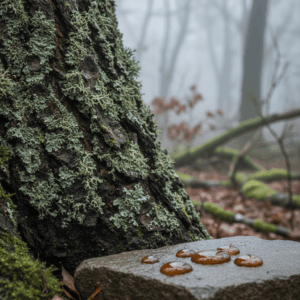
Contrary to what one might think, oakmoss does not come only from oaks. Oakmoss is a lichen, a cross between a fungus and an alga found on different varieties of trees such as oaks of course, but also pines, willows, ashes, cedars, firs, etc.
Oakmoss is harvested during winter and spring. To produce one kilogram of oakmoss absolute, 100 kilograms of lichen must be collected. To obtain oakmoss absolute, tree moss must be extracted, thanks to the technique of volatile solvent extraction, in order to obtain the famous concrete and then the absolute.
Oakmoss in Perfumery
Oakmoss absolute is present in the fougère accord; it possesses woody, earthy, and marine accords. Oakmoss has green accents, undergrowth notes, damp, mushroom notes, even moldy, allied with marine notes from algae. It also possesses a smoky facet. It is a very powerful, very tenacious note. It is used in base notes.
Perfumers use oakmoss absolute to bring depth, great personality, warmth, tenacity, sensuality, richness, and power to feminine and masculine compositions. Oakmoss is easy to blend: it blends very well with citrus, vanilla, woody, resinous, or floral accords.
Used in large quantities, it can give a vintage effect. It also participates in the elaboration of the chypre accord.
Chypres: History and Composition
Who created the first chypre? Did you think like me that it was François Coty? We can see things differently.
Transitional Chypres
They correspond to the period between the end of the Second Empire and the Great War, rich in great scientific, technological, and industrial progress. It is the arrival of organic synthesis that makes new molecules available to perfumers such as vanillin in 1874, coumarin in 1878, ionones (violet notes) around 1884, and nitrated musks in 1888. Some old chypre perfumes:
- Eau de Chypre, Guerlain, around 1850
- Chypre de Tentation, Roger et Gallet, 1893
- Cyprisime, Guerlain, 1894
- Chypre, Lubin, 1898
- Chypre de Paris, Guerlain, 1909
While perfumes remained elitist and of limited distribution until the Great War, François Coty broke the tradition in 1917 with his Chypre, the first mass-market perfume with exceptional resonance. François Coty was the first to do marketing without knowing it. He succeeded in advertising this perfume remarkably.
The olfactory qualities of this fragrance were certainly also the key to its success. This perfume was composed of bergamot, jasmine (central in a chypre), rose, patchouli, oakmoss, cistus labdanum (coming from the island of Cyprus), and amber notes (ambrein).
Composition of the Chypre Accord
The chypre accord relies on the following notes: bergamot, jasmine (central in a chypre), rose, patchouli, oakmoss, and the amber notes of cistus labdanum (coming from the island of Cyprus) associated with animal notes.
This chypre accord is orchestrated with luminous top notes, in opposition to darker undergrowth base notes. Rose and jasmine serve to link the joyful opening to the deep and penetrating base.
How to Simply Evoke the Notion of Chypre?
The chypre accord is a rather abstract scent; no note is truly dominant, and it results from a balance difficult to master between all the notes that compose it. This is why the term chypre is quite enigmatic for a customer. One can then speak of scents of undergrowth, forest, wood, autumnal scents, imbued with mystery, charisma, magnetism, capable of being feminine or masculine.
Chypres denote great strength of character. When a customer is addicted to a style of chypre perfumes, she generally remains very faithful to it. These are often perfumes that appeal to olfactory highly educated people. To take an image in the culinary world, chypre perfumes appeal to fine gourmets. All chypre perfumes are consequently woody.
Reformulations and IFRA
Oakmoss is restricted by IFRA, the body that represents and regulates the perfume industry, because it is allergenic. Perfumers can use natural moss extracts provided they are filtered to eliminate the incriminated molecules, namely atranol and chloroatranol. But this skimmed version does not have the same taste as the original.
So much so that only substituting oakmoss with this natural tree moss is not enough to bring great chypre perfumes up to standards. Mitsouko by Guerlain, for example, which is a masterpiece of balance, required a lot of time and also required the talent of a reformulation technician, in order to remain as close as possible to the initial formula.
Some perfumers preferred to replace oakmoss with Evernyl, even if this synthetic note does not really reproduce the very complex scent of oakmoss. Nowadays, in new creations, oakmoss is often replaced by patchouli, deemed more current.
Selection of Chypre Perfumes
Fruity Chypres
- Mitsouko by Guerlain
- Ma Griffe by Carven
- Femme by Rochas
- Coco Mademoiselle by Chanel (also oriental)
- Miss Dior Chérie by Dior
- Parure by Guerlain (now discontinued)
- Chypre Fatal in the Elixirs Charnels collection by Guerlain
- Y and Yvresse by Saint Laurent (ex. Champagne)
- Rush by Gucci
- Jubilation 25 by Amouage
- Sublime Balkiss by The Different Company
Floral Chypres
- Coriandre by Jean Couturier
- Diva by Ungaro
- Knowing by Estée Lauder
- Aromatics Elixir by Clinique
- Paloma by Paloma Picasso
- Eau du Soir by Sisley
- Idylle by Guerlain
- Chant d’Arômes
- Rose Barbare by Guerlain
- Nomade by Chloé
- Portrait Of The Lady by Éditions Frédéric Malle (and woody/oriental)
- La Panthère by Cartier
- Chyprissime by Mugler
- Mon Paris by YSL
Green Floral Chypres
- Vol de Nuit by Guerlain (and oriental)
- Miss Dior Original 1947
- Scherrer by Jean Louis Scherrer
- Idylle by Guerlain
Musky and Aldehydic Chypres
- For Her by Narciso Rodriguez (musky)
- Calèche by Hermès (aldehydic)
- Paloma by Paloma Picasso (aldehydic)
- Deneuve by Catherine Deneuve (aldehydic)
Aromatic/Leathery Chypres
- Aramis by Aramis
- Antaeus by Chanel
- Bandit by Grès
- Cabochard by Grès (1959)
- 1881 by Cerruti
- Polo by Ralph Lauren
- Bel Ami by Hermès
Citrus with a Chypre Facet
- Eau Sauvage by Dior
- Eau de Guerlain
- Monsieur by Chanel
- Cristalle by Chanel
- Diorella by Dior
- Eau de Rochas
- Eau Du Sud by Annick Goutal
- Iskander by Parfum d’Empire